
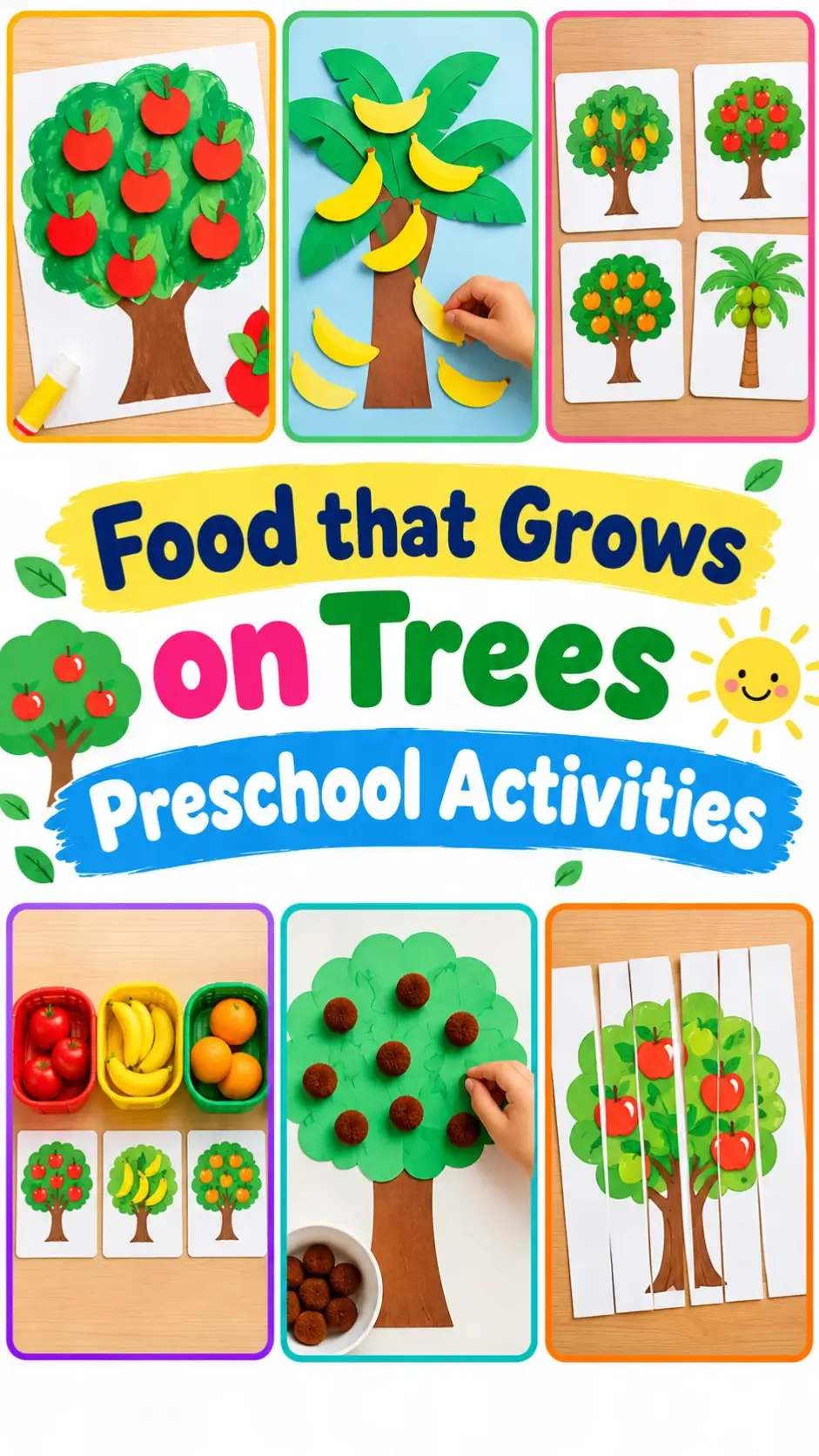
When you ask a preschooler where an apple comes from, they might say, “The grocery store.”
That’s actually a great place to start.
Children see fruit in baskets, lunch boxes, and supermarkets every day. These food that grows on trees preschool activities help them connect familiar foods with the trees and plants where they grow.
You can use real fruit, toy food, paper cutouts, pictures, or even things you already have around the house. The activities below work well for ages 3–5 and can be adjusted for younger or older preschoolers.
If you’re building a bigger learning routine at home, you can also mix these ideas with the activities in my guide to the best educational activities for preschoolers.
What foods grow on trees?
Start with foods children already know.
Some common examples include:
- Apples
- Mangoes
- Oranges
- Lemons
- Guavas
- Pears
- Peaches
- Plums
- Cherries
- Avocados
- Coconuts
- Dates
- Olives
- Cacao pods
You can explain that different trees produce different fruits or other foods.
For example, an apple grows on an apple tree. A mango grows on a mango tree. Coconuts grow on coconut palms.
And there’s a useful little detail to teach older preschoolers: bananas are commonly called “tree fruit,” but banana plants aren’t actually trees. They’re large flowering plants. You don’t need to make this a science lecture. A simple sentence is enough.
15 food that grows on trees preschool activities
1. Put the fruit on the tree
Draw a large tree on a sheet of paper.
Cut out or draw several fruits such as apples, mangoes, oranges, and lemons. Give your child the fruit pieces and ask them to place each one on the branches.
Then ask:
“Which fruit is hanging from the tree?”
“How many apples are on this branch?”
“Can you put the mango higher up?”
This turns a simple craft into a language and early math activity.
For more ideas that combine numbers with hands-on preschool learning, see these counting activities for preschoolers.
2. Make a fruit tree with fingerprints
Draw a tree trunk and branches on paper.
Give your child washable paint and let them use a fingertip to make little fruit dots on the branches. Red can become apples, orange can become oranges, and yellow can become lemons.
Hafsa loves activities where she can make something with her hands, and this kind of project usually keeps the table busy for longer than a worksheet does.
Ask her to make 5 red apples, then 3 yellow fruits. You can quietly bring counting into the activity without turning it into a formal lesson.
If your child enjoys this kind of hand work, you can add ideas from these fine motor activities for preschoolers.
3. Build a fruit tree from loose parts
Gather blocks, cardboard tubes, craft sticks, paper, and toy fruit.
Ask your child to build a tree.
The trunk can be made from blocks or a cardboard tube. Green paper can become leaves. Small toy fruits can be placed around the branches.
Then give the tree a name.
“Is this an apple tree?”
“How many branches does it have?”
“Where would the mangoes go?”
There’s plenty of room for your child to change the design. A crooked tree is perfectly fine. Preschool trees don’t need to look like the ones in a textbook.
Children who enjoy building and hands-on play can also try more ideas from these preschool learning activities for 3-year-olds.
4. Fruit tree picture match
Print or draw pictures of several trees and fruits.
For example:
- Apple tree → apple
- Mango tree → mango
- Orange tree → orange
- Coconut palm → coconut
Mix all the cards.
Your child picks one fruit and finds the tree picture that goes with it.
For a younger preschooler, use only 2 or 3 pairs at first. Older children can handle 5 or 6.
You can also ask your child to tell you why the pictures belong together. That little explanation gives you a better idea of what they understand.
5. What fruit is hiding behind the leaf?
Draw a simple tree with large paper leaves.
Hide small fruit pictures behind some of the leaves. Your child moves one leaf at a time to discover what’s underneath.
When a fruit appears, ask:
“What did you find?”
“What color is it?”
“Would this fruit grow on a tree?”
For a harder version, don’t show the fruit immediately. Give your child a clue such as:
“It’s yellow and sour.”
“It’s usually red or green.”
“It’s big and has a large seed inside.”
Let your child guess.
You can connect this with early language practice through beginning sound activities for preschoolers. For example, ask, “What sound does mango start with?”
6. Fruit branch balance test
This one adds a little science.
Place a few lightweight pretend fruits on a cardboard branch or a ruler balanced across a block.
Start with 1 fruit.
Then add another.
Keep adding fruits and watch what happens.
Ask your child:
“Does the branch stay level?”
“What happens when we put all the fruit on one side?”
“Which side is heavier?”
Your preschooler doesn’t need to understand the physics. You’re giving them a chance to notice weight, balance, and cause and effect.
For more simple hands-on math ideas, you can try these easy math activities for preschoolers.
7. Fruit skin texture hunt
Choose 3 or 4 fruits with different surfaces.
A lemon, coconut, mango, orange, apple, or avocado can give children very different textures to compare.
Let your child touch each one.
Ask:
“Which one feels smooth?”
“Which one feels bumpy?”
“Which one feels rough?”
You can also let your child describe the fruit without naming it.
“It’s round. It’s bumpy. It smells fresh. What do you think it is?”
This works well before snack time because the fruit is already sitting right there.
PBS Kids also recommends letting young children investigate fruits through their smell, texture, taste, and appearance.
8. Make an orchard on the floor
Use paper circles, blocks, or toy trees to create a pretend orchard.
Put several apple trees together. Then make a small section for mango trees or orange trees.
Your child can walk between the trees and pretend to be an orchard worker.
You can give simple directions:
“Walk to the mango tree.”
“Stand beside the apple tree.”
“Touch the orange tree.”
“Put the basket under the tree.”
This brings position words and listening into the activity. If your child enjoys this type of movement-based learning, you can also explore where do animals live preschool activities for another nature-themed activity set.
9. Fruit tree seasons drawing
Draw 4 simple trees on one page.
Label them:
Spring → Summer → Fall → Winter
Ask your child to draw what they think happens to the tree during each season.
For a younger child, you can simply talk about leaves, flowers, and fruit.
Older preschoolers can draw flowers first and fruit later.
Apple trees are especially useful for this because children can see a clear change from blossom to fruit. You don’t need to make every tree follow exactly the same seasonal pattern.
This also gives you a natural opportunity to use pre-writing activities for preschoolers because your child can draw branches, leaves, circles, and simple lines.
10. Fruit tree movement game
Turn the whole activity into a movement game.
Call out a fruit and give your child an action.
“Apple!” → pretend to pick an apple.
“Mango!” → reach high into the tree.
“Coconut!” → stretch both arms overhead.
“Orange!” → make a round shape with your arms.
“Fallen fruit!” → squat down.
You can speed up the calls once your child understands the rules.
This works especially well when your preschooler has been sitting for a while and needs to move.
For more playful learning ideas that use games and movement, see educational games for preschoolers.
11. Make a fruit tree sorting tray
Place several pretend or real fruits on a tray.
Give your child small paper tree cards labeled with fruit names or pictures.
Instead of sorting fruits by color or size, sort them by the tree they grow on.
For example:
Apple tree: apples
Mango tree: mangoes
Orange tree: oranges
Coconut palm: coconuts
Use only a few fruits at first.
This gives the child a clear connection between a food and the plant that produces it. Pre-K Printable Fun also uses matching and sorting activities to help preschoolers think about how fruits and vegetables grow.
12. Design your own fruit tree
Give your child a blank sheet of paper.
Say:
“Draw a tree that grows your favorite fruit.”
Maybe your child creates a tree covered in mangoes. Maybe they invent a tree with purple apples. That’s fine.
After the drawing, ask a few questions:
“What is your tree called?”
“What fruit grows on it?”
“What color is the fruit?”
“How many fruits can you see?”
You can write down your child’s answers underneath the picture.
For older preschoolers, ask them to add a sign such as Hafsa’s Mango Tree or Apple Orchard.
This makes a nice bridge into early writing and pencil control. You can find more ideas in these pencil grip activities for preschoolers.
13. Fruit shadow matching
Cut out simple black shapes of fruits.
Make a second set using colored fruit pictures.
Mix them up and ask your child to match each fruit to its shadow.
Start with obvious shapes, such as an apple, orange, coconut, and pear.
Then add fruits with less familiar shapes.
You can ask:
“Which shadow belongs to the mango?”
“How did you know?”
“Which fruit has the roundest shape?”
This works nicely with shape recognition activities for preschoolers because children are looking closely at outlines and shapes.
14. Visit a tree and look for food
If you have a fruit tree nearby, take your child outside.
You don’t need a special field trip.
A mango tree in the neighborhood, a coconut palm, a lemon tree in someone’s yard, or an orchard can become your classroom for 10 minutes.
Look at the trunk, branches, leaves, flowers, and fruit.
Ask your child to find:
- A branch
- A leaf
- A fruit
- A flower, if there is one
- A fallen fruit
Only let your child touch or collect things when it’s safe and permitted.
If you don’t have a fruit tree nearby, look at photographs together. You can also use the tree walk as a starting point for where does food grow preschool activities, which covers the wider idea of where different foods come from.
15. Make a simple fruit tree book
Fold a few sheets of paper in half and staple them together.
Give each page one fruit.
For example:
Page 1: Apple
Page 2: Mango
Page 3: Orange
Page 4: Coconut
Your child can draw the tree and fruit on each page.
You can write one short sentence under the drawing:
“An apple grows on an apple tree.”
“Mangoes grow on mango trees.”
“Coconuts grow on coconut palms.”
Read the little book together when you’re finished.
If your child enjoys adding letters to pictures, you can connect this activity with alphabet activities for preschoolers.
What should preschoolers learn from these activities?
The main idea is simple: food comes from living things that grow.
A 3-year-old can begin by recognizing familiar fruits and saying which ones grow on trees.
A 4-year-old can match fruits to trees, describe differences, and answer simple questions.
A 5-year-old can talk about how a tree changes, explain what a fruit tree needs, and draw or describe the process.
You can also bring in vocabulary such as:
- Tree
- Trunk
- Branch
- Leaf
- Flower
- Fruit
- Seed
- Root
- Orchard
- Harvest
Keep the vocabulary connected to something your child can actually see.
A real mango in your hand is much easier to talk about than a long explanation about mango trees.
For age-specific ideas, you can also see my guides to preschool learning activities for 4-year-olds and preschool learning activities for 5-year-olds.
Foods that grow on trees worksheet ideas
You can turn this topic into simple printable worksheets too.
Try:
- Circle the foods that grow on trees.
- Match each fruit to its tree.
- Color the apples red.
- Draw 3 fruits on the tree.
- Trace the word apple.
- Find all the mangoes.
- Match the fruit to its shadow.
- Cut and paste fruits onto the correct tree.
- Draw your favorite tree fruit.
- Count the fruits on each branch.
For cutting practice, use large fruit shapes and short, simple lines rather than tiny detailed pictures. My cutting activities for preschoolers post has more age-appropriate scissor ideas.
You can also add a small tracing section for children who are ready for pencil work. These number tracing activities for preschoolers can give you ideas for the tracing side of the worksheet.
Food that grows on trees activities for 3-year-olds
Keep the activity physical and simple.
A 3-year-old can:
- Match 2 or 3 fruits to tree pictures.
- Put paper fruit onto a tree.
- Touch and describe real fruit.
- Make a fingerprint fruit tree.
- Pretend to pick fruit.
- Name familiar tree fruits.
Give your child one instruction at a time.
“Put the apple on the tree.”
Then wait.
Once that becomes easy, add another step.
“Find the apple and put it on the tree.”
You can also use ideas from preschool learning activities for 3-year-olds when planning the rest of the learning session.
Food that grows on trees activities for 4-year-olds
Four-year-olds can handle a little more sorting and reasoning.
Try:
- Matching 5 or 6 fruits to trees
- Drawing a fruit tree
- Comparing fruit textures
- Making an orchard
- Talking about tree parts
- Creating a fruit tree book
- Sorting fruits by their trees
Ask questions that need more than a yes or no.
“What do you think this tree grows?”
“How do you know?”
“What would happen if we put the coconut on the apple tree?”
There isn’t a single right answer to every question. The conversation is part of the activity.
If you want a broader collection of learning ideas for this age, see 25 preschool learning activities for 4-year-olds.
Food that grows on trees activities for 5-year-olds
Five-year-olds can go a little deeper.
Ask them to draw a fruit tree and label the trunk, branch, leaf, flower, and fruit.
They can also make a simple sequence:
Flower → small fruit → growing fruit → ripe fruit
Give them a few pictures and let them decide the order.
You can bring in early math too. Put 4 apples on one branch and 2 on another. Ask your child to figure out how many apples there are altogether.
For more activities around this stage, you can use my guide to preschool learning activities for 5-year-olds.
Turn tree fruit into a math activity
Tree fruit gives you plenty of natural math opportunities.
Put 3 apples in one basket and 5 mangoes in another.
Ask:
“Which basket has more?”
“How many apples are there?”
“How many more mangoes do we need to make 5?”
You can use toy fruit, paper fruit, bottle caps, or real fruit.
For more ideas around comparing quantities, try which has more preschool activities.
Older preschoolers can also make tiny addition stories.
“You picked 2 mangoes. Then you picked 1 more. How many mangoes do you have?”
For subtraction, say:
“There were 5 apples in the basket. Hafsa ate 1. How many are left?”
You can build on this with simple addition activities for preschoolers and subtraction activities for preschoolers.
Add colors and patterns
Fruit trees are also handy for color work.
Give your child red, yellow, green, and orange fruit pictures.
Ask them to make a simple arrangement such as:
red, yellow, red, yellow
Then let them make their own.
You can find more ideas in these color matching activities for preschoolers and pattern activities for preschoolers.
Keep the pattern short. Preschoolers don’t need a complicated sequence to get the idea.
How long should a tree fruit activity last?
You don’t need a long lesson.
For a 3-year-old, 5–10 minutes can be enough for one focused activity.
A 4-year-old may stay with an activity for 10–15 minutes, especially when you let them touch, move, draw, or talk.
A 5-year-old may stay longer when the activity has several steps.
Follow your child’s attention.
If the child is still interested, keep going. If the apples have suddenly become footballs, the activity has probably finished for the day.
My guide on how many hours should a preschooler study explains how to think about short planned learning sessions alongside play and everyday activity.
More ways to connect this theme with preschool learning
You can stretch this topic into several other areas without turning it into a huge lesson.
For literacy, make a little fruit book or practice the first sound in apple, mango, or orange.
For rhyming, use simple words connected with food and nature. My fun rhyming activities for preschoolers can help you build that part of the session.
For identity and language, you could ask your child, “What fruit do you like?” and let them explain their choice. You can also use ideas from Who Am I preschool activities for simple speaking practice.
For a nature-themed reading session, Where the Wild Things Are preschool activities can give you another way to bring books, imagination, and movement into the day.
And if your child wants to turn the fruit into pretend food, you can continue with preschool cooking activities.
A simple 5-day food-from-trees plan
You can spread the activities across 5 short sessions.
Day 1: Put the fruit on the tree
Learn apple, mango, orange, and coconut.
Day 2: Fruit skin texture hunt
Touch, smell, compare, and describe real fruit.
Day 3: Make an orchard
Build trees with blocks and pretend to pick fruit.
Day 4: Fruit tree seasons drawing
Talk about flowers, leaves, and fruit.
Day 5: Make a fruit tree book
Draw 3–4 fruits and say one sentence about each.
That’s plenty for one week.
You don’t have to finish every activity in one sitting. Preschoolers learn a lot through repeating a simple idea in different ways.
Simple materials you can use
You probably already have most of what you need:
- Paper
- Crayons
- Washable paint
- Glue
- Scissors
- Blocks
- Toy fruit
- Real fruit
- Small baskets
- Cardboard
- Paper leaves
- Craft sticks
Real fruit is especially useful because children can touch it, smell it, look at its shape, and later taste it.
If you want more ideas using everyday materials, my best educational activities for preschoolers collection is a good place to continue.
A few safety points
Stay with your child when using scissors, small objects, or food pieces.
Wash fruit before eating it, and cut hard or large pieces into child-safe sizes.
When you’re outside, teach your child that they should ask an adult before picking or eating fruit from a tree. Some plants and berries aren’t safe to eat.
And don’t turn the activity into a test.
If your child calls an orange a lemon, correct it naturally and keep going. Preschool learning works better when the child feels comfortable talking, guessing, and trying again.
Frequently asked questions
What foods grow on trees?
Common examples include apples, mangoes, oranges, lemons, guavas, pears, peaches, plums, cherries, avocados, coconuts, dates, and olives.
The exact fruits available will depend on where you live.
What is the easiest food that grows on trees to teach preschoolers?
Apples and mangoes are easy choices because many children already know them.
Use fruit your child sees at home or in local markets. Familiar food makes the connection easier.
How do you teach preschoolers where fruit comes from?
Start with a real piece of fruit.
Show the fruit, show a picture of its tree, and talk about the connection. Then use a simple matching, drawing, sorting, or pretend-play activity.
What fruit grows on trees for kids to learn?
Start with familiar examples such as apples, mangoes, oranges, lemons, guavas, coconuts, pears, and avocados. You can add less familiar fruits once your child understands the basic idea.
What age is this topic suitable for?
This topic works well from about age 3 to 5.
Younger preschoolers can identify and match fruits. Older preschoolers can discuss tree parts, seasons, fruit growth, and simple sequences.
More preschool activities to explore
If you’re building a complete preschool learning library, these related topics can fit naturally around this one:
- Number recognition activities for preschoolers for recognizing numbers while counting fruit
- Shape recognition activities for preschoolers for looking at fruit shapes
- Arctic animals activities for preschoolers for a completely different nature theme
- Pre-writing activities for preschoolers for drawing branches, fruit, and simple lines
- Color matching activities for preschoolers for fruit color practice
The goal can stay small: help your child look at an apple and understand that it grows on a tree.
Once that connection clicks, you can build from there.