
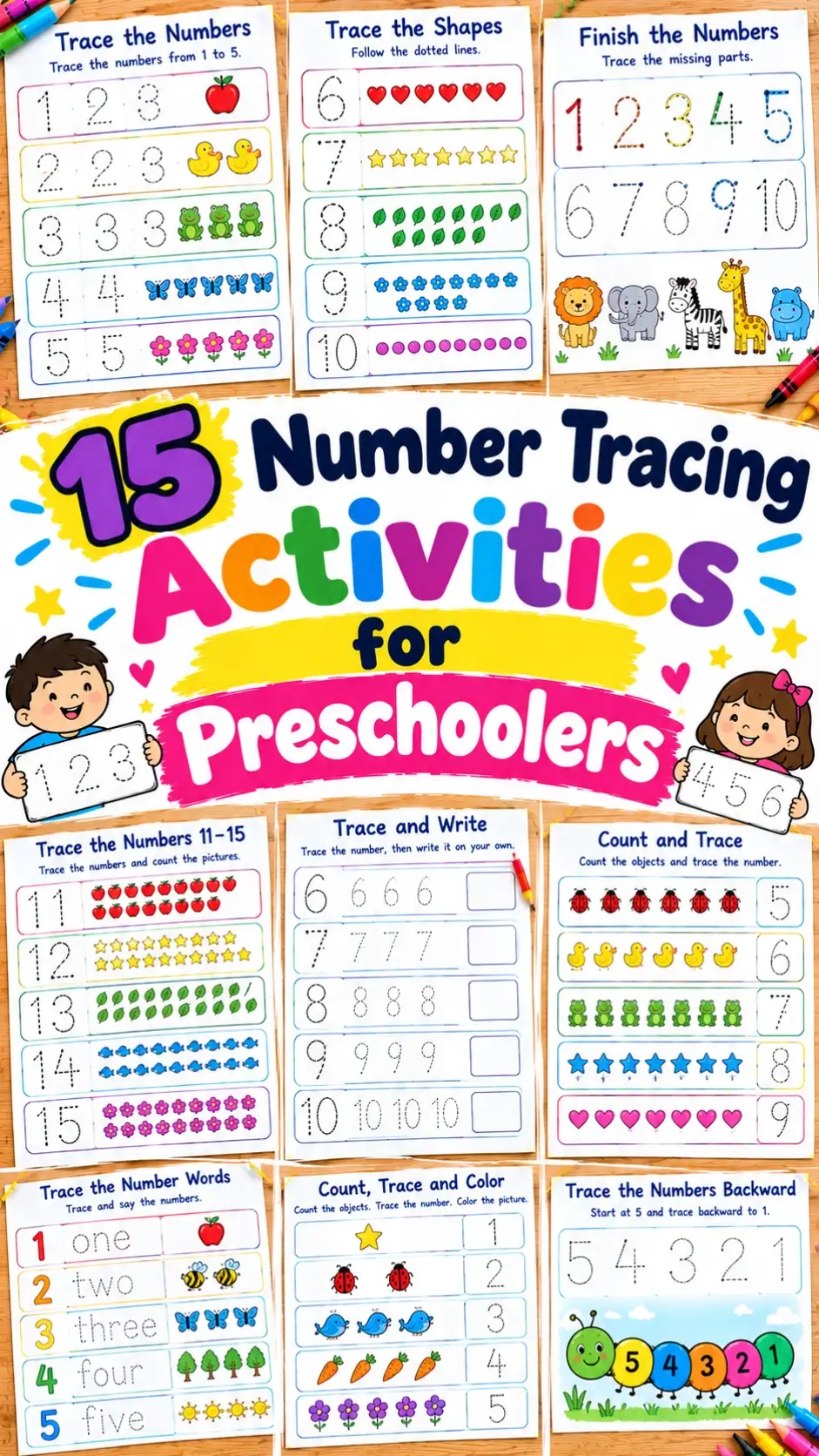
Learning to write numbers takes time. A preschooler may recognize the number 5, count 5 objects correctly, and still struggle to make a 5 with a pencil.
That’s normal.
Number tracing activities give preschoolers a guided path to practise how numerals are formed before they write them independently. Tracing also gives them repeated practice with pencil movement, hand control, and the visual shape of each number.
Start with large movements, such as finger tracing or writing in a tray, then gradually move to paper and pencil. For many young children, a thick crayon or washable marker feels easier to control than a thin pencil.
Here are 15 number tracing activities you can try at home or in a preschool classroom.
15 number tracing activities for preschoolers
1. Finger trace big numbers
Write a large number on a sheet of paper.
Ask your child to place a finger at the starting point and slowly follow the number. Say the number aloud while tracing it.
Start with numbers 1–5. Once those feel familiar, introduce 6–10.
This is a good first step because your child can concentrate on the shape without worrying about holding a pencil.
2. Trace numbers in a salt tray
Pour a thin layer of salt into a shallow tray.
Write a large number on a card and place it beside the tray. Your child looks at the card, then draws the same number with one finger in the salt.
Give the tray a little shake to erase the number and try again.
You can use flour or fine sand if that’s what you already have at home.
3. Make a number road
Draw large numbers on pieces of paper and turn each one into a little road.
Your child can move a small toy car along the number from the starting dot to the end.
“Drive around the 8.”
“Follow the 5.”
This works especially well for children who get bored when a tracing sheet feels too much like schoolwork.
4. Trace numbers with a chunky crayon
Print or draw large dotted numbers with clear starting points.
Give your child a chunky crayon and let them trace over each number slowly.
A large writing tool can be easier for small hands to grip. Preschool number-tracing resources commonly use large numerals and guided paths before children move toward independent writing.
Keep the page short. 3 or 4 numbers can be plenty for one sitting.
5. Rainbow number tracing
Write a large number with a dotted outline.
Let your child trace it several times, using a different crayon color each time. For example, the first 3 might be red, the second 3 blue, and the third 3 green.
The finished number gets a little rainbow effect, and your child gets several chances to repeat the same movement.
6. Make numbers with yarn
Cut short pieces of thick yarn.
Write a large number on paper and help your child lay the yarn along the shape of the numeral. Once the number is covered, your child can run a finger along the yarn from the starting point.
You can glue the yarn down afterward if your child wants to make a number card.
This gives children another way to feel the shape of a numeral before they write it.
7. Trace numbers on a window
Use a washable window marker to write a large number on a glass window or mirror.
Your child can trace over it with a finger or another washable marker.
The upright position changes the movement a little, and kids tend to find writing on a window pretty exciting.
Just check that your marker is suitable for the surface before you start.
8. Build a number with playdough
Roll thin pieces of playdough into long “snakes.”
Show your child a large number and help them bend the playdough into the same shape.
For example, make a long curve for 3 or form a straight line and diagonal line for 4.
After building it, let your child trace the finished number with a finger.
This activity gives the hands something to squeeze, roll, bend, and press while the child studies numeral formation.
9. Trace textured number cards
Make number cards with raised surfaces.
You can create them with glue, thick craft foam, or another child-safe textured material. Once the surface is dry and secure, your child can trace each number with a fingertip.
Ask, “Where does your finger start?”
Then have your child follow the number slowly.
The goal is to remember the movement, not race across the card.
10. Number tracing with water
Take a small paintbrush and a cup of water outside.
Draw a large number with water on a dry wall, pavement, or outdoor board. Your child can trace the wet number with the brush and then watch it disappear as the surface dries.
This one is especially handy on a warm day.
And there’s no stack of worksheets waiting on the table afterward.
11. Trace and build the same number
Give your child a number card with a large numeral.
First, trace the number with a finger. Then build the same number using small craft sticks, pipe cleaners, or strips of paper.
For curved numbers such as 2, 3, 5, 6, 8, and 9, pipe cleaners are easier than straight sticks.
The child gets to look at the same numeral in 2 different ways, which can help the shape stick.
12. Trace numbers with a cotton ball
Draw a large numeral on paper.
Give your child a cotton ball and a little washable paint. Instead of drawing inside the number, have them dab along the dotted path.
This is a nice option for children who aren’t ready for much pencil work yet.
You can use just 1 number per page and make it large.
13. Trace, then write
Give your child a page with 1 large dotted number followed by a blank writing space.
First, trace the dotted number. Then ask your child to try the same number independently.
For example:
Trace: 4 4 4
Try: ___
This gradual move from guided tracing to independent writing is useful because children get to copy the movement immediately after tracing it. Number-writing worksheets commonly use this trace-then-write structure.
Don’t worry if the independent number looks messy. You’re watching for progress in the movement.
14. Trace the number word
Once your child is comfortable with a few numerals, add the written number name.
For example:
5
FIVE
Your child can trace the numeral first and then trace the word.
This activity works better for older preschoolers who already recognize several letters. You can keep the focus on the numeral and treat the number word as a little extra practice.
If you’re working on early literacy at the same time, you might also enjoy these alphabet activities for preschoolers and beginning sound activities for preschoolers.
15. Make a personal number tracing book
Fold or staple 10 small sheets of paper together.
Put 1 number on each page. Your child traces the number and decorates the page with a drawing.
For 3, they might draw 3 balloons.
For 7, they could draw 7 flowers.
You can make the book as short as 5 pages for a younger preschooler. A homemade book gives your child a reason to keep practising without turning the activity into a long worksheet session.
What do children learn from number tracing?
Number tracing gives children repeated practice with numeral formation and pencil control. It can also connect the written symbol to the number they already know from counting.
There are a few separate skills involved:
- Recognizing the numeral
- Remembering its shape
- Following a starting point
- Moving the hand in the correct direction
- Controlling a pencil, crayon, finger, or marker
- Writing the numeral without a dotted guide
- Connecting the written numeral with its quantity
These skills don’t all appear at the same time.
A child might trace 6 beautifully but still write a backwards 6 when the dots disappear. Give that child more practice with the movement rather than turning every mistake into a correction.
When should preschoolers start tracing numbers?
There’s no single age when every child should begin.
Around age 3, you can introduce large numbers and finger tracing, especially for 1–5. Some children will enjoy tracing on paper, while others will do better with playdough, salt, water, or large arm movements first.
By age 4, many children are ready for more regular numeral tracing and short pencil activities. You can gradually move from numbers 1–5 toward 1–10 as recognition and hand control improve.
By age 5, some children will be ready to trace and then write numbers independently. Others will still need a starting dot or model. That’s okay.
I’ve found that children can look very different in this area. My little girl, Hafsa, would probably want to turn the tracing activity into a game before sitting quietly through a whole page, so I’d rather give her 5 good minutes than push through 20 unhappy ones.
Number tracing for 3-year-olds
Keep it large and tactile.
Try:
- Finger tracing numbers 1–5
- Salt-tray numbers
- Playdough number shapes
- Water painting
- Large crayon tracing
You can also connect each numeral to a small quantity. After tracing 3, ask your child to bring you 3 blocks or 3 toy animals.
For more activities at this age, see these preschool learning activities for 3-year-olds.
Number tracing for 4-year-olds
At 4, you can add more pencil-based practice.
Try tracing numbers 1–10, then give your child a blank space to copy the number once. You can also introduce number words for familiar numbers.
Keep the writing area large enough for the child to move comfortably.
If you’re planning a wider activity routine, these preschool learning activities for 4-year-olds give you more ideas to rotate through the week.
Number tracing for 5-year-olds
Older preschoolers can handle a little more independence.
Give them a number card, let them trace it, cover the model, and then ask them to write it from memory.
You can also work with numbers 1–20 if your child already recognizes the numerals comfortably. There’s no need to rush into larger numbers just because they can count higher.
For more age-specific ideas, see these preschool learning activities for 5-year-olds.
How to help a child who struggles with number tracing
Start bigger.
A tiny worksheet number demands more pencil control than a large number drawn on a tray, window, or piece of paper. Let your child move with a finger or whole hand first.
Then check the starting point.
A child may know what a number looks like but begin the stroke from the wrong place. Use a clear starting dot and, when needed, a small arrow showing the direction.
Keep practice short, too. Preschoolers don’t need long handwriting sessions. A few focused minutes can be enough, especially when you’re doing this regularly. If you’re building a larger daily routine, my guide to how many hours a preschooler should study can help you keep table work in proportion.
Should number tracing be connected to counting?
Yes, when it feels natural.
If your child traces 4, you can ask them to find 4 buttons, 4 blocks, or 4 toy cars. This helps connect the written symbol with an actual amount.
Number tracing worksheets can also pair a numeral with pictures to count, which gives children a chance to connect number formation with quantity.
Number tracing worksheets: how to use them well
Worksheets are useful when your child is ready for them.
Look for large numerals, clear starting points, enough space between numbers, and a short amount of work per page. A trace-and-write format can work well because the child gets guided practice before trying the numeral alone.
You can also make your own worksheet in a few minutes.
Write:
Trace 3: 3 3 3
Now try: 3
Then add a small picture beside it, such as 3 apples.
Since I make preschool worksheets myself, I like giving each page one clear job. A child shouldn’t have to figure out 5 different instructions before getting started.
For broader math ideas, you can also visit these math activities for preschoolers.
Number tracing and fine motor skills
Number writing needs hand control.
Children practise this control through many everyday actions, including drawing, squeezing, pinching, cutting, building, and manipulating small objects. You can mix these activities into the week rather than making every practice session about handwriting.
A few good options are:
- Playdough
- Clothespins
- Large beads
- Puzzles
- Drawing
- Sticker activities
- Cutting with child-safe scissors
- Building with small blocks
For more preschool ideas that mix learning with hands-on play, see the best educational activities for preschoolers.
Number tracing doesn’t have to happen at a table
You can practise numbers during ordinary routines.
Write a number on a small card and leave it beside your child’s breakfast. Trace it together before eating.
Draw a number outside with water.
Trace a number in condensation on a mirror.
Make a number with playdough while you’re already playing.
These tiny moments count. Your child doesn’t need a formal lesson every time they practise forming a numeral.
And you can rotate number tracing with other preschool skills so the week doesn’t feel like one long handwriting session. Try Who Am I preschool activities, fun rhyming activities for preschoolers, or themed learning such as Where the Wild Things Are preschool activities.
More ways to connect numbers with everyday learning
You can connect number tracing to almost any preschool theme.
While talking about food, trace 3 and then count 3 pieces of fruit. My Where Does Food Grow preschool activities post has more food-based learning ideas.
Animals work, too. Trace 5 and then count 5 toy animals before putting them away. You can find more animal-themed ideas in Where Do Animals Live preschool activities.
Cooking gives you another natural chance to use numbers. You can trace a number first, then count ingredients together with your child using these preschool cooking activities.
For comparison skills, you can pair number work with Which Has More preschool activities.
What about addition and subtraction?
Once your child understands numbers and small quantities, you can gradually introduce very simple number stories.
For example:
“You have 2 crackers. I give you 1 more. How many do you have?”
Later:
“You have 4 blocks. Take 1 away. How many are left?”
Keep the objects in front of your child so the math stays concrete.
You can continue with simple addition activities for preschoolers and subtraction activities for preschoolers when your child is ready.
FAQ about preschoolers’ number tracing activities
What numbers should a preschooler trace first?
Start with numbers your child already recognizes, usually 1–5 for younger preschoolers. Move toward 1–10 as recognition and hand control become more comfortable.
How long should number tracing practice last?
Keep it short. Around 5–10 minutes can be plenty for a focused preschool activity, especially for a younger child.
Should my child trace numbers with a pencil?
A pencil is one option. Finger tracing, salt trays, playdough, water painting, chunky crayons, and washable markers can all give children practice with numeral shapes before or alongside pencil work.
What if my child writes numbers backward?
Number reversals can happen while young children are learning to write. Give them clear starting points, model the movement, and let them practise without turning every attempt into a correction.
Should I teach numbers 1–10 or 1–20?
Start with the range your child can recognize comfortably. For many preschoolers, 1–10 is a useful starting range. Once those numerals are familiar, you can introduce 11–20.
Are number tracing worksheets good for preschoolers?
Yes, when the worksheet matches the child’s current skill level. Large numbers, clear tracing paths, and short practice sessions work better than filling a page with tiny repeated numerals.
Final thought
Number tracing is a small skill, but preschoolers need plenty of time to get comfortable with it.
Start with big movements. Let your child trace with a finger, build numbers with playdough, draw them with water, and eventually pick up a crayon or pencil.
Then give them a blank space and see what happens.