
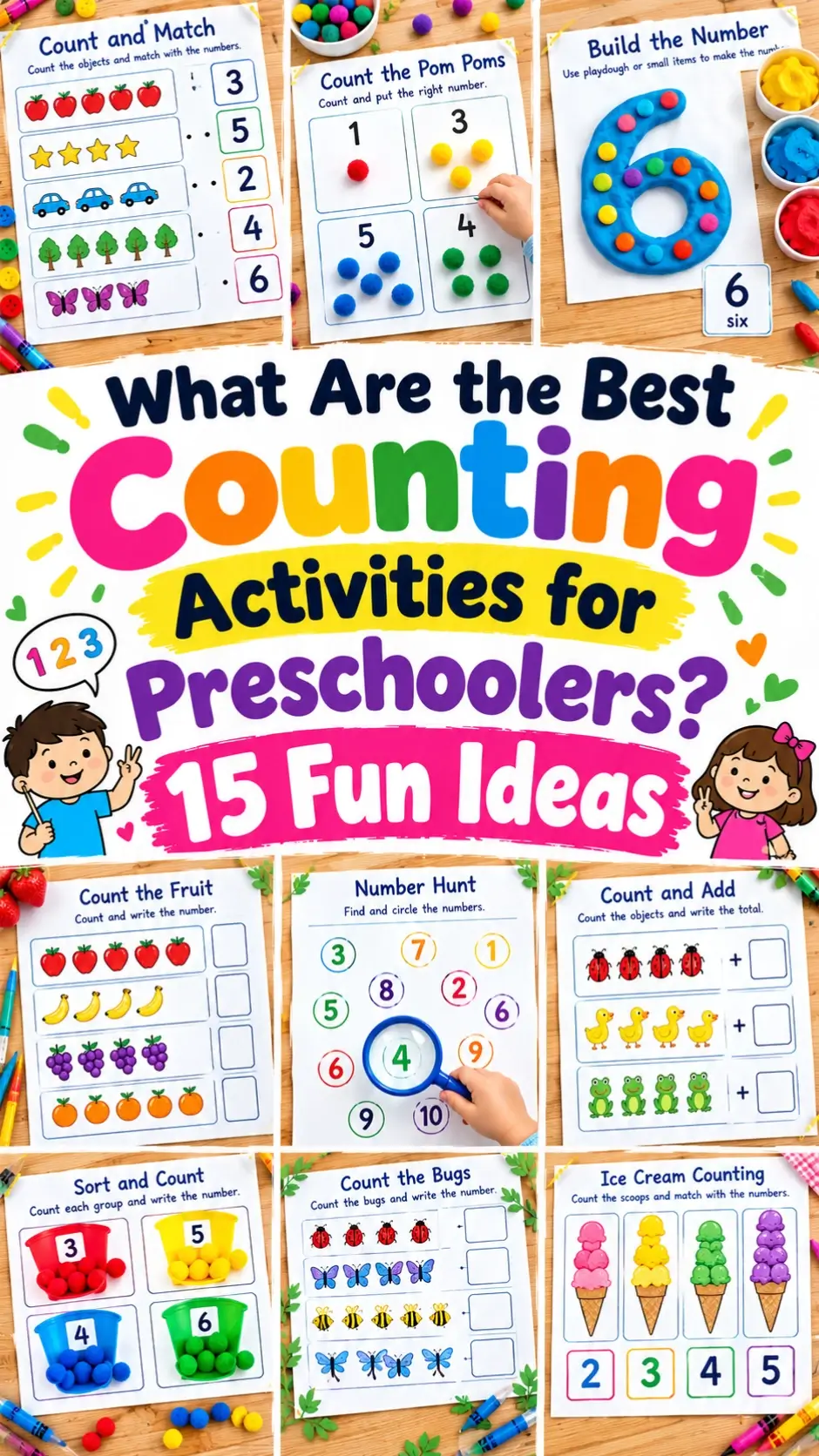
Counting starts long before a child sits down with a math worksheet.
You can count socks while folding laundry, steps while walking, crackers during snack time, or toy animals during play. These little moments give preschoolers a reason to use numbers.
The best counting activities for preschoolers let children touch, move, say, and see quantities. A child might know how to recite “1, 2, 3, 4, 5” and still count 5 toys incorrectly because they skip one or count the same toy twice. That skill, called one-to-one correspondence, takes practice.
I see this with my little girl, Hafsa. When counting becomes part of something she can actually do, she has much more reason to pay attention to the numbers.
Here are 15 counting activities you can try at home or in a preschool classroom.
1. Count the socks
Grab a small pile of clean socks and ask your child to count them.
Touch one sock for each number: “1, 2, 3, 4…”
Then mix them up and count again.
You can turn this into a tiny laundry game by asking, “Can you give me 4 socks?” Your child has to count out the correct amount rather than simply recite numbers.
Try this with: socks, washcloths, small towels, or other safe household items.
2. Count while setting the table
Give your child a simple job at mealtime.
If 4 people are eating, ask your child to bring 4 spoons. Count each spoon as it goes onto the table.
You can do the same with cups, napkins, or plates.
This is a nice way to help children understand that numbers describe real amounts. They aren’t just words to memorize.
3. Snack counting
Snack time gives you an easy counting opportunity.
Place a few pieces of fruit, cereal, crackers, or another age-appropriate food on a plate. Ask your child to count them one at a time.
Try questions like:
- “How many crackers do you have?”
- “Can you give me 3 pieces?”
- “Let’s count them together.”
- “You ate one. How many are left?”
Keep the amounts small at first. For a younger preschooler, 1–5 pieces may be plenty.
4. Count the stairs
Every time you go up or down a set of stairs, count the steps together.
“1, 2, 3, 4, 5…”
Your child gets to connect each number with one physical movement.
You can also count steps during a walk, but stay close and focus on safety around stairs.
5. Give each toy a home
Line up 3–5 stuffed animals or toy figures.
Give your child a small basket, box, or pretend bed for each one. Ask your child to place one toy in each spot while counting.
For example:
“1 teddy.”
“2 teddy.”
“3 teddy.”
Then ask, “How many teddy bears are there?”
This gives children practice matching one number word with one object. That’s a core part of accurate counting.
6. Count the bubbles
Blow a few bubbles and count the ones your child pops.
“1, 2, 3…”
You probably won’t get a perfect count every time. That’s fine.
The fun part is that your child has to watch each bubble and connect one pop with one number. You can stop at 5 or 10 depending on your child’s ability.
7. Make a counting train
Use toy cars, blocks, or other objects that can be lined up.
Ask your child to make a train with 5 pieces.
Count as each piece is added:
“1 car, 2 cars, 3 cars…”
Then make a longer train together.
For an older preschooler, ask, “You have 5 cars. What happens if we add 1 more?”
This starts bringing counting on into everyday play.
8. Count jumps
Put some paper circles on the floor, or simply choose a target number.
Say, “Let’s do 5 jumps.”
Count each jump out loud.
“1, 2, 3, 4, 5!”
You can change the movement each time:
- 3 claps
- 4 jumps
- 5 toe touches
- 6 marches
Experts also recommend movements such as walking and jumping as a way to connect each number word with an action.
9. Fill the egg carton
An empty egg carton makes a handy counting tray.
Give your child several large, safe objects such as blocks, large pom-poms, or toy pieces. Ask them to put one object into each section while counting.
Start with 3 or 4 sections.
Later, you can ask, “Can you put 6 objects in the carton?”
The individual spaces make it easier for children to see which objects they’ve already counted.
10. Count during a nature walk
Take counting outdoors.
Ask your child to find and count things such as:
- 3 leaves
- 5 stones
- 4 flowers
- 6 sticks
Use objects that are safe to touch and appropriate for your setting.
You can also choose one thing to count during the walk. For example, “Let’s see how many red flowers we can find.”
This activity works especially well because the number has a job. Your child is looking for something, collecting it, and keeping track.
11. Count spoonfuls while cooking
Preschool cooking gives you plenty of small counting opportunities.
Ask your child to put 3 spoonfuls of oats into a bowl or add 4 pieces of fruit to a mixture, depending on the recipe and your child’s ability.
You can also count eggs, cups, slices, or other ingredients with an adult handling anything hot or sharp.
If your child enjoys this kind of activity, you can find more ideas in my guide to preschool cooking activities.
12. Count the cars at the window
Stand near a safe window or outdoor viewing spot and count passing cars.
Start with a small target.
“Let’s count 5 cars.”
Touch a finger or make a small mark for each car you see.
You can make it more interesting by counting one type of vehicle at a time:
“How many buses did we see?”
“How many red cars?”
Keep the game short. Traffic may not cooperate with your lesson plan, and that’s part of the fun.
13. Build a counting staircase
Use blocks to make a small staircase.
Put 1 block in the first tower, 2 in the next, 3 in the next, and continue as far as your child can comfortably manage.
Then count each tower together.
Ask:
“Which tower has more blocks?”
“Which one has fewer?”
“What happens when we add one block?”
This activity connects counting with quantity and comparison. If your child enjoys comparing groups, my post on which has more preschool activities is a useful next activity.
14. Count the pieces for a craft
Before starting a simple craft, ask your child to count the materials.
For example:
“Can you give me 5 paper circles?”
“Let’s count 4 crayons.”
“Can you find 3 stickers?”
The child has to figure out how many items are needed and then collect that amount.
This is a simple way to make counting useful during an activity your child already wants to do.
15. Make a counting collection
Give your child a small basket or container.
During play, ask them to collect a certain number of safe objects.
“Can you find 5 blocks?”
“Can you put 4 toy animals in the basket?”
“Can you collect 3 balls?”
Afterward, count the collection together.
Change the objects from day to day so your child learns to count different things rather than memorizing one particular arrangement.
Why one-to-one counting matters
A preschooler can recite numbers from memory and still need practice counting actual objects.
One-to-one correspondence means saying one number for each object counted. If there are 5 blocks, the child touches or moves each block once while saying “1, 2, 3, 4, 5.”
The final number also tells the child how many objects are in the group.
So after your child counts 5 blocks, ask, “How many blocks are there?”
Give your child a moment to answer.
That little question matters because it checks whether the child understands the total quantity, rather than simply saying a sequence of numbers.
Counting activities for 3-year-olds
At 3, keep counting small and physical.
Start with groups of 1–5 objects. Let your child touch, move, give, collect, or place each object while counting.
Good choices include:
- Snack counting
- Counting jumps
- Giving toys one item each
- Counting socks
- Counting bubbles
- Counting stairs with an adult
You don’t need a long math session. A few minutes during normal play can be enough.
For more activities suited to this age, see my guide to preschool learning activities for 3-year-olds.
Counting activities for 4-year-olds
A 4-year-old can usually handle slightly larger groups and more counting challenges.
Try asking your child to count 5–10 objects, collect a specific amount, or add one more object to a group.
Good choices include:
- Counting collections
- Block staircases
- Nature counting
- Cooking measurements
- Counting cars
- Simple counting trains
You can find more age-specific ideas in preschool learning activities for 4-year-olds.
Counting activities for 5-year-olds
By 5, many children are ready for counting beyond 10, depending on their development and previous practice.
You can begin asking questions that require a little more thinking:
“What comes after 7?”
“You have 6 blocks. What happens if I give you 1 more?”
“There are 8 apples here. Can you give me 3?”
You can also bring in simple counting-on games and early addition during play.
My guide to preschool learning activities for 5-year-olds has more activities for this age.
Counting and number recognition are different skills
Counting and recognizing written numbers are connected, but children can develop them at different speeds.
A child might count 1–10 aloud while still having trouble identifying the written numeral 7.
That’s perfectly reasonable during preschool.
For activities that specifically practice recognizing written numerals, see number recognition activities for preschoolers.
You can gradually connect the two skills. After your child counts 5 blocks, show the numeral 5 and say, “This is the number we use for 5 blocks.”
How long should counting practice last?
You don’t need to sit your preschooler down for a long counting lesson.
A few minutes of focused practice can work well, especially when counting is mixed into play, meals, movement, chores, or outdoor time.
If you’re planning structured learning at home, my guide on how many hours should a preschooler study explains how much planned learning makes sense at different preschool ages.
What if my child keeps skipping objects?
Slow the activity down.
Ask your child to move each object into a separate pile as they count it. This gives them a physical way to remember which objects they’ve already counted.
For example, put 5 blocks on the left side.
Your child picks up one block and says “1,” then moves it to the right. Continue until all the blocks have moved.
If your child is still struggling, use fewer objects. Three accurate counts are more useful than a rushed count of 10.
What if my child can count to 20 but can’t count 8 objects?
This is common.
Reciting the number sequence and counting a group of objects require different skills. A child may have memorized the sequence up to 20 while still learning to coordinate each number word with one object.
Go back to small groups and let your child touch or move each object.
Once that becomes comfortable, increase the number gradually.
A simple 5-day counting plan
You can keep the week very simple.
Monday: Count 5 pieces of snack.
Tuesday: Count jumps from 1–5.
Wednesday: Count 5 toy animals and give each one a pretend item.
Thursday: Count leaves, flowers, or other safe outdoor objects.
Friday: Build a block staircase and count each tower.
Each activity can take only a few minutes.
And if your child wants to keep playing, let the play continue. You don’t have to stop because the “math activity” is technically finished.
Frequently asked questions
What are the best counting activities for preschoolers?
The best activities give children something real to touch, move, collect, or use while counting. Snack counting, toy collections, movement games, nature counting, block activities, and simple household jobs are all good choices.
What should a preschooler learn first when counting?
Start with saying numbers in the correct order, then practice matching one number word to one object. As counting becomes more accurate, ask the child how many objects there are altogether.
How high should a preschooler be able to count?
There isn’t one number that every preschooler must reach at the same time. Focus on accurate counting of objects and understanding quantities rather than making the highest possible number the goal.
How can I teach counting at home?
Use everyday moments. Count socks, snacks, steps, toys, blocks, cars, ingredients, or objects you see outside. Short, repeated practice works well for young children.
Should I use counting worksheets?
Worksheets can give children extra practice, but preschool counting also needs real objects and movement. Let your child count physical things before expecting a worksheet to make sense.
For broader preschool learning ideas, visit best educational activities for preschoolers.
More preschool learning ideas
Counting is only one part of early learning.
If you’re building a mix of language, early math, science, and social activities at home, you might also like:
- Alphabet activities for preschoolers
- Beginning sound activities for preschoolers
- Who am I preschool activities
- Fun rhyming activities for preschoolers
- Where the Wild Things Are preschool activities
- Where does food grow preschool activities
- Where do animals live preschool activities
The nice thing about counting is that you don’t need a special setup. Your child already has plenty of things to count.
Start with 3 socks, 4 crackers, or 5 blocks. That’s enough for today.