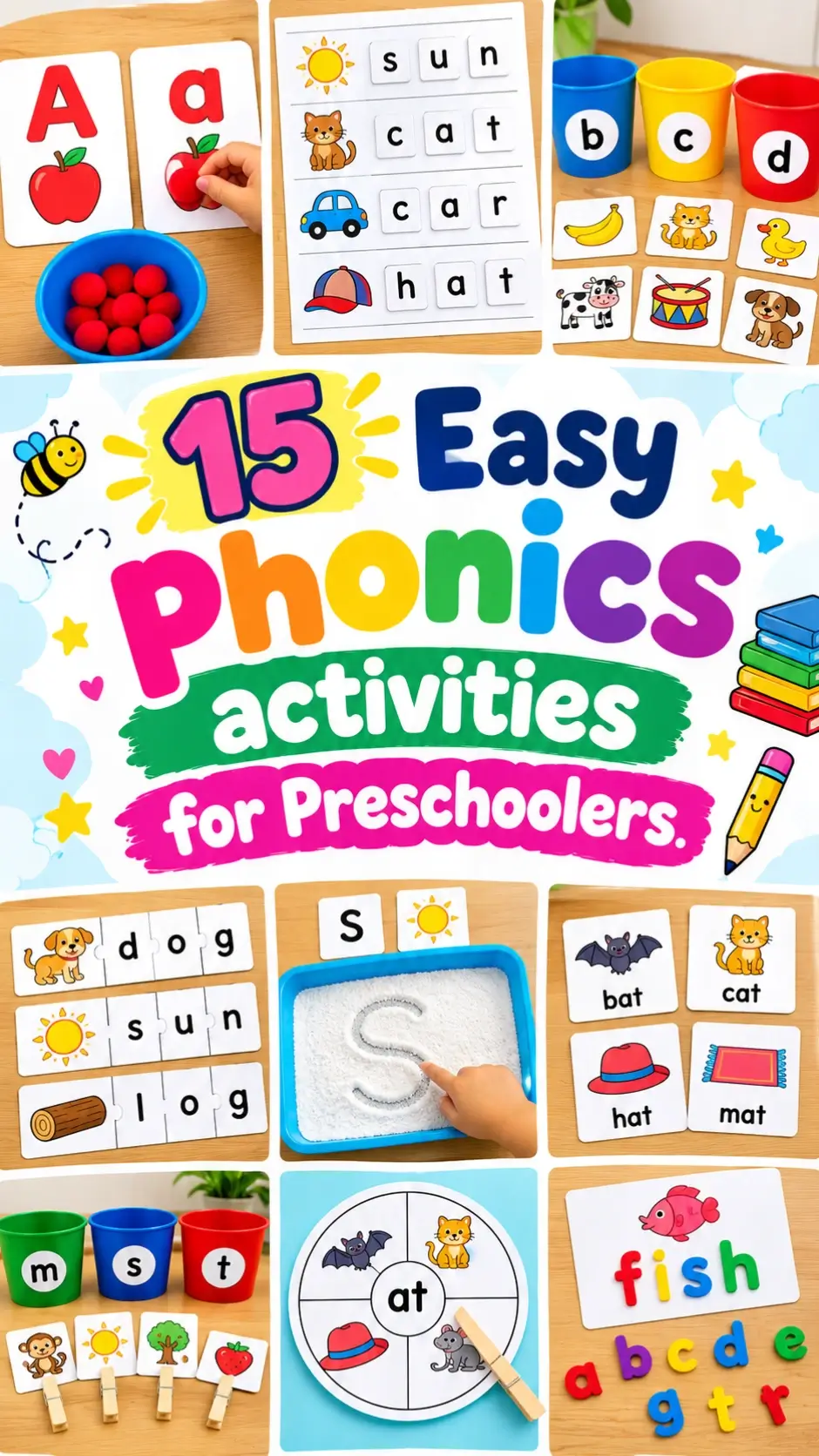
Phonics can start with something as simple as a sound.
Your child hears mmm and connects it to m. Then they hear m-a-t and begin to understand that those sounds can come together to make mat.
Short games work well for preschoolers. You can use toys, picture cards, paper, books, or things already sitting around the house.
These easy phonics activities for preschoolers are designed for ages 3–5. They move from listening and identifying sounds toward simple blending and segmenting.
And you don’t need to finish all 15 activities. Pick one or two and stop while your child is still having fun.
What is phonics for preschoolers?
Phonics teaches children to connect letters with the sounds they represent.
For example, your child learns that the letter m represents the /m/ sound in moon, or that s represents /s/ in sun.
Phonics also connects to phonological awareness, the ability to hear and work with sounds in spoken language. Children can practice some of these skills before they know many letters.
For preschoolers, you can work on:
- Hearing individual sounds
- Recognizing letter sounds
- Matching sounds to letters
- Hearing the first sound in a word
- Blending sounds together
- Breaking short words into sounds
- Listening for similar sounds
- Reading simple CVC words when your child is ready
If you’re starting from the alphabet itself, my alphabet activities for preschoolers post is a useful companion.
When should you start phonics with a preschooler?
You can start with sound play around age 3.
At first, keep it mostly oral. Talk about sounds, play with words, listen for sounds, and introduce a few familiar letter sounds.
Around 4, many children are ready for more direct letter-sound practice. Some 5-year-olds may be ready to blend and segment simple words such as cat, sun, and map.
Children develop at different speeds. So I wouldn’t rush into reading whole lists of words because another child already can.
A short, regular practice session is enough.
15 easy phonics activities for preschoolers
1. Sound and letter parking lot
Draw 4 or 5 parking spaces on a piece of paper.
Write one letter in each space, such as m, s, t, p.
Give your child small toy cars. Say a sound, such as /m/, and ask them to drive the car to the letter m.
Then switch it around.
Point to s and ask, “What sound does this letter make?”
Keep the number of letters small. Four letters are plenty for a young preschooler.
This gives you a simple way to practice letter-sound connections without sitting down with a stack of flashcards.
2. Feed the sound monster
Make a paper monster with a big open mouth.
Write 3 or 4 letters on small pieces of paper.
Choose a sound and tell your child, “The monster is hungry for /b/!”
Your child finds b and feeds it to the monster.
Then try a word.
“Which letter does ball start with?”
This works well when your child enjoys pretend play.
You can change the monster into a robot, dinosaur, puppet, or anything else your child likes.
3. Sound boxes with household objects
Take 3 small boxes or containers.
Put a letter on each one, such as b, m, s.
Now find a few small objects that begin with those sounds.
A ball can go with b.
A spoon can go with s.
A toy mouse can go with m.
Let your child place each object beside the correct letter.
PreKinders uses a similar letter-cup approach, where children sort small objects according to their beginning sounds.
You can make this easier by using only 2 letters at first.
4. Letter sound treasure basket
Choose one sound.
Let’s say you’re working on /t/.
Walk around the room together and look for things that start with that sound.
You might find a toy train, towel, teddy bear, or toothbrush.
Put the objects into a basket.
Then say the words slowly:
t-t-teddy
t-t-towel
t-t-train
The goal is to help your child notice that different words can begin with the same sound.
You can turn this into a quick 5-minute routine before another activity.
5. Stretch the sound
Some letter sounds can be stretched easily.
Try:
mmmmmm
ssssss
fffffff
Let your child copy you.
Then connect the sound to a word.
“Listen: mmmmmmilk.”
“Listen: ssssssun.”
Don’t worry about making every sound perfectly long. The point is to help your child hear the sound clearly.
This is different from simply naming a letter. Your child is listening to what the letter actually sounds like.
6. Sound stepping stones
Put several pieces of paper on the floor.
Write one letter on each paper.
Say a sound.
Your child steps onto the matching letter.
For example:
“Find /p/.”
Your child steps on p.
Then try a sequence:
“/m/, /s/, /t/.”
Your child finds each letter in order.
For children who need more movement, this can work much better than sitting at a table.
You can also connect phonics with other movement-based learning through educational games for preschoolers.
7. The sound train
Make a paper train with 3 or 4 carriages.
Write one letter on each carriage.
Start with a simple word such as cat.
Write:
c | a | t
Point to each letter and say the sound.
Then slowly slide your finger across:
c-a-t
“Cat!”
The child learns that the separate sounds can come together to make one word.
Oral blending is a useful early reading skill, and activities can begin with spoken sounds before children work with printed letters.
8. Robot talk
Bring out a toy robot.
Tell your child, “The robot talks in sounds.”
Then say:
c-a-t
Ask:
“What word did the robot say?”
Your child says:
“Cat!”
Try easy words such as:
- m-a-t
- s-u-n
- p-i-g
- d-o-g
- f-i-sh
Keep the words familiar.
If your child struggles, say the sounds more smoothly and answer a couple of tries. Oral blending games are commonly used to help preschool and early-years children put individual sounds together.
9. Sound buttons for short words
Draw 3 circles under a simple CVC word.
For dog, you might write:
d o g
Put one small dot or button under each letter.
Your child touches each button while saying the sound.
Then slide a finger underneath all 3 sounds and say the word.
This gives your child something physical to do while listening.
Start with 2 or 3 words. You can use pictures beside the words if your child can’t read the letters independently yet.
10. Build the word with bottle caps
Save a few clean bottle caps.
Write letters on them.
Give your child c, a, t.
Ask them to arrange the caps to make cat.
Then change one letter.
cat → cap
Ask:
“What changed?”
This is a nice activity for children who are beginning to understand that changing one sound can change the word.
You can also use magnetic letters or letter tiles if you already have them.
11. Which sound disappeared?
Say a word slowly.
For example:
“sun.”
Then say:
“Now say it without /s/.”
For a preschooler, this can be difficult, so don’t expect a perfect answer every time.
You can make it easier with simple word pairs.
“Say sat. Now listen to at. What sound did we take away?”
This is a later phonemic-awareness skill. If your child isn’t ready, go back to simple sound matching and oral blending.
12. First sound and last sound detective
Choose a familiar word.
Say sun.
Ask:
“What sound do you hear first?”
Then:
“What sound do you hear at the end?”
For younger preschoolers, stick with the first sound.
Older preschoolers who are comfortable with beginning sounds can start noticing final sounds too.
This builds on sound awareness without turning the activity into a worksheet.
For more targeted work with initial sounds, you can use my beginning sound activities for preschoolers.
13. Read a sound-filled picture book
Pick a simple picture book.
Choose one sound before you start reading.
For example, pick /b/.
As you read, listen for words such as ball, bear, baby, and bed.
Pause when you hear one.
“Bear starts with /b/. Can you say /b/?”
You don’t need to stop on every page.
Reading aloud also gives preschoolers regular practice with sounds, letters, words, and rhyming language.
If you’re already working on rhyming, you can pair this with these fun rhyming activities for preschoolers.
14. Make a CVC word picnic
Put several picture cards on the table.
Use simple words such as:
cat
dog
sun
pig
bus
Make a pretend picnic.
Your child picks a picture and says the word.
Then help them break it apart:
“Dog.”
“d-o-g.”
Then blend it again:
“dog!”
For children who are ready, add the printed word next to the picture.
For children who aren’t ready for printed words, stay with the pictures and spoken sounds.
That’s perfectly fine.
15. Phonics scavenger hunt
Choose 3 letters.
Write them on cards and place them around the room.
Now give your child a sound clue.
“Find something that starts with /s/.”
Your child looks around.
Maybe they find a sock.
Then ask:
“What sound does sock start with?”
Next clue.
“Find something that starts with /b/.”
This gets your child listening to sounds in real words instead of only looking at letters on a page.
You can make the hunt easier or harder depending on your child’s age.
Easy phonics activities for 3-year-olds
At 3, focus heavily on listening.
Try:
- Stretching easy sounds
- Sound treasure baskets
- Sound hunts
- Listening for the first sound
- Singing sound-rich songs
- Finding familiar letters
- Matching a few letters with their sounds
You can also use activities from my preschool learning activities for 3-year-olds guide to build the rest of your learning time.
Don’t worry if your 3-year-old can’t blend c-a-t yet.
There’s plenty of useful phonics work to do before that.
Easy phonics activities for 4-year-olds
Four-year-olds can usually handle a little more structure.
Try:
- Letter-sound matching
- Sound sorting
- Sound stepping stones
- Simple oral blending
- Building CVC words
- Listening for first and last sounds
- Matching pictures to simple words
Keep your letter set small.
If you’re teaching 4-year-olds more broadly, you can also use these preschool learning activities for 4-year-olds.
Easy phonics activities for 5-year-olds
By 5, some children are ready to work more directly with CVC words.
You can try:
- Building short words with letter tiles
- Blending 3 sounds
- Segmenting 3-sound words
- Changing one letter in a word
- Matching CVC words to pictures
- Reading familiar short words
- Listening for beginning and ending sounds
A child who isn’t ready for all of these can stay with the earlier activities.
For more age-specific ideas, see preschool learning activities for 5-year-olds.
How I practice phonics with Hafsa
With Hafsa, I’d keep phonics connected to things she already sees.
If we’re playing with a ball, I can say, “B-b-ball.”
If we’re looking at a sun picture, I can stretch the /s/ sound.
And if she starts making up her own silly words, I’ll usually play along. That kind of sound play is useful too.
I wouldn’t sit her down for a long phonics lesson.
A few minutes here, another little game later, and a sound we notice while reading a book can be enough for one day.
Phonics and alphabet learning
Phonics and alphabet knowledge are connected, but they’re different skills.
Knowing that a symbol is the letter m is letter recognition.
Knowing that m represents /m/ is a letter-sound connection.
A preschooler can know many letter names and still need time to learn their sounds.
That’s why I like keeping both types of practice in the weekly routine.
You can pair these activities with alphabet activities for preschoolers and introduce a few letters at a time.
Phonics without worksheets
You don’t need a worksheet every time you practice phonics.
Use:
- Toy cars
- Bottle caps
- Blocks
- Paper cards
- Toy animals
- Household objects
- Books
- Puppets
- Plastic letters
- Small baskets
A sock can become a sound-hunt object.
A toy car can drive to the letter m.
A puppet can speak in robot sounds.
That’s often enough.
If you do use printable pages, pair them with hands-on practice. For example, after a beginning-sound worksheet, ask your child to find 3 real objects that start with the same sound.
Phonics and fine motor practice
You can combine sound learning with hand work.
Have your child:
- Pick up letter cards with tongs
- Place bottle caps to build words
- Stick letter stickers onto sound cards
- Trace a large letter after saying its sound
- Build words with small blocks
- Clip a clothespin onto the correct letter
These ideas can fit nicely beside my fine motor activities for preschoolers.
If you’re using scissors for a phonics craft, choose a simple project and supervise closely. My cutting activities for preschoolers post has more scissor practice ideas.
Phonics and pre-writing
Writing letters comes later than simply hearing their sounds for many children.
You can still prepare the hand through drawing, tracing, lines, curves, and other pre-writing work.
Try drawing a large s in sand while making the /s/ sound.
Or let your child trace a large m with a finger before picking up a pencil.
For more ideas, see these pre-writing activities for preschoolers and pencil grip activities for preschoolers.
Use familiar topics to practice phonics
Your child’s favorite topics can make phonics easier to repeat.
If they love animals, use words such as cat, dog, pig, and fox.
If they love food, use jam, bun, egg, and ham.
If you’re talking about nature, you can use words from your food that grows on trees preschool activities post.
You can even pull words from story themes. After reading a favorite story, choose 2 or 3 short words and play with their sounds.
A simple 5-day phonics routine
You can keep a weekly routine very short.
Day 1: Listen
Choose one sound.
Say it clearly and find objects that begin with it.
Day 2: Match
Use 3 or 4 letter cards.
Say a sound and let your child find the matching letter.
Day 3: Move
Put letters around the room.
Call out a sound and let your child move to the correct letter.
Day 4: Blend
Use a few easy words.
Say m-a-t and let your child guess the word.
Day 5: Build
Use letter cards or bottle caps to make 2 or 3 simple words.
That’s enough.
If your child wants to keep playing, keep going. If they’re done after 5 minutes, you’re done too.
For broader preschool scheduling, you can also read how many hours should a preschooler study.
How to know if your child is ready for blending
Watch what your child can already do.
If they can recognize several letter sounds and enjoy listening to sounds in words, you can try simple oral blending.
Start with very familiar words.
Say:
m-a-p
Pause.
“Map.”
Then let your child try.
If it doesn’t work, go back to individual sounds and try again another day.
Blending and segmenting develop over time, and guidance from Reading Rockets recommends moving from larger sound units toward individual phonemes as children become ready.
Common phonics mistakes to avoid
Teaching too many letters at once
Stick with a small group.
Your child needs repeated practice with a sound before adding a pile of new ones.
Turning every activity into a test
Ask questions, but give your child room to guess.
You can model the answer and let them try again.
Starting with difficult words
Use short, familiar words first.
cat is easier to work with than a long unfamiliar word.
Expecting perfect pronunciation
Young children are still developing speech sounds.
Focus on the phonics skill you’re teaching rather than correcting every little pronunciation difference.
Making sessions too long
Five focused minutes can be useful.
You can always come back later.
Can phonics activities include numbers and math?
Sure.
You can make letter cards numbered 1–5 and ask your child to put them in order.
Or count how many objects you find during a sound hunt.
For more preschool math ideas, you can use number recognition activities for preschoolers, math activities for preschoolers, and counting activities for preschoolers.
You don’t need to combine every subject in every activity, though. One small learning goal is usually enough.
Frequently asked questions
What are the best phonics activities for preschoolers?
Simple activities that let children hear sounds, connect sounds to letters, and play with short words work well.
Sound hunts, letter-sound matching, object sorting, oral blending, sound stepping stones, and building CVC words are good choices.
What age should preschoolers start phonics?
Sound and listening activities can begin around age 3.
Direct letter-sound work can be introduced gradually as children are ready. Older preschoolers may begin blending and segmenting simple words.
What are CVC words?
CVC means consonant-vowel-consonant.
Examples include:
– cat
– dog
– sun
– map
– pig
– bus
These short words are useful for early blending and segmenting practice.
Should preschoolers learn letter names or sounds first?
Teach both as part of early literacy, but give plenty of attention to the actual sounds letters represent.
A child needs to connect printed letters with their sounds when learning to decode words.
How long should a preschool phonics activity last?
Start with about 5–10 minutes.
Some children will stay interested longer. Others will be finished quickly. Follow the child.
More preschool learning ideas
Once your child is comfortable with these activities, you can build phonics into other parts of the day.
Try a sound hunt while cleaning up toys.
Listen for a target sound during story time.
Build one short word with letter cards after snack.
Or ask your child to find a letter on a food package.
You can also mix phonics into your wider preschool routine with the best educational activities for preschoolers.
For other language activities, try Who Am I preschool activities.
For nature and science themes, you can explore Where the Wild Things Are preschool activities, Where Do Animals Live preschool activities, and Arctic animals activities for preschoolers.
And if you want to bring patterns and colors into your learning week, you can try pattern activities for preschoolers and color matching activities for preschoolers.
The same idea works with shape learning too. See shape recognition activities for preschoolers.
You can also use which has more preschool activities for simple comparison practice, and later introduce simple addition activities for preschoolers or subtraction activities for preschoolers when your child is ready.
Final thought
Phonics grows through repetition.
Your child might hear /m/ today, forget it tomorrow, and recognize it again next week. That’s normal.
Keep the practice short. Use familiar words. Let your child move around and play with the sounds.
And when Hafsa suddenly points at a letter on a cereal box and says its sound, that’s the kind of little moment you’re working toward.