
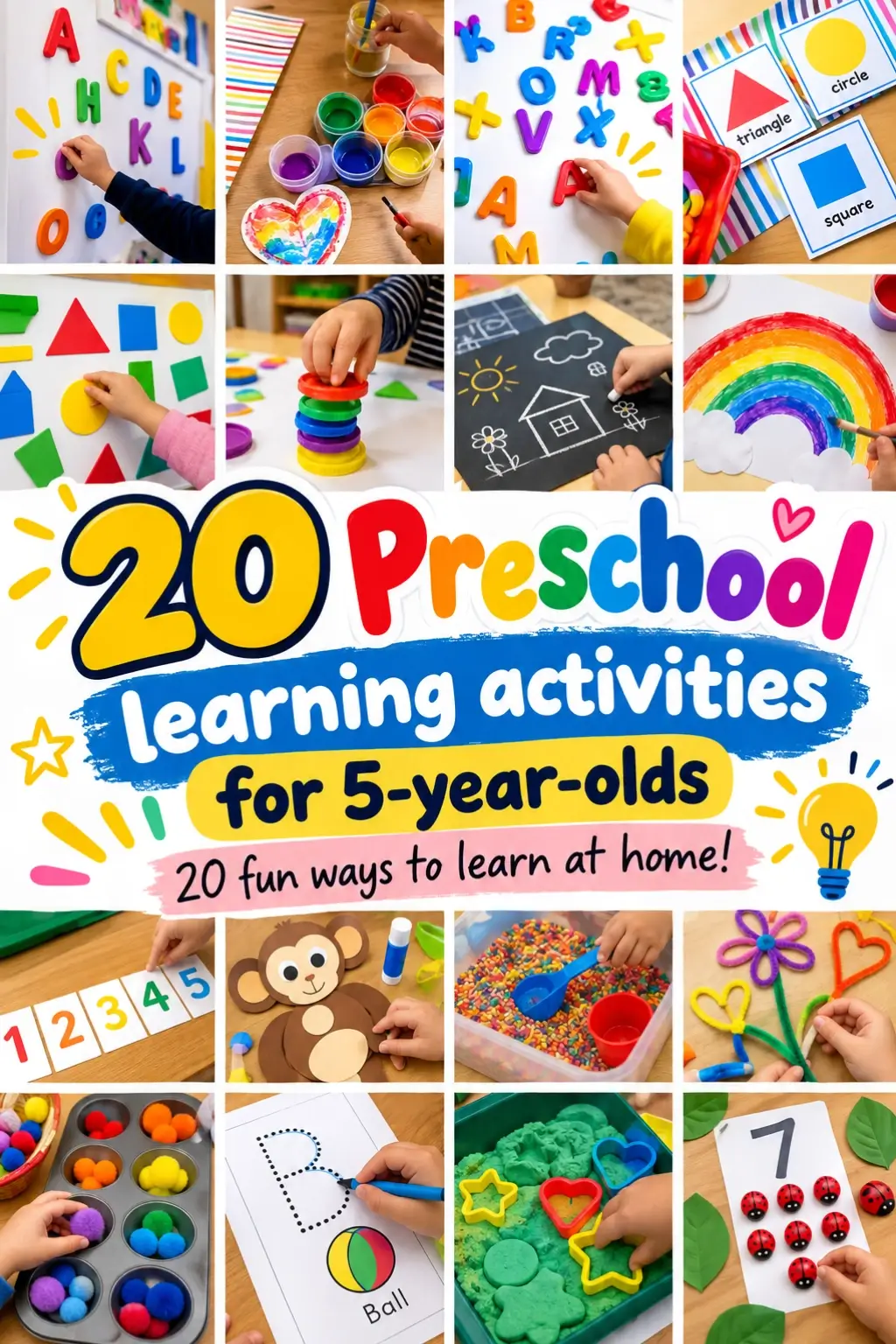
Five-year-olds are ready to do more with what they already know.
They can begin connecting sounds to letters, reading simple words, writing short sentences, working with larger numbers, following a plan, and explaining how they reached an answer. At the same time, they still need plenty of play, movement, stories, and hands-on experiences.
I see this with my little girl, Hafsa. Give her something with a little challenge, and she often wants to keep going until she figures it out. That persistence is something I like to encourage at this age.
So when I plan preschool learning activities for 5-year-olds, I look for activities that make children think, talk, read, write, count, compare, create, and solve small problems.
You don’t need expensive learning materials. A few paper cards, pencils, household objects, books, and everyday situations can give you plenty to work with.
What should a 5-year-old learn through activities?
Every child develops differently, so there’s no single checklist that every 5-year-old needs to complete.
Still, activities at this age can give children regular practice with:
- Letter sounds and phonics
- Reading simple words
- Spelling familiar words
- Vocabulary and comprehension
- Writing short sentences
- Listening and following instructions
- Counting and number relationships
- Addition and subtraction
- Measurement
- Time and calendars
- Patterns and logical thinking
- Memory and concentration
- Fine-motor control
- Creativity
- Planning and problem-solving
- Independence
Reading Eggs describes early reading development around this age in terms of hearing sounds within simple words and building phonemic awareness.
Related Posts:
👉 25 Best Educational Activities for Preschoolers
👉 How Many Hours Should a Preschooler Study?
👉 25 Best Preschool Learning Activities for 4-Year-Olds
👉 30 Best Preschool Learning Activities for 3-Year-Olds
20 preschool learning activities for 5-year-olds
1. Build words with sound cards
Write individual letters on small cards.
Start with a simple word such as sun. Ask your child to say each sound slowly, then put the cards together to make the word.
Try other simple words such as:
- cat
- dog
- map
- bed
- fish
- cup
Once your child understands the game, give them the letters out of order and let them work out how to arrange them.
This gives phonics practice a hands-on element. Reading Eggs similarly recommends activities where children identify the individual sounds in simple words and blend them.
Skills practiced: Phonics, blending, word recognition, spelling.
2. Play word-family ladders
Write a simple word such as cat.
Ask your child to change one letter to make another word:
cat → hat → hot → hop
You can also make a word family:
cat, bat, hat, mat, sat
Let your child read the words aloud and circle the part that stays the same.
Skills practiced: Phonics, spelling patterns, reading, vocabulary.
3. Go on a word hunt
Choose a simple word your child already knows, such as the, and, is, or my.
Look for that word in books, signs, labels, or magazines.
Each time your child finds it, they can point to it and read it.
You can later give them two or three target words to find.
Skills practiced: Word recognition, reading fluency, visual scanning.
4. Make a sentence scramble
Write a short sentence on separate cards.
For example:
The / cat / is / sleeping.
Mix the cards and ask your child to put them back in the correct order.
Then make another sentence together.
At five, children can start thinking about how individual words work together to communicate an idea.
Skills practiced: Sentence structure, reading, grammar, sequencing.
5. Create a mini book
Fold three or four sheets of paper in half.
Ask your child to choose a topic, such as:
- My family
- My favorite animal
- A trip to the park
- My favorite food
Let them draw a picture on each page and write one simple sentence or label.
You can help with spelling when needed.
The finished book doesn’t need to look perfect. Your child is practicing turning an idea into words and pictures.
Skills practiced: Writing, vocabulary, storytelling, creativity.
6. Play “finish the sentence”
Start a sentence and let your child finish it.
For example:
“If I had a pet dragon, I would…”
“My favorite place is…”
“If I could fly, I would…”
“There was a tiny door in the wall, and…”
There are no fixed answers. Encourage your child to explain their idea.
Skills practiced: Language, vocabulary, imagination, sentence formation.
7. Make a reading detective game
After reading a short story together, ask your child to find specific information.
For example:
“Who found the ball?”
“Where did the dog go?”
“What happened after they opened the box?”
You can also ask a prediction question:
“What do you think will happen next?”
The goal is to get your child thinking about the meaning of what they read, rather than simply saying the words aloud.
Skills practiced: Reading comprehension, memory, prediction, speaking.
8. Make number bonds with objects
Put five buttons or blocks on the table.
Separate them into two groups.
For example:
2 + 3 = 5
Then change the groups:
1 + 4 = 5
Ask your child to find as many ways as possible to make five.
When that becomes easy, move to 10.
Skills practiced: Number relationships, addition, counting, mathematical reasoning.
9. Play “make 10”
Give your child a small number card from 1 to 9.
Ask:
“What number do we need to make 10?”
If the card says 6, your child needs to find 4.
Use fingers, counters, blocks, or drawings to make the idea visible.
Skills practiced: Addition, number bonds, mental maths.
10. Explore tens and ones
Write a number such as 24.
Make two groups using small objects:
- 2 groups of ten
- 4 single objects
Explain that the 2 represents two tens and the 4 represents four ones.
Keep the activity practical rather than turning it into a formal lesson.
Skills practiced: Place value, counting, number representation.
11. Make a simple class-style survey at home
Ask family members one question.
For example:
Which fruit do you like best?
Give three choices: apple, banana, or orange.
Record everyone’s answer using marks or small drawings.
Then count the results.
Ask:
“Which has the most?”
“Which has the fewest?”
“How many people chose bananas?”
Skills practiced: Counting, data collection, comparison, simple graphing.
12. Make a paper clock
Draw a large clock face and add the numbers.
Use two strips of paper for the hands and attach them with a paper fastener.
Start with simple times such as:
- 3 o’clock
- 6 o’clock
- 9 o’clock
- 12 o’clock
Then give your child a time and ask them to move the hands.
You can connect the game to daily routines:
“When do we eat breakfast?”
“When do we go to bed?”
Skills practiced: Number recognition, time awareness, sequencing daily events.
13. Make a weekly calendar
Create a simple seven-day calendar.
Ask your child to write or copy the days of the week and mark important events.
For example:
Monday: School
Wednesday: Park
Friday: Movie night
Sunday: Family day
Ask questions such as:
“What day comes after Tuesday?”
“How many days until Friday?”
Skills practiced: Sequencing, reading, time concepts, memory.
14. Make a fraction snack
Cut a sandwich, pancake, banana, or another suitable food into two equal parts.
Talk about half.
Then, when appropriate, divide something into four equal parts and introduce quarter.
Ask:
“Which piece is bigger?”
“What happens when we put the two halves together?”
Skills practiced: Fractions, comparison, problem-solving.
15. Try a tangram challenge
Use a simple set of geometric pieces or make your own from paper.
Give your child a picture of an animal, house, boat, or another simple shape.
Ask them to recreate it using the pieces.
When they’re comfortable, let them create their own picture.
Skills practiced: Spatial reasoning, geometry, problem-solving, creativity.
16. Create a paper weaving project
Cut a piece of paper into strips, leaving one edge attached.
Cut separate strips of another paper.
Show your child how to weave the strips over and under the first sheet.
Let them create a simple pattern.
This takes patience, so don’t worry if it takes several attempts.
Skills practiced: Fine-motor control, concentration, patterns, hand-eye coordination.
17. Make a “how does it work?” challenge
Choose an everyday object such as a zipper, umbrella, stapler, flashlight, or simple kitchen tool.
Ask your child to look closely and explain how they think it works.
Then let them investigate it safely with you.
You can ask:
“What moves?”
“What stays still?”
“Why do you think this part is there?”
The point is curiosity and explanation, not getting every answer right.
Skills practiced: Observation, reasoning, vocabulary, problem-solving.
18. Create a simple obstacle plan
Instead of simply running through an obstacle course, let your child design it.
Give them a few safe options:
- Walk around a chair
- Step over a cushion
- Crawl under a table
- Jump between floor markers
- Carry a soft ball to a basket
Ask your child to decide the order.
Then they can explain the plan before trying it.
Skills practiced: Planning, sequencing, movement, communication.
19. Make a chore checklist
Choose a few small jobs your child can manage with appropriate adult supervision.
For example:
☐ Put books on the shelf
☐ Put clothes in the basket
☐ Place napkins on the table
☐ Put toys in their box
Let your child check each task when finished.
This turns everyday responsibility into a small reading and sequencing activity.
Skills practiced: Independence, reading, organization, following steps.
20. Play a “teach me something” game
Ask your child to teach you how to do something they know well.
It could be:
- How to draw a flower
- How to build a particular toy
- How to play a game
- How to make a paper shape
- How to care for a favorite toy
Don’t interrupt too quickly.
Let your child explain the steps in their own words.
This is a surprisingly useful activity because the child has to remember, organize, explain, and check whether you understood.
Skills practiced: Communication, sequencing, memory, confidence, vocabulary.
How long should learning activities last at age 5?
Five-year-olds can often stay with a structured activity longer than younger preschoolers, but you still don’t need long lessons.
A 10–20 minute activity can be plenty.
Some activities, such as making a mini book or doing a science investigation, may naturally take longer. Others, such as a phonics game, may only need five minutes.
I like having a few small learning opportunities throughout the day rather than trying to turn the whole afternoon into school.
A simple weekly learning plan for a 5-year-old
You could organize the week like this:
| Day | Main focus | Activity |
|---|---|---|
| Monday | Phonics | Word-family ladder |
| Tuesday | Maths | Number bonds |
| Wednesday | Reading | Reading detective |
| Thursday | Writing | Make a mini book |
| Friday | Maths | Paper clock |
| Saturday | Problem-solving | Tangram challenge |
| Sunday | Life skills | Chore checklist |
You can still read together every day.
And everyday conversations count too. Ask questions, introduce new words, let your child explain things, and encourage them to tell you about their ideas.
How can I make activities challenging without making them frustrating?
Add one small step.
If your child can read three-letter words, try four-letter words.
If they can make 5 using number bonds, try 10.
If they can write one sentence, ask them to write two connected sentences.
If they can follow two instructions, occasionally try three.
Watch how your child responds.
A little struggle can be useful. Too much frustration usually means the activity needs to be simplified.
Should a 5-year-old use worksheets?
Worksheets can be helpful at this age, especially for short periods of focused practice.
Good options include:
- Phonics and beginning-sound worksheets
- Word-building activities
- Simple reading comprehension
- Number bonds
- Addition and subtraction
- Number writing
- Handwriting
- Patterns
- Shapes and measurement
- Simple logic activities
But I’d still mix worksheets with books, conversation, games, creative work, movement, and real-life tasks.
For example, after completing a number-bond worksheet, use buttons to find the same number combinations. After a phonics worksheet, look for those sounds in a story.
That extra step helps connect paper practice with something your child can see and touch.
What if my 5-year-old makes lots of mistakes?
Keep the tone calm.
If your child writes a word incorrectly, ask them to listen to the word again. If they get a maths problem wrong, use objects to work through it together.
And give them time to think before jumping in with the answer.
At five, learning how to keep trying matters alongside learning the actual skill.
What should I avoid?
Don’t turn every activity into a lesson
Children still need plenty of free play.
Don’t rush reading
Some children become confident readers quickly, while others need more practice with sounds and blending.
Don’t correct every little mistake
Choose the mistakes that matter for the skill you’re practicing and keep the activity enjoyable.
Don’t compare your child with other children
Age gives you a general guide, not an exact timetable.
Don’t make activities unnecessarily complicated
If a simple paper game works, use it.
You don’t need a room full of educational toys to give your child useful learning experiences.
Frequently asked questions
What are the best preschool learning activities for 5-year-olds?
Activities involving phonics, simple reading, writing, number relationships, problem-solving, time, measurement, storytelling, and everyday responsibility are good choices. The best activity also depends on what your child currently enjoys and finds challenging.
What should a 5-year-old learn at home?
A 5-year-old can continue building phonics, reading, vocabulary, writing, counting, addition, subtraction, measurement, problem-solving, communication, and independence through play and everyday activities.
How can I teach phonics to my 5-year-old?
Try sound cards, word-building games, word families, sound hunts, simple spelling games, and reading short phonics-based words. Keep practicing the sounds your child is currently learning.
How can I teach maths to a 5-year-old?
Use real objects and everyday situations. Number bonds, counting, simple addition and subtraction, tens and ones, time, calendars, measurement, and simple fractions can all be introduced through practical activities.
How long should a 5-year-old study at home?
You don’t need long study sessions. Short activities of around 10–20 minutes are often enough, with plenty of movement, reading, free play, and everyday learning around them.
Are worksheets useful for 5-year-olds?
Yes. Short, age-appropriate worksheets can give children extra practice with literacy and maths. They work well when combined with hands-on activities and conversation.
How can I make learning fun for a 5-year-old?
Turn skills into games. Let your child move around, choose between activities, solve small challenges, make things, tell stories, and use everyday objects while learning.
Final thoughts
Five-year-olds are at an interesting stage.
They can start doing more independently, but they still learn so much through play and everyday experiences.
A word-building game can become a reading lesson. A calendar can become a maths activity. A family survey can become a graph. Even putting books away can become an opportunity to practice reading and responsibility.
I don’t think every afternoon needs a carefully planned educational activity.
Some days, Hafsa might want to make a little book. Another day, she may be more interested in figuring out a puzzle or helping with something around the house.
That’s fine.
The goal is to give a 5-year-old plenty of chances to think, talk, read, write, count, create, and solve problems while keeping learning enjoyable.
Resources
https://home.oxfordowl.co.uk/kids-activities/learning-activities-age-5-6/
https://readingeggs.com.au/articles/preschool-learning-activities-home/