
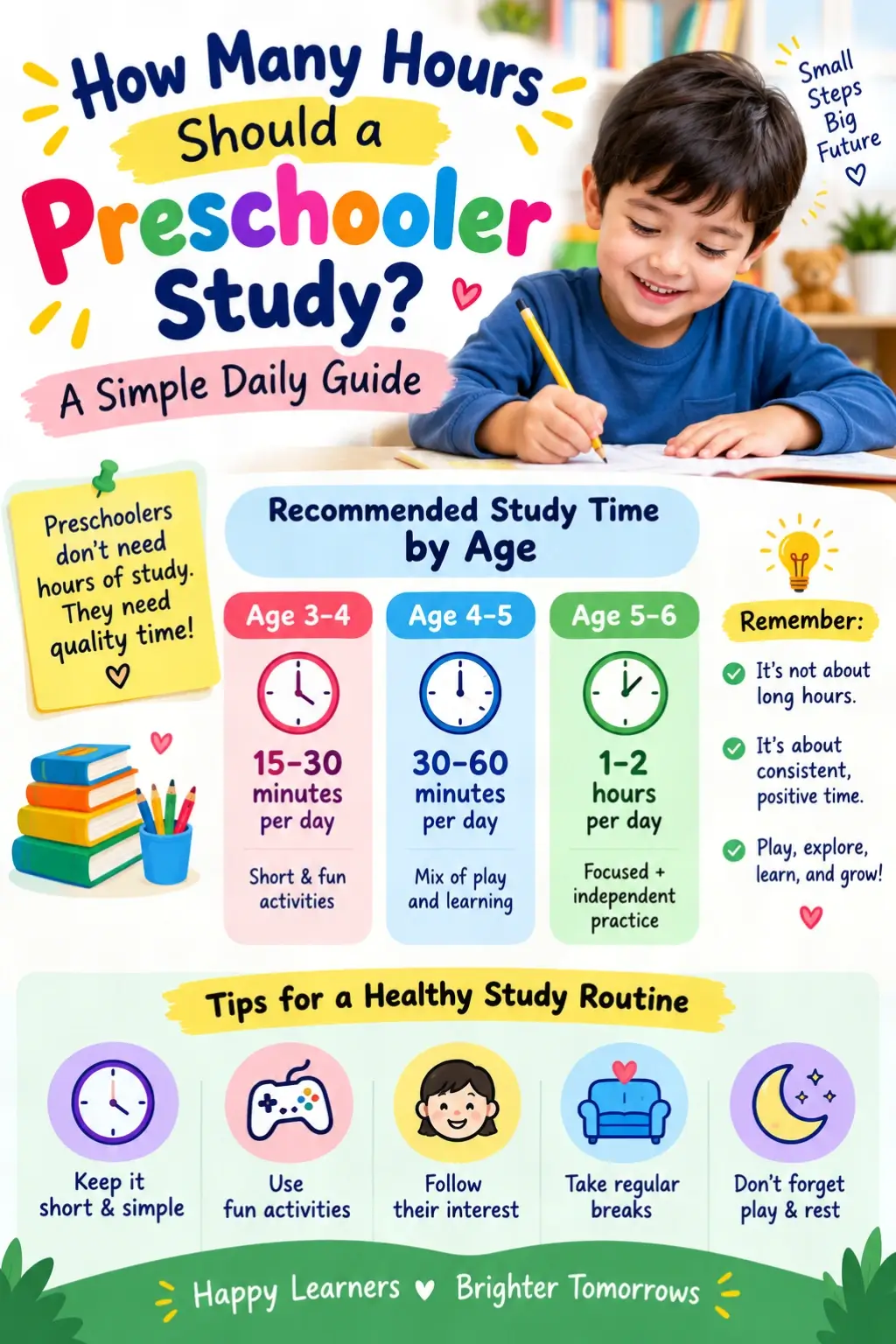
If you’re wondering how many hours a preschooler should study each day, you’re probably already noticing something important: young children don’t learn the same way older schoolchildren do.
A preschooler may happily spend 20 minutes drawing, listening to a story, counting objects, or working on a puzzle. Then five minutes later, they’re ready to run around the room.
That’s normal.
I see this with my little girl, Hafsa. Some days she can stay with an activity because she’s interested in it. Other days, she needs to move on quickly. I don’t try to force the same amount of “study time” every day.
For preschool children, the better question is often how much focused learning can they handle comfortably while still getting plenty of play, movement, sleep, and family time?
So, how many hours should a preschooler study?
There isn’t one official number of study hours that applies to every preschooler.
For home learning, a practical starting point is about 30 to 60 minutes of planned, focused learning spread across the day for many preschoolers. This doesn’t have to happen in one sitting.
A 3-year-old may need very short sessions, while a 5-year-old who enjoys structured activities may comfortably handle several short learning periods.
The rest of the child’s day should include free play, active movement, books, conversations, creative activities, meals, family time, outdoor time, and rest.
That’s very different from asking a preschooler to sit at a desk for two or three hours.
Current guidance for children ages 3–5 emphasizes active play across the day. The Australian Government recommends at least 3 hours of physical activity throughout the day, including about an hour of energetic activity. It also advises breaking up long periods of sitting.
So I would think about the day as a learning-and-play routine, rather than a study schedule.
Related Posts:
👉 25 Best Educational Activities for Preschoolers
👉 20 Best Preschool Learning Activities for 5-Year-Olds
👉 25 Best Preschool Learning Activities for 4-Year-Olds
👉 30 Best Preschool Learning Activities for 3-Year-Olds
How much focused learning is suitable by age?
Every child is different, but you can use age as a rough starting point.
| Age | Suggested planned learning at home | How to divide it |
|---|---|---|
| 3 years | About 15–30 minutes | Very short activities |
| 4 years | About 20–45 minutes | 2–3 small sessions |
| 5 years | About 30–60 minutes | Several short sessions |
These are practical ranges, not medical or developmental requirements.
A child might happily spend 30 minutes building something one day and lose interest after 10 minutes the next day.
That’s okay.
The activity, the child’s mood, sleep, interest, and the rest of the day’s routine all matter.
What counts as “study” for a preschooler?
This is where many parents accidentally make the day harder than it needs to be.
Learning doesn’t only happen when a child is sitting with a worksheet.
Reading a picture book together counts.
Talking about what you see outside counts.
Counting apples while putting groceries away counts.
Building something and figuring out why it falls over is learning too.
Helping you sort laundry can involve colors, matching, and classification.
The U.S. Department of Education’s early-childhood guidance emphasizes that preschool activities can be simple parts of everyday routines, and that children don’t all learn the same things at exactly the same rate.
So your child’s total learning time can be much larger than the amount of time you formally label as “study.”
A better preschool day: study, play, and rest
A healthy preschool routine has different kinds of activities.
For example:
Morning
- Breakfast and conversation
- 10–15 minutes of focused learning
- Free play
- Outdoor movement
Late morning
- Story or book time
- Creative activity
- Snack
- Independent play
Afternoon
- Another 10–20 minute learning activity
- Outdoor play
- Household activity
- Quiet time
Evening
- Family conversation
- Picture books
- Calm play
- Bedtime routine
You don’t have to follow these times exactly.
The idea is simply to avoid turning the entire day into a series of lessons.
Why preschoolers shouldn’t study for several hours at a time
Young children are still developing their ability to maintain attention, control their bodies, remember instructions, and manage frustration.
Long periods of sitting can make learning feel tiring.
And once a child becomes frustrated or mentally tired, adding another worksheet usually doesn’t solve the problem.
The American Academy of Pediatrics’ HealthyChildren guidance describes playful learning as an important part of early childhood and recommends balancing structured learning with unstructured play, movement, social interaction, and everyday experiences.
Preschoolers need opportunities to explore things on their own, too.
How long should one preschool learning session be?
Short sessions usually work better than one long lesson.
You could try:
For a 3-year-old:
5–10 minutes at a time
For a 4-year-old:
10–15 minutes at a time
For a 5-year-old:
10–20 minutes at a time
These aren’t strict limits.
If your 4-year-old is deeply interested in a book and wants to continue for 25 minutes, there’s no reason to stop just because the clock says 15 minutes.
And if your child loses interest after six minutes, there’s no prize for making them sit for another nine.
What should a preschooler do during study time?
Keep the activities varied.
You might rotate between:
- Storybooks
- Letter and sound practice
- Simple writing
- Counting
- Number games
- Puzzles
- Drawing
- Cutting and pasting
- Music
- Conversation
- Simple science exploration
- Matching and sorting
- Building
- Memory games
- Early problem-solving
You don’t need to cover everything every day.
One day might naturally be more focused on language. Another might include more numbers and building.
A simple 30-minute preschool learning routine
If you want a starting point, try this:
10 minutes: language
Read a short story together.
Ask one or two questions about it.
“What happened first?”
“Which character did you like?”
“Why did the character do that?”
10 minutes: early maths
Use objects your child can touch.
Count them, compare groups, look for patterns, or solve a very simple number problem.
10 minutes: hands-on activity
Let your child draw, build, create, investigate, or work on a simple puzzle.
Then stop.
Your child can move into free play or another part of the daily routine.
What about preschool worksheets?
Worksheets can be part of a preschool routine, but they don’t need to take up the whole learning period.
For example, your child might spend 10 minutes doing a tracing or counting worksheet and then spend another 10 minutes using toys to practice the same idea.
That’s often more interesting than completing page after page.
And if your child is clearly tired, you can stop the worksheet and come back another day.
Should preschoolers study every day?
A little learning every day can be useful, but “study” doesn’t need to look the same each day.
Reading together can happen daily.
Conversation happens throughout the day.
Play happens every day.
You can add a short structured activity on most days if your child enjoys it.
There may also be days when the best thing you can do is go outside, visit family, run errands together, or let your child have a long stretch of uninterrupted play.
Those experiences still contribute to learning.
How much play does a preschooler need?
A lot.
For children ages 3–5, the Australian Government recommends at least three hours of physical activity spread throughout the day, including energetic activity.
Play also supports thinking, communication, social development, creativity, and problem-solving.
The Raising Children Network describes play as a major way preschoolers develop their ability to think, communicate, remember, imagine, and work out what might happen next.
So play shouldn’t be treated as something that happens only after the “real learning” is finished.
For preschoolers, play is part of the learning.
How much sleep does a preschooler need?
Sleep deserves a place in this conversation because a tired child usually won’t get much from extra study time.
The CDC recommends 10–13 hours of sleep per 24 hours for children ages 3–5, including naps.
That means a preschool schedule should leave enough room for a consistent bedtime and adequate rest.
If you have to choose between squeezing in another worksheet and protecting your child’s sleep routine, sleep deserves much more attention.
Signs your child may be studying too much
There isn’t a magic number of minutes that automatically means “too much.”
Instead, watch your child.
You may need to reduce structured learning if your child regularly:
- Becomes very frustrated during simple tasks
- Avoids learning activities
- Has trouble staying engaged even with favorite activities
- Becomes unusually irritable after study sessions
- Needs constant pressure to continue
- Has very little time for free play
- Is missing outdoor movement or family time
- Is going to bed late because of learning activities
One difficult day doesn’t mean you’ve scheduled too much.
Look for a pattern.
Signs your preschool routine is balanced
A balanced routine usually leaves room for different kinds of experiences.
Your child gets opportunities to:
- Learn something new
- Play independently
- Play with other children
- Move their body
- Listen to stories
- Talk with adults
- Create things
- Help with simple tasks
- Rest
- Sleep enough
The NSW Government’s guidance for children ages 3–5 also recommends building learning into normal routines through play, outdoor activities, family conversations, chores, and simple kitchen activities.
That can make a big difference for parents who feel they have to “teach” all day.
What if my child wants to study for longer?
That’s fine.
If your child is genuinely interested in a book, puzzle, writing activity, building project, or another learning task, you don’t have to stop just because the planned time has finished.
Follow the interest.
Just make sure the overall day still includes movement, free play, meals, rest, social interaction, and sleep.
A child who spends 40 minutes happily working on something is having a different experience from a child who spends 40 minutes being pressured to finish a worksheet.
What if my child doesn’t want to study?
Don’t turn every learning activity into a battle.
Try changing the format.
If your child doesn’t want to practice letters on paper, read a book.
If they don’t want to count objects, use a song or a game.
If they don’t want to sit at the table, try a movement-based activity.
And sometimes, simply stop.
You can try again later.
Preschool children are still learning how to manage attention and emotions. A short positive experience is often more useful than a long argument.
Should parents create a strict preschool timetable?
A routine can help, but it doesn’t need to be rigid.
Young children often benefit from knowing what comes next.
For example:
Wake up → breakfast → learning → play → snack → outdoor time → lunch → quiet time → play → family time → bedtime
The exact clock times don’t matter nearly as much as having a predictable rhythm.
Makoons’ preschool schedule guidance similarly recommends balancing short learning periods with outdoor play, creative activities, family time, meals, and rest rather than keeping children in study mode all day.
A sample preschool home schedule
Here’s one simple example for a child who isn’t spending the whole day at preschool.
| Time | What to do |
|---|---|
| 7:00 | Wake up and get ready |
| 7:30 | Breakfast |
| 8:00 | Free play |
| 9:00 | 10–15 minutes of focused learning |
| 9:20 | Free or outdoor play |
| 10:30 | Snack and conversation |
| 11:00 | Story or creative activity |
| 12:00 | Lunch |
| 1:00 | Quiet time or nap |
| 2:30 | Free play |
| 3:30 | 10–20 minutes focused learning |
| 4:00 | Outdoor activity |
| 6:00 | Family time |
| 7:00 | Dinner |
| 7:30 | Books and bedtime routine |
| 8:00 | Sleep |
This is an example, not a required timetable.
Your child’s preschool schedule, nap needs, family routine, and bedtime may look completely different.
What if my child already attends preschool?
Then you don’t necessarily need to add another long study session at home.
Ask what your child already does at preschool.
If they spend several hours there learning, playing, socializing, moving, listening to stories, creating, and participating in classroom activities, home can be a much more relaxed environment.
You might simply:
- Read a book together
- Talk about their day
- Practice something they enjoyed at school
- Let them play
- Spend time outdoors
- Help with a small household task
Home doesn’t have to become a second classroom.
How parents can make learning time more effective
Keep the setup simple.
Choose one activity.
Explain what you’re doing.
Let your child try.
Give them time to think.
Help when they need it.
Then move on when the activity is finished.
You can also let your child choose between two options.
“Do you want to read a story or do the number game first?”
A little choice can make the child feel involved in the routine.
The CDC also recommends giving preschoolers limited, simple choices as part of supporting their growing independence.
Frequently asked questions
How many hours should a 3-year-old study?
A 3-year-old usually doesn’t need hours of formal study at home. Around 15–30 minutes of planned learning spread across short sessions can be a reasonable starting point, alongside plenty of play, movement, stories, conversation, and everyday learning.
How many hours should a 4-year-old study?
Around 20–45 minutes of planned learning spread across the day can work well for many 4-year-olds. Some children will want more when they’re interested, while others will need shorter sessions.
How many hours should a 5-year-old study?
Around 30–60 minutes of planned learning across several short sessions is a practical starting point for many 5-year-olds. The rest of the day should include play, movement, reading, social interaction, daily routines, and rest.
Should a preschooler study for 2 hours a day?
There is no general need for a preschooler to spend two hours doing formal academic work at home. If a child enjoys a long project, that’s different from requiring two hours of worksheets or desk work.
Is 1 hour of study enough for a preschooler?
For many preschoolers, one hour of planned learning spread across several short sessions is plenty. Remember that reading, conversation, play, household tasks, exploration, and outdoor experiences can also support learning.
Should preschoolers study every day?
A daily routine can include some learning, but it doesn’t need to be formal study every day. Reading, talking, playing, helping around the house, and exploring the world are all useful learning experiences.
How long should a preschooler sit and study?
Keep individual sessions short and adjust them according to your child’s age and attention. Around 5–10 minutes may work for a younger preschooler, while a 5-year-old may manage 10–20 minutes for an engaging activity.
Is play more important than study for preschoolers?
Preschoolers need both structured learning and play. Play gives children opportunities to move, communicate, imagine, experiment, solve problems, and interact with others. Current guidance strongly supports active play and reducing long periods of sitting.
Final thoughts
There isn’t a magic number of study hours that makes a preschooler learn better.
For most children, short periods of focused learning are enough.
The bigger picture matters more.
A preschooler needs time to play, move, talk, listen to stories, explore, create, help with everyday tasks, spend time with family, and sleep well.
I don’t want Hafsa’s whole day to feel like a school day. I want her to have time to be curious about things, make a mess, ask questions, play, and discover something without me turning it into a lesson.
That’s why I’d rather have a child spend 15 happy minutes learning something than an hour sitting at a table feeling frustrated.
At this age, learning happens throughout the day. The goal is to give it enough structure to be useful while leaving plenty of room for childhood.
Resources
https://gokulpreschool.com/how-many-hours-should-a-preschool-child-spend-in-school/
https://makoons.com/blogs/study-and-play-schedule-for-preschool-kids
https://krazytots.com/blog/how-many-hours-should-a-preschool-child-spend-in-school/
https://lemontreepreschool.co.uk/how-many-hours-a-day-should-a-child-attend-preschool/
https://www.quora.com/How-many-hours-should-a-4-5-year-old-kid-study