
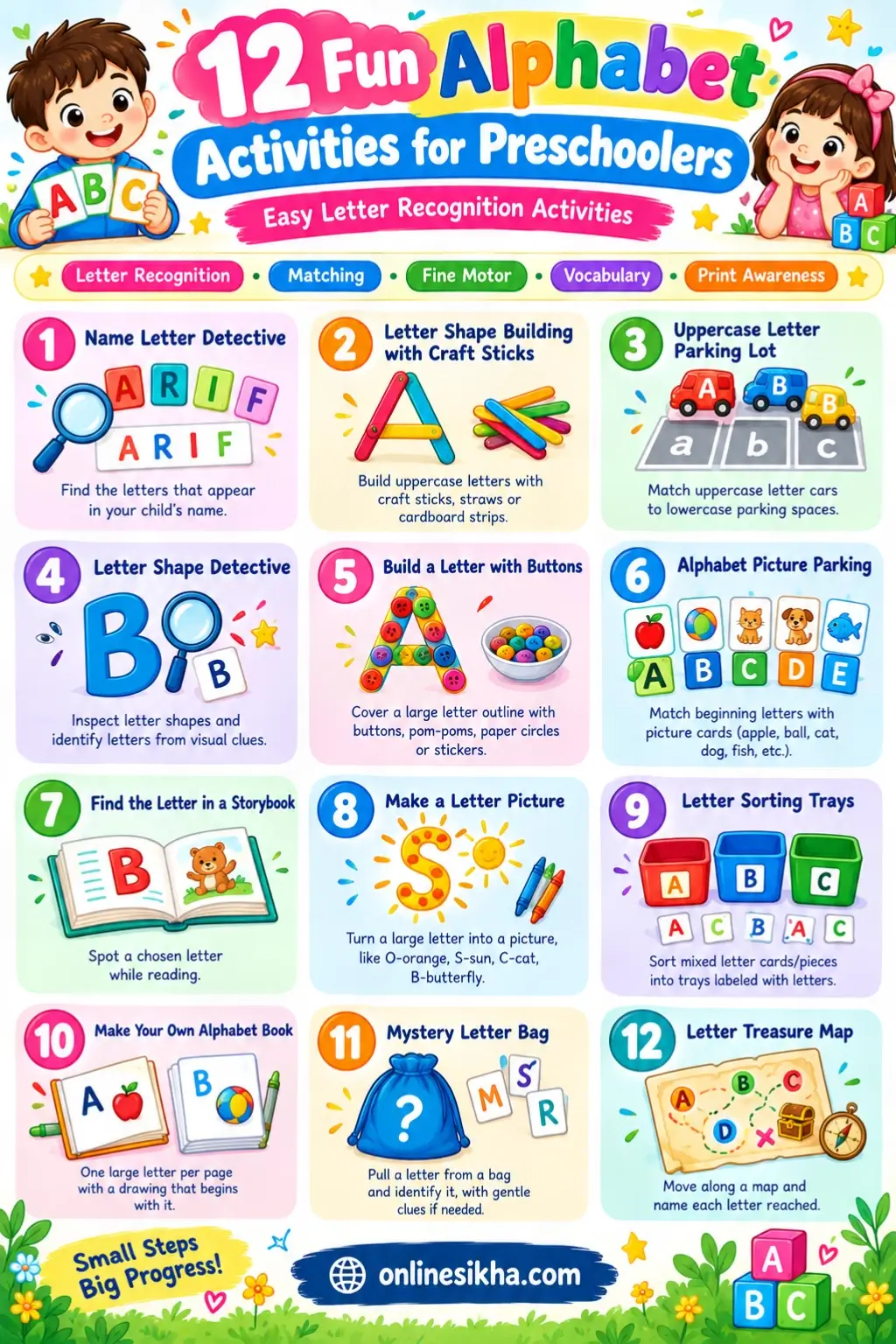
Learning the alphabet does not have to mean sitting at a table and memorizing 26 letters. For preschoolers, letters become much easier to remember when children can see, touch, move, create, and play with them.
These simple alphabet activities for preschoolers are designed to make early literacy enjoyable while helping children recognize uppercase and lowercase letters. They also give children opportunities to notice letter shapes and connect familiar letters with sounds and words.
You do not need expensive materials for most of these learning activities. A few paper cards, household objects, crayons, stickers, or blocks can turn everyday play into useful letter recognition activities for preschoolers.
Why Are Alphabet Activities Important for Preschoolers?
Letter recognition is one of the early skills that supports later reading and writing. Before children can read words, they need opportunities to notice and name individual letters.
Preschool children can gradually learn to:
- Recognize familiar uppercase letters
- Recognize lowercase letters
- Match uppercase and lowercase letters
- Notice differences between similar-looking letters
- Connect some letters with their sounds
- Recognize letters in their own names
- Become familiar with the shapes of letters
- Develop fine-motor skills through hands-on alphabet play
The goal at this age is not to make children memorize the entire alphabet quickly. Short, playful practice is often more appropriate than long lessons.
🔥 Related: How Many Hours Should a Preschooler Study? A Simple Daily Guide
12 Fun Alphabet Activities for Preschoolers
Here are some simple educational activities you can use at home, in preschool, or during homeschool learning.
1. Name Letter Detective
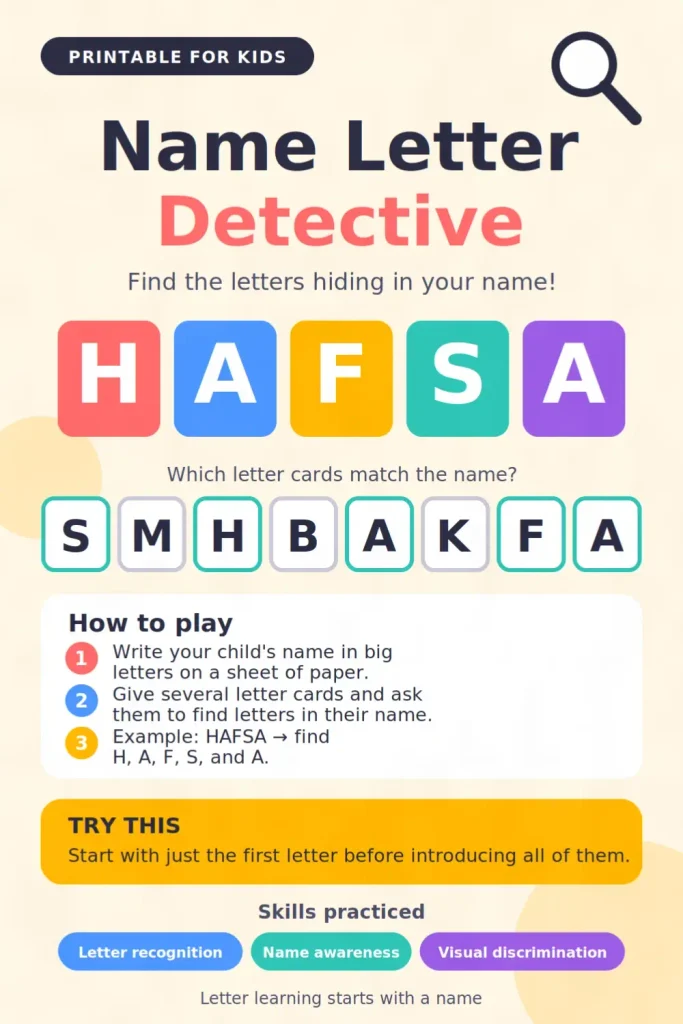
Children usually have a strong interest in their own names, which makes the name a natural starting point for letter learning.
Write your child’s name on a sheet of paper in large letters. Give your child several letter cards and ask them to find the letters that appear in their name.
For example, if the name is HAFSA, your child can search for H, A, F, S, and A.
Try this: Start with the first letter of the child’s name before introducing all of the letters.
Skills practiced: Letter recognition, name awareness, visual discrimination.
2. Letter Shape Building with Craft Sticks
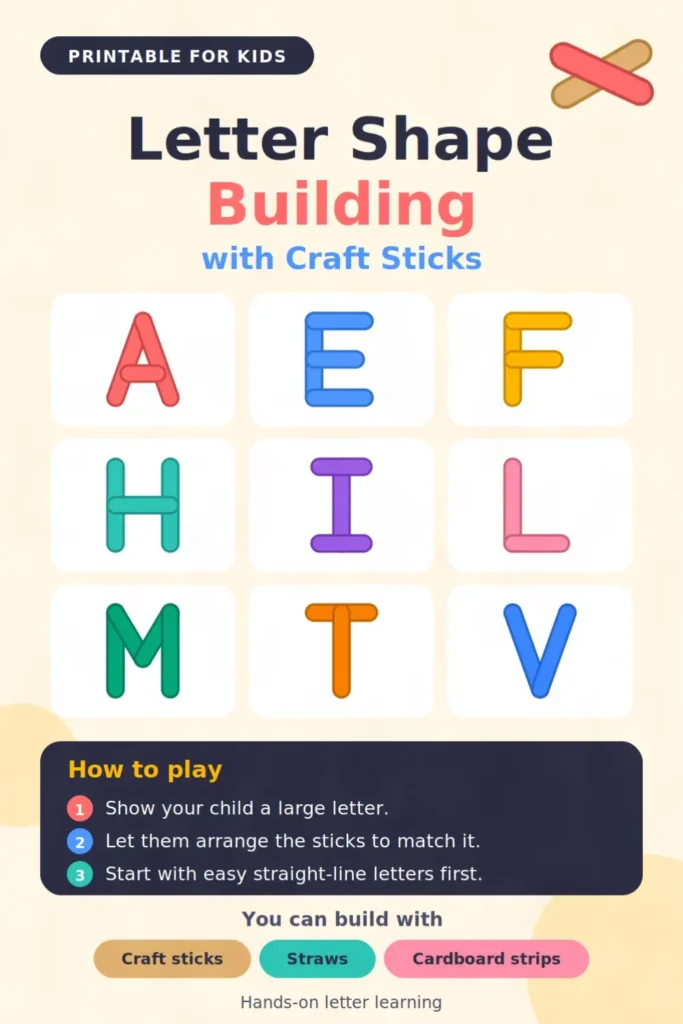
Use craft sticks, straws, or small strips of cardboard to build simple uppercase letters.
Start with letters that are easy to construct using straight lines, such as A, E, F, H, I, L, M, T, and V.
Show your child a large letter and let them arrange the sticks to make the same shape.
Ask:
“What letter did you make?”
This activity helps children pay attention to the individual parts and shapes that make up a letter.
Skills practiced: Letter recognition, visual discrimination, fine-motor coordination.
3. Uppercase Letter Parking Lot
Draw several parking spaces on a large sheet of paper. Write one lowercase letter in each space.
Next, write the matching uppercase letters on small pieces of paper and attach them to toy cars.
Invite your child to “drive” each car into its matching parking space.
For example, a car labeled B should park in the space marked b.
Start with only five or six letter pairs instead of using the entire alphabet at once.
Skills practiced: Uppercase-lowercase recognition, visual matching, hand-eye coordination.
4. Letter Shape Detective
Instead of asking children to identify letters immediately, encourage them to look closely at how letters are formed.
Place several letter cards on a table. Ask questions such as:
- “Which letter has a big circle?”
- “Can you find a letter with two straight lines?”
- “Which letter has a curved side?”
- “Can you find a letter that looks like a tall stick?”
Once your child finds the letter, say its name together.
This turns letter recognition into a simple visual investigation.
Skills practiced: Visual discrimination, letter identification, vocabulary.
5. Build a Letter with Buttons
Draw a large uppercase letter on paper. Give your child buttons, pom-poms, small paper circles, or stickers.
Ask the child to place the objects along the letter’s outline.
For example, draw a large S and let your child cover its shape with small objects.
As they work, repeat the letter name naturally: “You’re making an S!”
Safety note: Small objects should be used only with children who are past the stage of putting objects in their mouths and should always be supervised.
Skills practiced: Letter formation awareness, fine-motor skills, concentration.
6. Alphabet Picture Parking
Create two groups of cards: letter cards and picture cards.
Choose a few simple picture words such as:
- Apple
- Ball
- Cat
- Dog
- Fish
Place one letter beside each picture. Ask your child to decide which beginning letter belongs with each picture.
For younger preschoolers, focus on recognizing the letter rather than expecting them to explain the sound independently.
Skills practiced: Letter recognition, beginning-sound awareness, vocabulary.
7. Find the Letter in a Storybook
Choose a familiar picture book and pick one letter for the activity.
For example, tell your child:
“Today we’re looking for the letter B.”
While reading, pause occasionally and look at the printed words together. Whenever your child spots a B or b, they can point to it.
Do not worry about finding every occurrence. The purpose is to help children notice that letters appear naturally in books.
Skills practiced: Letter recognition, print awareness, attention.
8. Make a Letter Picture
Choose one letter and turn it into a simple picture.
For example:
- O → Orange
- S → Sun
- C → Cat
- B → Butterfly
Write the letter in a large size and let your child add drawings around it.
You can say the letter name and the picture word together: “S is for sun.”
This creates a visual connection between the letter and a familiar object.
Skills practiced: Letter recognition, vocabulary, creativity, beginning-sound awareness.
9. Letter Sorting Trays
Prepare three or four small containers or sections on a tray. Label each section with a different letter.
Give your child a mixture of letter cards or letter pieces.
The child picks one letter at a time and places it into the correct section.
For example, if the tray has A, M, and S, the child sorts all of the A’s together, all of the M’s together, and all of the S’s together.
Begin with letters that look noticeably different.
Skills practiced: Letter identification, visual matching, sorting, concentration.
10. Make Your Own Alphabet Book
Create a simple homemade alphabet book using folded paper or individual pages.
Give your child one page at a time. Write one large letter on each page and let your child draw something that begins with that letter.
You do not have to complete A–Z in one sitting.
One or two letters at a time is plenty for a preschooler.
Over time, the pages can become a personal alphabet book that your child can look through again and again.
Skills practiced: Letter recognition, vocabulary, drawing, print awareness.
11. Mystery Letter Bag
Put several large letter cards into a bag.
Let your child reach inside and choose one without looking.
Ask:
“What letter did you find?”
If your child does not know it, give a gentle clue rather than immediately providing the answer.
For example:
“This is the first letter in your name.”
After identifying the letter, place it on the table and continue with another card.
Skills practiced: Letter recognition, memory, tactile exploration, speaking.
12. Letter Treasure Map
Create a simple paper “treasure map” with several large letters hidden along a path.
Give your child a small toy figure or counter to move along the path.
When the child reaches a letter, they name it before moving forward.
You can make the game easier by using only letters your child already knows.
As recognition improves, add one or two unfamiliar letters.
Skills practiced: Letter recognition, visual attention, following directions, memory.
Easy Ways to Make Letter Recognition Easier
Some preschoolers recognize letters quickly, while others need much more repetition. That’s completely normal.
Try these simple approaches:
Start with familiar letters
Your child’s name is an excellent place to begin. Familiar letters can give children a sense of success before they work with less familiar ones.
Introduce a few letters at a time
You do not need to put all 26 letters in front of a young learner. A small group of letters can make the activity less overwhelming.
Use uppercase and lowercase gradually
Children eventually need to recognize both forms, but you can introduce them in manageable steps. Once a child is comfortable with an uppercase letter, begin showing its lowercase partner.
Repeat without making it feel like a test
The same letter can appear in books, signs, toys, art projects, and everyday objects. Repeated exposure helps children become more familiar with letter shapes.
Keep activities short
A five- or ten-minute activity can be enough. If your child loses interest, stop and try again another day.
Should Preschoolers Learn Letters in Alphabetical Order?
Not necessarily.
The traditional A to Z sequence is useful for learning the alphabet song and understanding alphabetical order, but children do not have to master letters strictly from A through Z.
You can introduce letters that are especially meaningful to the child, such as the letters in their name, alongside other developmentally appropriate letters.
Some early-literacy approaches also introduce letters based on their usefulness for building sound and word connections rather than simply following alphabetical order.
The most important thing is consistent, enjoyable exposure.
A Simple Weekly Alphabet Routine
You can keep alphabet learning very simple.
| Days | Activities |
|---|---|
| Monday | Introduce one or two letters with cards. |
| Tuesday | Build the letters using craft materials. |
| Wednesday | Look for the letters in a storybook. |
| Thursday | Play a letter-matching or sorting game. |
| Friday | Draw a picture connected to one of the letters. |
The following week, review the previous letters and introduce another small group.
This kind of routine gives children repeated practice without making alphabet learning feel like homework.
Final Thoughts
The best alphabet activities for preschoolers do more than ask children to memorize letters. They give children opportunities to recognize letters in different forms, talk about them, touch them, build them, and discover them during everyday play.
Try a few letter recognition activities for preschoolers and pay attention to which ones your child enjoys most. Some children love movement and games, while others prefer drawing, building, books, or hands-on activities.
Keep the learning playful, repeat familiar letters often, and introduce new ones gradually. With regular exposure, preschoolers can build a strong foundation for the reading and writing skills that come next.
Frequently Asked Questions
What are the best alphabet activities for preschoolers?
Hands-on activities such as name-letter games, uppercase-lowercase matching, letter sorting, letter building, alphabet books, and finding letters in storybooks can make alphabet learning engaging for preschoolers.
How can I teach letter recognition to my preschooler?
Start with a few familiar letters and practice them through short games, books, drawing, matching, and everyday activities. Gradually introduce more letters as your child becomes comfortable.
Should a 3-year-old know all the letters?
Preschool children develop at different rates. Some three-year-olds recognize many letters, while others are still becoming familiar with the alphabet. Focus on regular exposure and playful practice rather than expecting perfect mastery.
Should preschoolers learn uppercase or lowercase letters first?
Both are important. Many preschool activities begin with uppercase letters because their shapes can be easier for young children to distinguish, followed by lowercase forms. The best approach is gradual exposure to both.
Resources:
https://www.abcmouse.com/learn/activities/letter-recognition-activities-for-preschoolers/25750
https://ca.pinterest.com/howweelearn/preschool-alphabet-activities/
https://www.preschoolplayandlearn.com/alphabet/