Four-year-olds are ready for a little more challenge.
They can follow several steps, explain what they’re thinking, recognize more letters and numbers, and stay with an interesting activity for longer. But they still learn best when they can move, talk, touch, pretend, and experiment.
I see this with my little girl, Hafsa. When an activity feels like a game, she’s much more willing to keep trying. Give her a small problem to solve or something new to figure out, and suddenly learning feels like play.
That’s why I like using simple preschool learning activities for 4-year-olds instead of turning every learning moment into a lesson.
Experts recommend activities at this age that build speaking and listening, vocabulary, early literacy, numeracy, coordination, and independence through everyday play. UNICEF’s play-based resources for children around ages 4 to 6 also include activities involving shapes, colors, quantities, storytelling, emotions, and problem-solving.
You can do many of these activities at home with things you already have.
What should a 4-year-old learn through play?
At four, children are beginning to connect ideas together.
Instead of only naming a color, for example, they can describe two objects as “the big blue one” or explain why they chose something. They can also start using numbers, letters, sounds, stories, measurements, and simple reasoning during everyday activities.
Your activities can gently support:
- Listening and speaking
- Vocabulary development
- Letter and sound awareness
- Early reading skills
- Name recognition and writing
- Counting and number sense
- Simple addition and subtraction
- Measurement
- Problem-solving
- Memory and attention
- Following directions
- Fine-motor control
- Creativity and imagination
- Social and emotional skills
- Independence
The goal isn’t to finish every skill in one sitting. A five-minute game that your child actually enjoys can be more useful than a long activity they don’t want to do.
Related Posts:
👉 25 Best Educational Activities for Preschoolers
👉 How Many Hours Should a Preschooler Study?
👉 20 Best Preschool Learning Activities for 5-Year-Olds
👉 30 Best Preschool Learning Activities for 3-Year-Olds
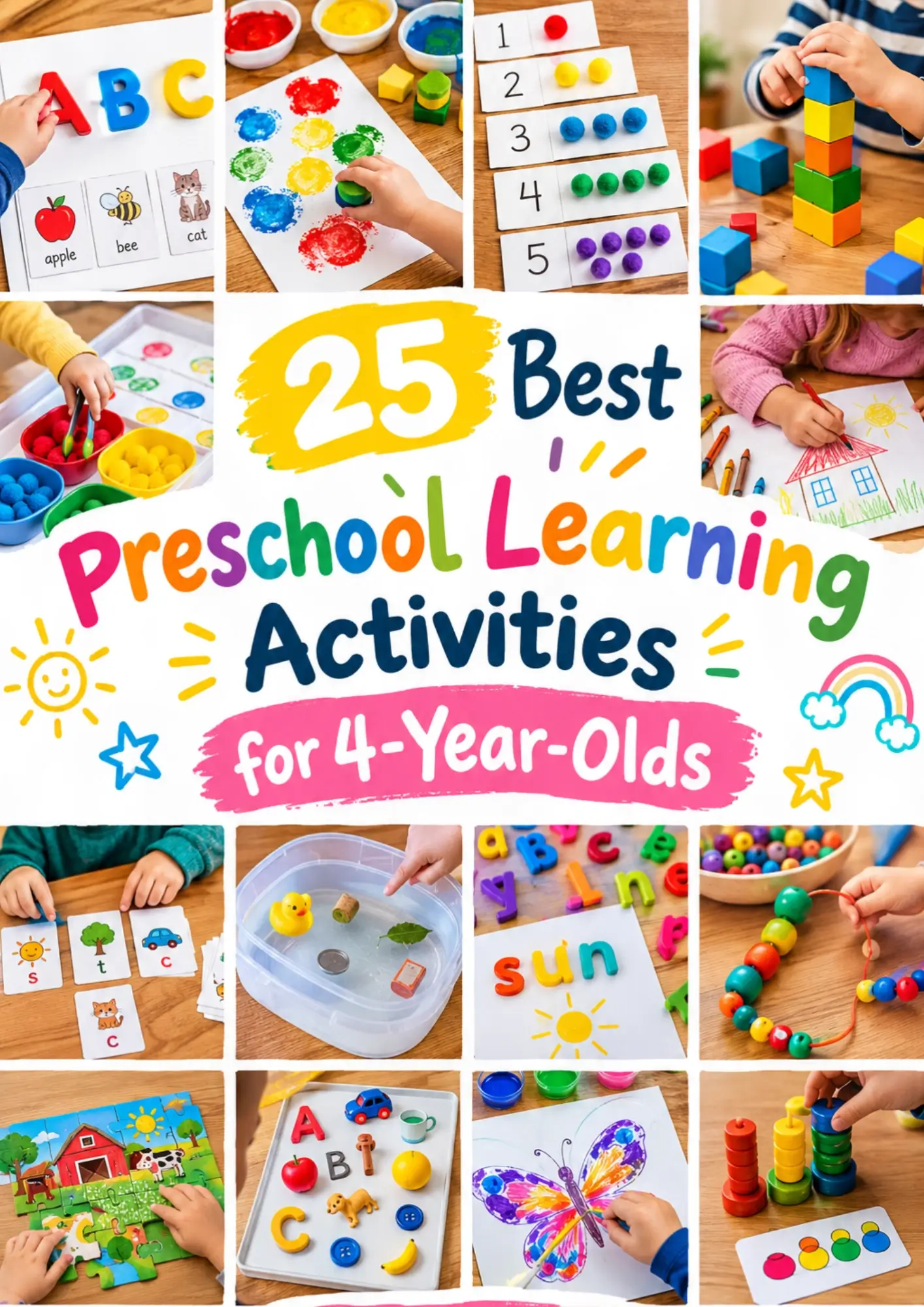
25 preschool learning activities for 4-year-olds
1. Make a name puzzle
Write your child’s name in large letters on a strip of paper. Cut between the letters and mix the pieces.
Ask your child to put the letters back in the correct order.
Once they understand the basic idea, make another version using a family member’s name. You can also ask, “Which letter comes first?” or “Can you find the letter H?”
Skills practiced: Name recognition, letter awareness, visual memory, sequencing.
2. Play an “I spy” sound game
Choose a sound rather than a letter.
For example, say, “I spy something that starts with /b/.”
Your child can look around the room for a ball, book, bottle, bag, or another object with that beginning sound.
Oxford Owl also recommends simple sound and rhyme games for children around the 4–5 age range because they give children practice listening closely to sounds in words.
Skills practiced: Listening, beginning sounds, vocabulary, phonological awareness.
3. Make a silly rhyming basket
Place a few familiar objects in a basket.
Pick one, such as “cat,” and ask your child to think of words that rhyme with it. They can use real words or silly words such as “zat” or “lat.”
You can make the game harder by giving two words and asking whether they rhyme.
Skills practiced: Listening, rhyming, vocabulary, sound awareness.
4. Build a sentence from picture cards
Draw or print three simple pictures: a child, a dog, and a ball.
Ask your child to make a sentence using all three.
Maybe they’ll say, “The boy plays with the dog and ball.” That’s great. Let the sentence be theirs.
Add more pictures when they’re ready and encourage them to tell a tiny story using the cards.
Skills practiced: Vocabulary, sentence formation, storytelling, imagination.
5. Clap the parts of a word
Choose familiar words and clap as you say them.
“Ap-ple” gets two claps.
“Ba-na-na” gets three.
Try your child’s name, family names, animals, foods, and favorite toys. You can turn it into a guessing game by clapping first and asking what word might fit.
Skills practiced: Listening, syllable awareness, speech rhythm.
6. Make a number path
Write numbers from 1 to 10 on separate pieces of paper and place them on the floor.
Ask your child to stand on number 4, then move forward two spaces.
“Where did you land?”
Later, start with a larger number and ask your child to move backward.
Skills practiced: Number recognition, counting, sequencing, early addition and subtraction.
7. Play “one more, one less”
Put four buttons, blocks, or toy animals on the table.
Ask, “What happens if I add one?”
Then try, “What happens if I take one away?”
Keep the numbers small so your child can physically see what is happening.
This makes early addition and subtraction easier to understand because the child is working with real objects.
Skills practiced: Quantity, addition, subtraction, number sense.
8. Go on a measurement hunt
Give your child a piece of string.
Find several objects around the house and compare their lengths.
Ask:
“Which is longer?”
“Which is shorter?”
“Can you find something about the same length?”
You can later use blocks as informal measuring units. For example, “The book is six blocks long.”
Skills practiced: Comparison, measurement, mathematical language.
9. Make a pretend shop
Turn a small table into a grocery store.
Use empty food packages or pretend food. Give each item a simple price, such as 1, 2, or 3.
Your child can be the shopkeeper while you become the customer. Then swap roles.
Ask your child to count the items, choose what costs more, or give you three things from the “shelf.”
Skills practiced: Counting, communication, memory, decision-making, pretend play.
10. Follow a three-step direction
Four-year-olds can begin practicing directions with several steps.
Try:
“Get your cup, put it on the table, and bring me the spoon.”
Or:
“Find the red pencil, put it beside the book, and sit on the chair.”
Keep the instructions playful. If your child forgets one step, simply repeat it.
Skills practiced: Listening, working memory, sequencing, following directions.
11. Play a memory tray game
Put five familiar objects on a tray.
Let your child look at them for about 30 seconds. Cover the tray and secretly remove one object.
Then ask, “What’s missing?”
Start with three objects if five feels difficult.
You can make the game harder by changing the position of two objects instead of removing one.
Skills practiced: Memory, observation, concentration, visual attention.
12. Make a simple treasure map
Draw a very simple map of one room.
Mark the sofa, table, door, and another familiar object.
Hide a toy and add a simple X to show where it is.
Let your child follow the map to find the treasure.
Later, ask your child to draw a map for you.
Skills practiced: Spatial awareness, following directions, drawing, problem-solving.
13. Play a position-word game
Use a toy car or stuffed animal.
Ask your child to put it:
- Under the chair
- Beside the box
- Behind the pillow
- In front of the book
- Between two toys
- On top of the table
Then let your child give you the directions.
Kids often enjoy being the teacher.
Skills practiced: Spatial language, listening, communication, following directions.
14. Create a “what comes next?” story
Tell a very short story with three events.
“For example, Sara put on her shoes. She opened the door. Then…”
Stop there.
Ask your child what they think happens next.
There can be several good answers. The point is to get your child thinking about sequence and cause and effect.
Skills practiced: Storytelling, prediction, sequencing, imagination.
15. Make a beginning-middle-end book
Fold a few pieces of paper together.
Ask your child to draw three parts of a story:
- What happened first?
- What happened next?
- How did the story end?
You can write down your child’s words underneath the drawings.
Don’t worry about perfect spelling. At this age, the child’s ideas and language are more important than producing a polished book.
Skills practiced: Story structure, speaking, drawing, early writing.
16. Play emotion charades
Write or draw simple emotions such as happy, sad, angry, surprised, worried, and excited.
Choose one without showing your child.
Act it out using your face and body.
Ask your child to guess the emotion. Then swap roles.
UNICEF includes emotion-recognition activities for children around ages 4 to 6, including activities that connect facial expressions with emotions.
Skills practiced: Emotional vocabulary, observation, empathy, communication.
17. Make a feelings thermometer
Draw a line from calm to very upset.
Talk about different situations and ask your child where they think each feeling belongs.
For example:
“You can’t find your favorite toy.”
“Grandma visits.”
“Someone takes your toy.”
“Your friend gives you a gift.”
There isn’t always one correct answer. Talk about why your child chose a particular place.
Skills practiced: Emotional awareness, communication, self-expression.
18. Try a simple science prediction
Fill two cups with water.
Put different safe objects into them and ask your child to predict what will happen before you test them.
You can try a sponge, plastic spoon, stone, leaf, or toy.
The interesting part comes before the answer. Ask, “Why do you think that?”
Skills practiced: Prediction, observation, reasoning, vocabulary.
19. Watch ice melt
Put an ice cube in a bowl.
Ask your child what they think will happen if you leave it in a warm room.
Check it after five minutes, then again later.
You can ask:
“Is it bigger or smaller?”
“What changed?”
“Where did the water come from?”
Skills practiced: Observation, prediction, describing change, early science thinking.
20. Mix colors and make a color chart
Give your child small amounts of washable paint in two colors.
Let them mix the colors and see what happens.
Try combinations such as blue and yellow or red and yellow.
UNICEF also includes color-mixing activities for children ages 4 to 6, with the activity encouraging children to experiment while completing the task.
Create a small chart showing the two starting colors and the new color they made.
Skills practiced: Observation, color recognition, experimentation, fine-motor control.
21. Make a rhythm copy game
Tap a simple rhythm on the table.
For example:
Tap, tap, pause, tap.
Ask your child to copy it.
Then let your child create a rhythm for you to copy.
You can use spoons, hands, cups, or simple musical instruments.
Skills practiced: Listening, memory, rhythm, attention, coordination.
22. Play freeze-and-move
Put on some music and let your child move.
When the music stops, everyone freezes.
Make different challenges:
“Freeze like a statue.”
“Freeze with one hand up.”
“Freeze like a sleeping cat.”
This turns a simple movement game into a listening activity.
Skills practiced: Listening, self-control, balance, body awareness.
23. Make a symmetry painting
Fold a piece of paper in half.
Put a few drops of washable paint on one side. Fold the paper, press gently, then open it.
Your child will see a mirrored design.
Talk about what looks the same on both sides.
Skills practiced: Fine-motor control, observation, creativity, early understanding of symmetry.
24. Use tweezers for a sorting challenge
Give your child child-safe tweezers or kitchen tongs and a few large objects that can be handled safely.
Ask them to move the objects from one bowl to another.
Then add a sorting rule.
“For example, put the soft objects in this bowl and the hard ones in that bowl.”
You can also sort by color, type, or size.
Skills practiced: Hand strength, coordination, classification, concentration.
25. Cook something simple together
Cooking gives you plenty of natural learning opportunities.
Ask your child to count four strawberries, add two spoonfuls of an ingredient, compare which bowl has more, or help measure something with an adult.
Oxford Owl specifically suggests cooking as a way to introduce counting, measuring, estimating, and mathematical language during an everyday activity.
And children usually don’t mind practicing math when there’s a snack waiting at the end.
Skills practiced: Counting, measuring, vocabulary, following instructions, independence.
How long should learning activities last for a 4-year-old?
You don’t need to plan long lessons.
Some activities might last five minutes. Others can continue for 20 minutes because your child is genuinely interested.
I usually prefer following the child’s attention rather than watching the clock.
If Hafsa is enjoying a game, I’ll let it continue. If she’s clearly finished, there’s little value in pushing her through another round.
A useful routine might look like this:
| Time | Activity |
|---|---|
| 10 minutes | Story, rhyme, or conversation |
| 10–15 minutes | Early math or literacy game |
| 15–20 minutes | Creative or hands-on activity |
| 10 minutes | Movement game |
| Throughout the day | Learning through everyday tasks |
You can spread these activities across the day rather than doing them all together.
A simple weekly learning plan for 4-year-olds
You can also give each day a loose focus.
| Day | Main activity | Extra learning |
|---|---|---|
| Monday | Name and sound games | Storytelling |
| Tuesday | Number path and counting | Pretend shop |
| Wednesday | Science experiment | Drawing observations |
| Thursday | Story-making | Emotion game |
| Friday | Cooking activity | Measurement |
| Saturday | Music and movement | Memory game |
| Sunday | Free play | Child’s favorite activity |
This gives you structure without making home learning feel like school.
How to make these activities easier
Start with fewer objects.
If a memory game uses five objects and your child struggles, use three. If a three-step direction is too much, give two steps.
You can also demonstrate the activity once before asking your child to try.
For example, if you’re playing a measurement game, show your child how to compare two objects first. Then let them take over.
How to make them more challenging
Once your child understands an activity, change one part.
For a number game, increase the numbers slightly.
For a story game, add another picture.
For a memory game, add one more object.
For a direction game, add another step.
You don’t need to make everything harder. Just look for the moment when your child starts saying, “That’s easy!”
That’s usually a good time to add a small challenge.
Should 4-year-olds use preschool worksheets?
Yes, worksheets can be useful when they’re one part of a bigger learning routine.
At four, children may enjoy activities such as tracing letters, recognizing numbers, matching beginning sounds, counting pictures, identifying shapes, coloring, and simple early writing practice.
But hands-on learning still matters.
For example, after a worksheet about the number 5, you could ask your child to find five toys. After a letter worksheet, look around the room for objects beginning with that sound.
That connection helps the worksheet feel meaningful.
What if my 4-year-old doesn’t want to learn?
Take a break.
Four-year-olds can be very interested in something one day and completely uninterested the next.
Try changing the activity instead of insisting on the same one.
If your child doesn’t want to practice numbers on paper, count toy cars. If they don’t want to draw a story, let them tell you the story while you draw.
Learning can happen in many forms.
UNICEF’s play-based approach also emphasizes opportunities for play, learning, creative expression, and quality time between children and adults.
Common mistakes to avoid
Making every activity feel like a test
Ask questions, but don’t turn every answer into a correction.
If your child gives an unusual answer during a story activity, ask them to explain their thinking.
Doing too much at once
One good activity is enough.
You don’t need five worksheets, three games, and a craft every afternoon.
Expecting perfect writing
Four-year-olds are still developing the hand control needed for writing.
Let them draw, paint, build, cut with supervision, use play materials, and manipulate objects alongside early writing activities.
Comparing children
Children develop at different speeds.
One child may love letters while another spends months interested in counting or pretend play. Follow those interests while continuing to offer different kinds of activities.
How do I know if an activity is working?
Look beyond whether your child gets the answer right.
Ask yourself:
- Did my child understand the instructions?
- Did they try to solve the problem?
- Could they explain what they were doing?
- Did they ask a question?
- Did they try again after making a mistake?
- Did they enjoy participating?
Those are useful signs that the activity is doing its job.
Frequently asked questions
What are the best preschool learning activities for 4-year-olds?
The best activities are ones that match your child’s interests while giving them a small learning challenge. Story-making, sound games, counting games, pretend shops, simple science experiments, measurement activities, cooking, memory games, and movement games are all useful options.
What should a 4-year-old learn at home?
A 4-year-old can practice language, early reading skills, numbers, counting, measurement, problem-solving, fine-motor skills, creativity, emotional vocabulary, and following directions through everyday play.
How can I teach my 4-year-old letters?
Use games rather than relying only on writing practice. Try name puzzles, beginning-sound games, letter hunts, rhyming activities, picture cards, and simple letter-matching games.
How can I teach math to a 4-year-old?
Use real objects. Count toys, compare quantities, play a pretend shop, measure objects with blocks, move along a number path, and practice one more or one less with small groups of objects.
Are worksheets good for 4-year-olds?
Worksheets can support early literacy and math practice, especially when they’re short and age-appropriate. They work best alongside hands-on activities, conversation, stories, movement, and creative play.
How long should a preschool learning activity last?
There isn’t one perfect length. A short activity may last five minutes, while a favorite game or creative project can continue much longer. Follow your child’s attention and interest.
What can I do if my child gets bored quickly?
Change the format. Turn a worksheet into a movement game, use toys instead of paper, add pretend play, or let your child choose between two activities.
Final thoughts
Preschool learning activities for 4-year-olds can be wonderfully simple.
You can turn a grocery trip into a counting game, a kitchen activity into a measuring lesson, a story into a prediction game, or a few household objects into a memory challenge.
That’s what I love about learning at this age. You don’t need a classroom full of equipment.
You need time together, a little creativity, and activities that give your child something interesting to figure out.
And when you follow your child’s curiosity, you may find that some of the best learning moments happen when you weren’t planning a lesson at all.
Resources
https://www.youtube.com/watch?v=5-flsloEj_4
https://www.unicef.org/northmacedonia/play-based-learning-activities-children-aged-3-10