
A good preschool classroom can get loud. Someone is building a tower, another child is painting, two kids are arguing over a toy truck, and one child is quietly looking at a book in the corner.
That kind of classroom can still be a very good place to learn.
Preschoolers learn through movement, conversation, pretend play, hands-on materials, stories, and small discoveries. NAEYC recommends learning experiences that fit children’s age, individual needs, interests, language, and culture.
So when you’re planning classroom activities for preschoolers, think about what children can touch, move, say, build, draw, sort, test, and explain.
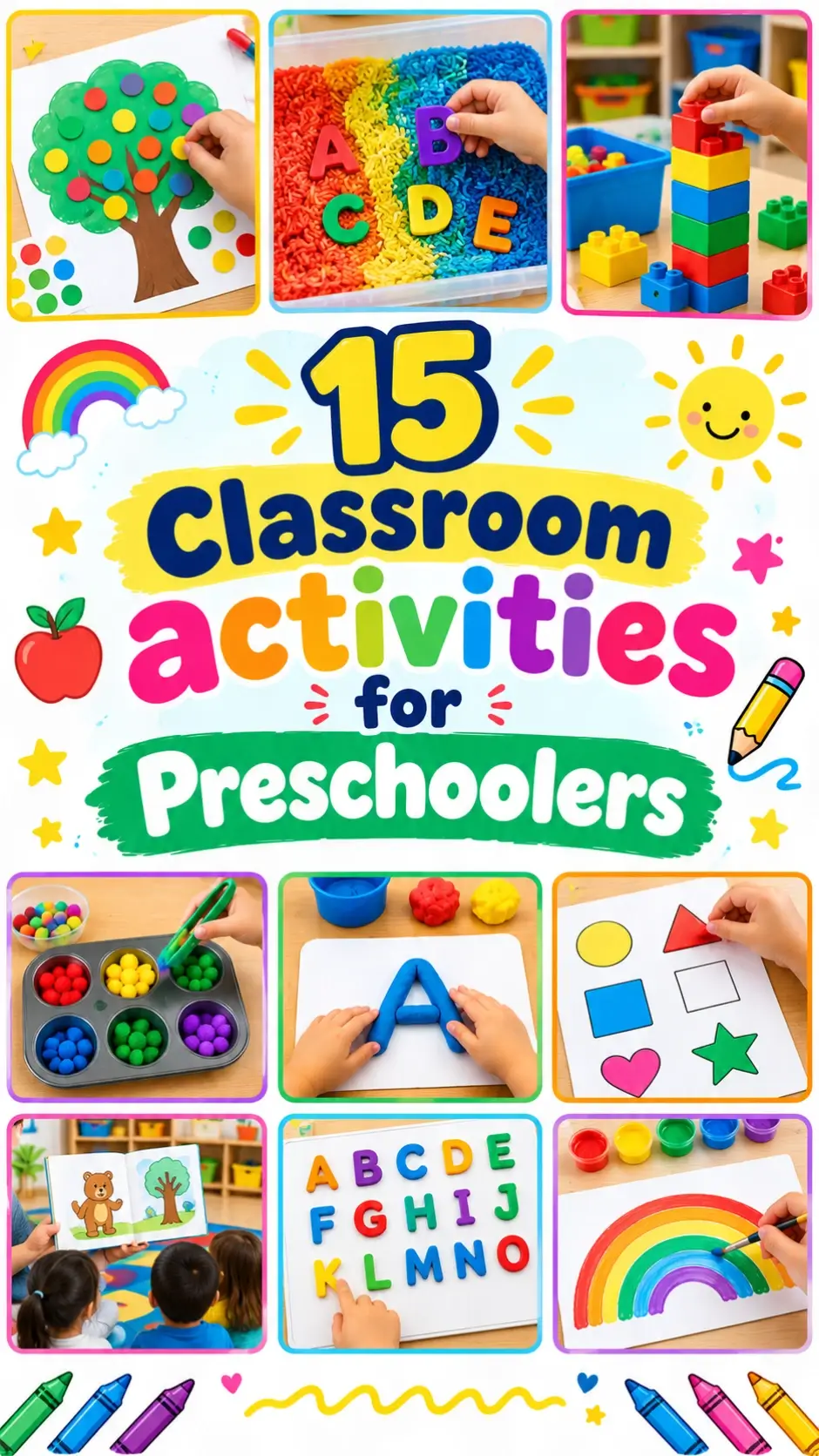
Here are 15 classroom-friendly activities that work well for ages 3 to 5.
What makes a good preschool classroom activity?
A useful classroom activity usually has a simple goal and enough room for children to make their own choices.
For example, you might want children to practice comparing sizes. Give them several objects and let them decide how to arrange them. You can ask questions as they work instead of giving every step.
This fits the idea of guided play. The teacher sets up the learning experience, while children still have room to make decisions and explore.
A strong preschool classroom also needs variety. Head Start guidance calls for teacher-directed and child-initiated activities, active and quiet learning, and individual, small-group, and large-group experiences.
If you’re building a wider collection of ideas, start with these best educational activities for preschoolers.
15 classroom activities for preschoolers
1. Classroom helper chart
Create a simple chart with classroom jobs such as book helper, plant helper, table helper, toy collector, and line leader.
Let children take turns choosing or receiving a job.
This gives them a reason to practice following routines, remembering instructions, and taking responsibility for something that belongs to the whole group.
For younger children, use pictures beside each job. A photo of a watering can can represent the plant helper, for example.
2. Build a classroom town
Put cardboard boxes, blocks, toy people, paper signs, and small vehicles in the block area.
Ask the children to build places they know: a house, shop, school, clinic, park, or bus stop.
Then let them decide where everything should go.
You can introduce simple vocabulary such as next to, behind, near, and between while they build. It also gives children a natural reason to talk to each other.
If your class enjoys learning about shapes, you can connect this activity with these shape recognition activities for preschoolers.
3. Classroom name card hunt
Write each child’s name on a separate card.
Place the cards around the classroom and invite children to find their own name. Once they find it, they can bring it back to the group table.
For ready children, ask them to find a friend’s name too.
You can extend the activity by asking, “Which letter do you see at the beginning?” This works especially well when children already recognize some letters.
For more letter practice, you can connect it with these alphabet activities for preschoolers.
4. Mystery texture table
Put several safe classroom materials into small trays or containers. Try cotton, a smooth stone, felt, a sponge, a wooden block, a piece of cardboard, and a soft fabric.
Children touch one item without looking and describe how it feels.
Ask questions such as:
- Is it soft or hard?
- Is it smooth or rough?
- Is it heavy or light?
- Which item feels similar?
This works well as a small-group activity because children get plenty of time to talk.
You can also connect sensory exploration with fine motor activities for preschoolers by adding scooping, pinching, pouring, or transferring materials.
5. Classroom sound walk
Take the children on a slow walk around the classroom.
Ask them to listen carefully for sounds. Maybe they hear a chair moving, paper tearing, water running, a pencil tapping, or someone opening a drawer.
Stop after each sound and ask children what they heard.
For children who are working on language and early literacy, you can add a few beginning-sound questions. These beginning sound activities for preschoolers can give you more ideas for that skill.
Keep this one short. Preschoolers don’t need a 20-minute listening lesson.
6. Feelings check-in board
Create a board with simple faces showing feelings such as happy, sad, angry, tired, worried, and excited.
When children arrive, they can place their name or photo beside the face that matches how they feel.
You can ask one simple follow-up question: “What happened?”
Some children will want to talk. Others won’t. Give both choices.
This can become part of the morning routine and gives teachers a quick way to notice how children are arriving each day.
For more conversation-based activities, try Who Am I preschool activities.
7. Rhyme basket
Put a few familiar objects or picture cards into a basket.
Take out one item and say its name. Then ask children if they can think of a word that rhymes with it.
If you’re holding a cat picture, children might suggest hat or bat.
Silly answers are fine. Preschoolers usually enjoy making up funny rhymes, and that playfulness keeps the activity moving.
You can build this into a literacy center alongside these fun rhyming activities for preschoolers.
8. What grows here?
Place pictures of foods on a table and ask children where each food grows.
Use examples such as carrots, bananas, tomatoes, potatoes, and apples.
Children can place each picture under categories such as underground, on a plant, on a tree, or above the ground.
This gives you a simple science and vocabulary activity without turning it into a lecture.
You can continue the topic with where food grows preschool activities or foods that grow on trees.
9. Animal home building
Give children small animal figures, blocks, paper, cardboard tubes, and natural materials such as sticks or leaves.
Ask each child to build a home for an animal.
A child might make a nest for a bird, a den for a bear, or a small shelter for a rabbit.
Then ask, “What does your animal need inside its home?”
This activity combines pretend play, vocabulary, building, and early science. You can extend it with more animal home activities for preschoolers.
10. Classroom snack shop
Set up a pretend shop using empty food boxes, play food, paper bags, and pretend money.
One child can be the shopkeeper while others choose items.
Ask simple questions:
“How many apples did you buy?”
“Which bag has more?”
“Can you give me 2 bananas?”
This is a nice way to bring math into dramatic play. For more ideas, see these math activities for preschoolers.
You can also turn the pretend shop into a real food-preparation activity on another day with these preschool cooking activities.
11. Number parking garage
Draw parking spaces on cardboard and write different numbers on them.
Give children toy cars with matching number cards.
They drive each car to the correct parking space.
For younger children, use numbers 1 to 5. Older preschoolers can work with larger numbers.
You can also ask children to compare two spaces: “Which number comes first?” or “Which number is bigger?”
If your class is working on number recognition, these number recognition activities for preschoolers can give you more classroom ideas.
12. Classroom counting collection
Give each small group a tray and a collection of classroom objects.
Children choose one type of object and count how many they have. They might count 7 blocks, 5 toy animals, or 9 crayons.
The teacher can record the number on a simple card.
Then ask, “Who has more?” or “Who has fewer?”
This connects naturally with counting activities for preschoolers and which has more preschool activities.
Keep the objects large enough for safe handling and supervise closely when small items are involved.
13. Paper weaving station
Give children strips of paper and a larger piece of paper with simple slits cut into it.
Children weave the strips over and under the slits.
You can use 2 colors and ask children to create their own arrangement.
This takes patience and hand control. It also gives children a chance to make something that looks different depending on the choices they make.
For more early hand and writing preparation, see pre-writing activities for preschoolers and pencil grip activities for preschoolers.
14. Weather window chart
Choose a classroom window as the daily weather spot.
Each morning, one child checks outside and chooses a weather card: sunny, cloudy, rainy, windy, or stormy.
Add the card to a weekly chart.
At the end of the week, count how many sunny or rainy days you had.
Now one small routine has turned into observation, vocabulary, counting, and simple data collection.
You can make the chart more interesting by letting children draw what they see outside.
15. Classroom pattern necklace
Give children large paper shapes or foam pieces with holes and pieces of yarn.
Start with a simple pattern such as circle, square, circle, square.
Children continue the pattern and then create their own.
Once they finish, ask them to explain their pattern to a friend.
This is a different way to work on patterns without relying on the usual block or snack activities. For more ideas, see these pattern activities for preschoolers.
Classroom activities by age
Classroom activities for 3-year-olds
Three-year-olds usually do well with short activities that involve movement, real objects, repetition, and simple choices.
Try:
- classroom helper jobs
- name card hunting
- texture exploration
- simple counting collections
- weather cards
- animal home building
Give directions one step at a time.
If you’re planning a full set of ideas for this age, see these preschool learning activities for 3-year-olds.
Classroom activities for 4-year-olds
Four-year-olds can usually handle activities with 2 or 3 steps.
Try:
- building a classroom town
- pretend shopping
- rhyme games
- animal home construction
- simple pattern making
- weather charts
You can start asking children to explain why they made a choice.
These preschool learning activities for 4-year-olds are useful when you’re planning a wider classroom routine.
Classroom activities for 5-year-olds
Five-year-olds are often ready for longer projects and more detailed conversations.
Try:
- creating a classroom map
- making simple class charts
- building pretend stores
- explaining patterns
- counting and comparing collections
- creating group stories from classroom objects
Give them jobs that involve planning and decision-making.
For more ideas, see preschool learning activities for 5-year-olds.
Mix quiet and active classroom activities
A preschool day can feel much easier when you alternate between movement and quieter work.
After a building or movement activity, you might move children to a book corner, drawing table, puzzle area, or small-group activity.
A classroom doesn’t need every child doing the same thing at the same time. Learning centers can give children different ways to work with the same theme. The New York State Education Department lists areas such as blocks, dramatic play, literacy, creative arts, math, sensory, science, writing, music, and a cozy corner.
You can read more about how many hours a preschooler should study when planning the balance between structured learning and other parts of the day.
Add literacy to everyday classroom play
You don’t need to create a separate literacy lesson every time.
Put books in the block area. Add labels to classroom objects. Keep paper and pencils near pretend play. Put simple letter cards near a writing station.
Children can also practice Bengali letters if Bengali is part of your classroom language. These Bengali alphabet learning activities for preschoolers can fit nicely into a language center.
For more focused writing practice, you can use number tracing activities for preschoolers.
Bring science into the classroom
Science for preschoolers can be very simple.
Give children something to observe and ask what they notice.
A class studying animals might investigate Arctic animals. A class reading Where the Wild Things Are can use Where the Wild Things Are preschool activities to connect a story with movement, art, and pretend play.
The teacher’s questions matter here.
“What do you think will happen?”
“What did you notice?”
“What changed?”
Those questions can turn a 5-minute observation into a real conversation.
Add movement during the day
Preschoolers spend a lot of time learning with their whole bodies.
Try a short movement break between table activities. Children can walk like different animals, follow a simple movement sequence, carry classroom materials, or move between marked spots on the floor.
You can also use an educational games for preschoolers session when the class needs a playful group activity.
Keep the rules simple enough that children can actually remember them.
Make math part of classroom routines
Math can happen while children are cleaning up, setting tables, lining up, building, or sharing materials.
Ask:
“How many children are here?”
“How many cups do we need?”
“Which tower is taller?”
“Can you give each friend 1 block?”
When children are ready, you can introduce simple addition through real classroom objects with these simple addition activities for preschoolers.
Subtraction can come later with familiar situations, such as removing toy animals from a group. These simple subtraction activities for preschoolers can help you plan those lessons.
Classroom activities that build hand skills
Preschool classrooms naturally provide many chances to use small hand movements.
Children can weave paper, manipulate blocks, turn pages, draw, squeeze, open containers, and use classroom tools.
For scissor practice, use cutting activities for preschoolers separately from your main classroom project so children can focus on learning how to control the scissors.
You can also bring color into the room with a simple matching station. These color matching activities for preschoolers can work well as an independent center.
A simple 5-day classroom plan
| Day | Main activity | Skill |
|---|---|---|
| Monday | Classroom helper chart | Routine and responsibility |
| Tuesday | Build a classroom town | Language and spatial thinking |
| Wednesday | Mystery texture table | Sensory exploration and vocabulary |
| Thursday | Classroom counting collection | Number sense |
| Friday | Paper weaving station | Hand control and patience |
You can repeat the same general routine while changing the materials and questions.
Children usually benefit from familiar routines. The content inside those routines can change.
Frequently asked questions
What are good classroom activities for preschoolers?
Good activities give preschoolers something to do with their hands, bodies, words, or ideas. Building, pretend play, sensory exploration, storytelling, counting, art, movement, and simple science investigations all work well.
How long should a preschool classroom activity last?
It depends on the children and the activity. A short 5-minute group activity can work well for younger preschoolers, while a child-chosen center may continue much longer.
Watch the children rather than forcing every activity into the same time slot.
How can I make classroom activities educational?
Choose one simple learning goal before you begin. Then give children materials and ask questions that help them notice, compare, count, describe, predict, or explain.
Should preschoolers use worksheets in the classroom?
Worksheets can be one tool, but preschool classrooms need plenty of hands-on experiences too. Texas prekindergarten guidance specifically describes learning centers as hands-on, open-ended experiences and recommends child-led writing experiences rather than worksheet-based writing practice.
How do I plan activities for mixed-age preschoolers?
Keep the same basic activity and change the level of challenge.
A 3-year-old might match 3 objects. A 5-year-old might count them, record the number, and compare the collection with a friend’s.
Can classroom activities support children who learn differently?
Yes. Give children different ways to participate.
A child might talk, point, build, draw, move, or use a picture card to show what they know. NAEYC’s developmentally appropriate practice framework asks educators to consider children’s individual development, language, culture, and abilities when planning learning experiences.
More preschool ideas
If you’re building a full preschool activity library, these topics can fit into different parts of your classroom plan:
- Fun activities for preschoolers
- Rhyming practice
- Number activities
- Fine motor practice
- Color matching
- Pre-writing practice
The best classroom usually has a little bit of everything: talking, moving, building, drawing, pretending, listening, counting, and plenty of time for children to make their own choices.