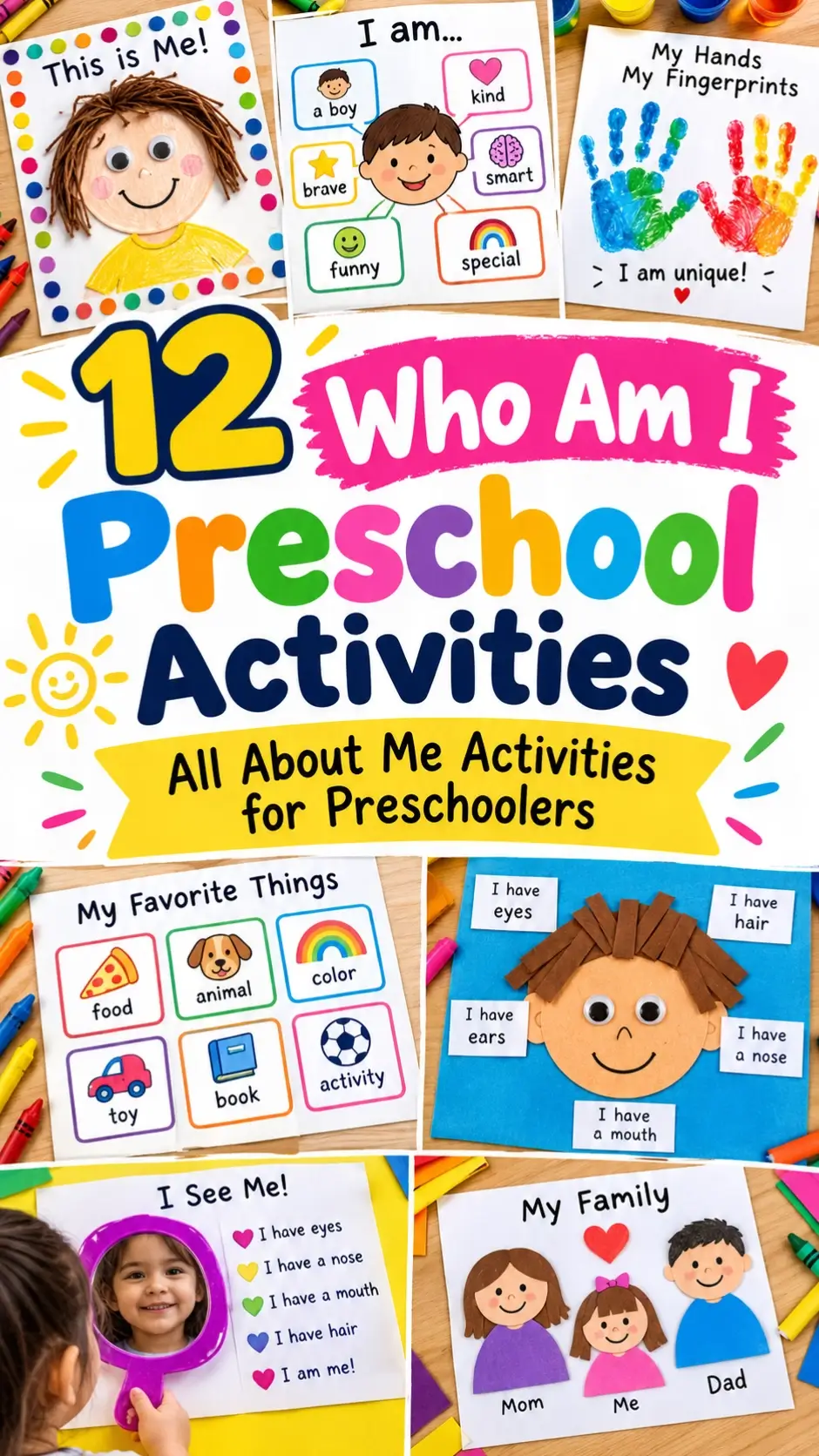
Preschool is a wonderful time for children to discover what makes them special. They are beginning to understand their likes and dislikes, recognize their emotions, talk about their abilities, and notice the ways they are similar to and different from other people.
That makes a Who Am I or All About Me theme especially useful for preschoolers.
These Who Am I preschool activities give children opportunities to talk, make choices, explore their personalities, and learn more about themselves. They also support communication, social-emotional development, observation, early math, and creative thinking.
Most of these preschool educational activities can be completed with simple items you already have at home or in the classroom.
Why Teach an All About Me Theme?
An All About Me theme gives preschoolers a chance to talk about things that are meaningful to them, including their preferences, feelings, abilities, routines, and experiences.
Activities around this theme can help children:
- Talk about themselves using simple sentences
- Express preferences and opinions
- Identify and describe emotions
- Recognize personal strengths and interests
- Practice listening to other children
- Notice similarities and differences respectfully
- Develop vocabulary
- Build confidence and independence
- Learn that every person is unique
All About Me activities are also useful for building classroom connections because children get opportunities to learn about one another.
12 Fun Who Am I Preschool Activities
1. My Favorite Things Basket
Give each child a small basket or box.
Ask them to choose three or four safe objects that represent things they enjoy. For example, a child might choose a toy car, a crayon, a small book, or a favorite stuffed animal.
Let the child show the objects to the group and talk about them.
You can ask:
- “What is this?”
- “Why do you like it?”
- “What do you like to do with it?”
For children who are still developing language skills, simply naming the objects is enough.
Skills practiced: Vocabulary, communication, self-expression, listening.
🔥 Related: 12 Fun Alphabet Activities for Preschoolers
2. Who Am I? Guessing Game
Choose one child or use a familiar character as the mystery person.
Give clues one at a time:
“This person likes bananas.”
“This person loves to jump.”
“This person has a red shirt.”
Children listen to the clues and try to guess who it is.
For a home activity, parents can describe the child:
“This person likes drawing and has a favorite blue cup.”
Then let the child guess.
As children become comfortable with the game, let them create clues about themselves.
Skills practiced: Listening, descriptive language, memory, reasoning.
3. My Superpower
Ask:
“What are you really good at?”
A preschooler might say:
- Running
- Building towers
- Singing
- Helping
- Drawing
- Cleaning up
- Making people laugh
Call the ability their “superpower.”
Skills practiced: Self-awareness, confidence, speaking, creativity.
4. I Like It / I Don’t Like It
Prepare pictures or objects representing familiar things such as:
- Apples
- Rain
- Dogs
- Dancing
- Ice cream
- Swimming
- Loud music
- Vegetables
Give children two spaces labeled “I Like It” and “Not for Me.”
Let each child place an item in the space that matches their opinion.
Talk about the results:
“You like apples, but Hafsa doesn’t. People can like different things.”
This is a simple way to introduce personal preferences while teaching children that different opinions are okay.
Skills practiced: Decision-making, vocabulary, social awareness.
5. My Daily Routine Cards
Create simple picture cards or flashcards showing parts of a child’s day:
Wake up → Get dressed → Eat → Play → Learn → Eat dinner → Sleep
Mix up the cards and ask your child to put them in the order that matches their own routine.
The activity becomes personal because children can talk about what they actually do.
Ask:
“What do you do after breakfast?”
or
“What do you do before bedtime?”
Skills practiced: Sequencing, communication, memory, time concepts.
6. How Do I Feel Today?
Place several simple emotion cards in front of your child, such as:
- Happy
- Sad
- Excited
- Tired
- Angry
- Worried
- Calm
Ask:
“Which one shows how you feel today?”
The child can point to a card rather than explaining if they aren’t ready to describe their feelings.
Follow up with:
“What happened that made you feel that way?”
Don’t pressure children to share personal information. Simply giving them a choice and emotion vocabulary is valuable.
Skills practiced: Emotional awareness, vocabulary, communication.
7. My Favorite Color Vote
Give each child several colored paper squares.
Ask:
“Which color do you like the most?”
Each child places one square under their chosen color.
Then count the choices together.
You can ask:
- “Which color has the most?”
- “Which color has the fewest?”
- “Did anyone choose the same color as you?”
This turns a simple personal preference into an early math activity.
Skills practiced: Counting, comparing, decision-making, vocabulary.
8. Same as Me, Different From Me
Pair two children or use a child and parent.
Say simple statements such as:
“We both like bananas.”
“You like drawing. I like building.”
“We both have two eyes.”
The important part is to keep the conversation positive. The purpose is to help children understand that people can share similarities while also having differences.
For younger preschoolers, use obvious and familiar examples.
Skills practiced: Observation, comparison, social awareness, language.
9. My Choice Story
Tell a short story with choices.
For example:
“Sam is going to the park. Should Sam take a ball or a book?”
Let your child choose.
Then continue:
“Sam is hungry. Would Sam like an apple or a sandwich?”
After several choices, ask the child to tell you what they would choose instead.
This turns an ordinary story into a conversation about personal preferences.
Skills practiced: Decision-making, listening, expressive language, imagination.
10. What Can My Hands Do?
Instead of focusing on naming body parts, explore what children can do with their hands.
Give them simple challenges:
- Clap
- Wave
- Stack blocks
- Turn a page
- Pick up a pom-pom
- Make a circle with their fingers
- Build something
After each challenge, talk about what their hands helped them accomplish.
You can say:
“Your hands helped you build that tower!”
This encourages children to think about their abilities and how their bodies help them interact with the world.
Skills practiced: Body awareness, fine-motor skills, observation, language.
11. My Favorite Sound
Ask children to think about sounds they enjoy.
Examples might include:
- Birds singing
- Rain
- Music
- A favorite song
- Animal sounds
- Laughter
- Ocean waves
Make or play a few simple sounds and let children identify which ones they enjoy.
Then ask:
“What is your favorite sound?”
Children can draw a picture showing where they hear that sound.
Skills practiced: Listening, sensory awareness, vocabulary, self-expression.
🔥 Related: 10 Beginning Sound Activities for Preschoolers
12. When I Grow Up…
Ask:
“What would you like to do when you grow up?”
A child might want to be a:
- Doctor
- Teacher
- Farmer
- Artist
- Chef
- Pilot
- Builder
- Animal doctor
There is no need to correct or evaluate their answer.
Ask them to explain:
“What would you do?”
This can become a wonderful conversation about imagination, interests, and the different kinds of work people do.
Skills practiced: Imagination, communication, vocabulary, future thinking.
Easy All About Me Questions for Preschoolers
If you’re looking for conversation starters, try simple questions that preschoolers can answer without much help:
- What is your favorite food?
- What game do you like to play?
- What makes you happy?
- What makes you laugh?
- What animal do you like?
- What is something you can do really well?
- What is your favorite color?
- What do you like to do with your family?
- What makes you feel calm?
- What would you like to learn?
- What is something you don’t like?
- What would you like to do when you grow up?
There is no need to ask all of these at once. One or two questions during everyday conversation can be enough.
A Simple 5-Day All About Me Plan
You don’t need to complete every activity in one week.
Here’s one simple way to organize the theme:
| Days | Activities |
|---|---|
| Monday | My Favorite Things Basket |
| Tuesday | Who Am I? Guessing Game |
| Wednesday | How Do I Feel Today? |
| Thursday | Same as Me, Different From Me |
| Friday | My Superpower and When I Grow Up |
Keep each activity short and leave plenty of time for conversation and free play.
Final Thoughts
Who Am I preschool activities give young children a meaningful reason to talk, make choices, listen, and express themselves.
At the same time, All About Me preschool activities can support much more than social-emotional learning. Children can practice counting, sequencing, vocabulary, observation, communication, and creative thinking while talking about things that are already important to them.
Frequently Asked Questions
What are Who Am I activities for preschoolers?
Who Am I activities help preschoolers learn about their own interests, feelings, abilities, preferences, routines, and personal experiences. They encourage children to talk about themselves while developing communication and self-awareness.
What are some good All About Me preschool activities?
Good preschool activities include favorite-things sharing, mystery-person guessing games, emotion choices, preference sorting, daily-routine sequencing, personal-strength discussions, and comparing similarities and differences.
Why is an All About Me theme important for preschoolers?
It gives children opportunities to develop self-awareness, communication, confidence, and social understanding. Children can also learn that other people may have different preferences, experiences, and abilities.
What questions can I ask during an All About Me activity?
Ask simple questions such as “What makes you happy?”, “What do you like to play?”, “What are you good at?”, and “What would you like to learn?” Choose questions that match the child’s age and language abilities.
How long should an All About Me preschool activity last?
Most activities can be kept to about 5–15 minutes, depending on the child’s interest. Conversation and play can continue naturally afterward.
Related: How Many Hours Should a Preschooler Study? A Simple Daily Guide