
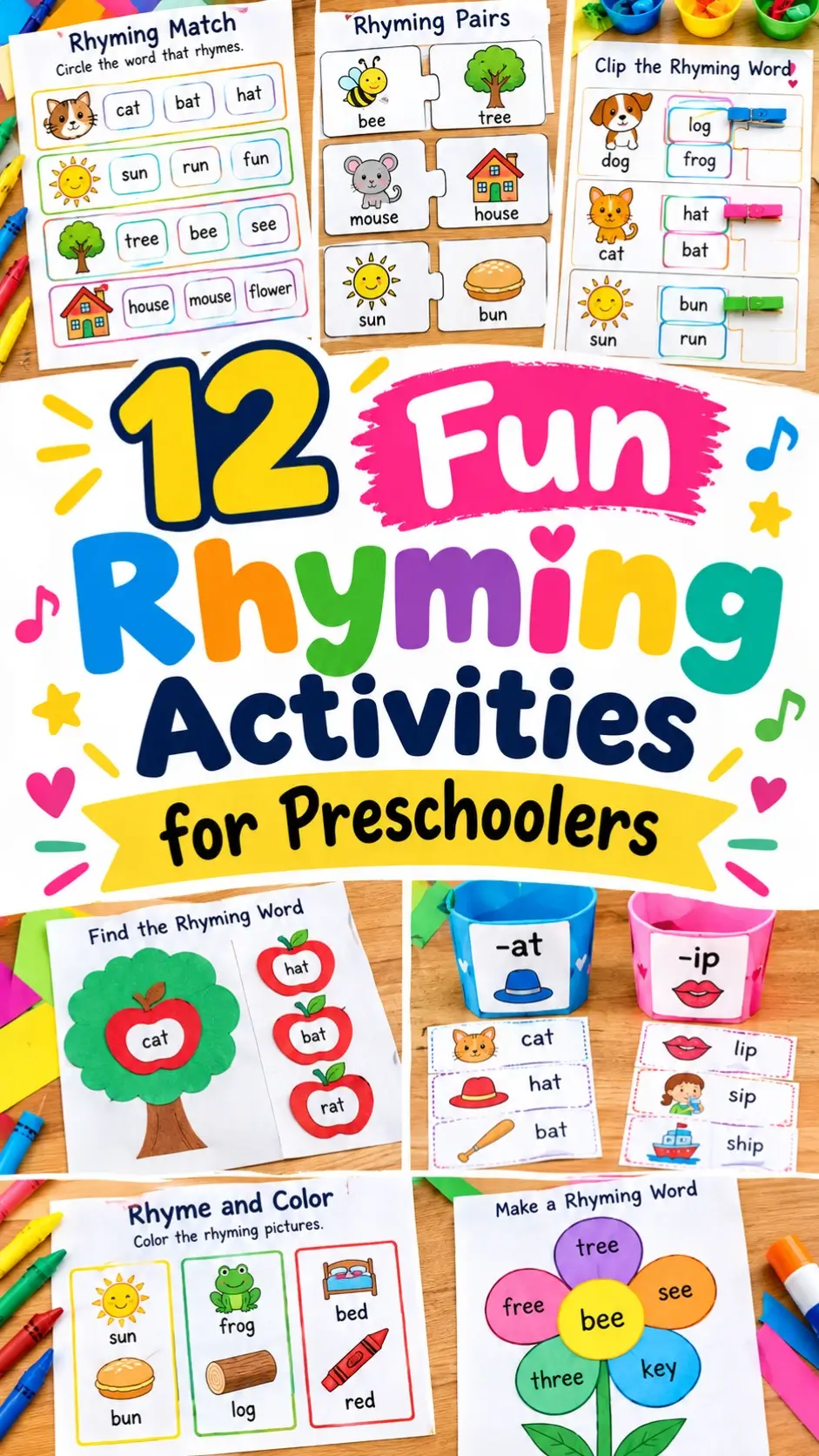
Rhyming is one of those early literacy skills that can develop naturally through songs, stories, silly words, and everyday conversation. Preschoolers don’t need formal reading lessons to begin noticing that cat and hat sound alike at the end.
The best fun rhyming activities for preschoolers give children plenty of opportunities to listen to words, recognize rhymes, and eventually think of their own rhyming words. Rhyming is one part of phonological awareness and can help children pay attention to sound patterns in spoken language.
For young preschoolers, simply recognizing that two words rhyme is enough. As children become more confident, you can ask them to produce their own rhymes.
What Is Rhyming?
Words rhyme when they have the same or similar ending sound, such as:
- cat – hat
- sun – fun
- boat – goat
- tree – bee
- sock – clock
- cake – snake
The words don’t have to be spelled the same way to rhyme. What matters is how they sound.
For preschoolers, it is usually easier to begin with hearing and recognizing rhymes before expecting them to create lots of rhyming words themselves. A developmental progression often moves from enjoying and repeating rhymes to recognizing them and eventually producing rhymes.
Why Are Rhyming Activities Important for Preschoolers?
Rhyming gives children a playful way to listen closely to language.
Regular rhyme experiences can help children:
- Develop phonological awareness
- Notice patterns in spoken words
- Listen for ending sounds
- Build vocabulary
- Improve listening skills
- Participate in songs and poems
- Become more comfortable playing with language
- Prepare for later phonics and reading instruction
Rhyming should not be treated as a test of reading ability. It is simply one enjoyable way to help children become more aware of the sounds in words.
🔥 Related: 12 Who Am I Preschool Activities
12 Fun Rhyming Activities for Preschoolers
1. Rhyme or Not? Listening Game
This is a simple activity for children who are just beginning to understand rhyming.
Say two words aloud and ask:
“Do these words rhyme?”
Try:
- cat – hat
- sun – moon
- fish – dish
- tree – car
- dog – log
Your child can give a thumbs-up for yes and put their hands on their head for no.
Don’t worry if your child makes mistakes. Say the two words again with a little extra emphasis on their endings.
Skills practiced: Listening, rhyme recognition, auditory discrimination.
2. Rhyming Word Train
Pretend that you are building a train.
Choose a starting word such as cake.
Say:
“The cake train is leaving!”
Now add rhyming passengers:
cake → snake → lake → make
For younger children, you can provide the words yourself and let them repeat them.
Older preschoolers can try adding a new rhyming word to the train.
Skills practiced: Rhyming, vocabulary, memory, oral language.
3. Rhyme Detective
Tell your child that they are a rhyme detective.
Say a short group of words and ask them to listen for the two that rhyme.
For example:
bear – fish – chair
Ask:
“Which two words sound alike at the end?”
Try several combinations:
- boat – cat – goat
- tree – dog – bee
- sock – clock – sun
- star – car – fish
You can make the game more exciting by giving your child a toy magnifying glass or simply pretending to investigate the sounds.
Skills practiced: Auditory discrimination, rhyme recognition, listening.
4. Nursery Rhyme Pause
Choose a familiar nursery rhyme or children’s song.
As you say or sing it together, pause just before an expected rhyming word and let your child finish the line.
For example, you might say:
“Hickory dickory dock, the mouse ran up the…”
Let your child supply the familiar ending.
This works especially well with rhymes your child already knows because they can use both the rhythm and the meaning of the rhyme to predict what comes next.
Nursery rhymes and songs provide natural opportunities for children to hear repeated sound patterns.
Skills practiced: Listening, memory, rhyme awareness, language.
5. Rhyme and Move
Give each child a simple movement to make when they hear a rhyme.
For example:
- Rhyming words: clap
- Words that don’t rhyme: freeze
Say pairs such as:
“Mouse – house.”
Children clap.
Then:
“Mouse – dog.”
Children freeze.
Once children understand the game, increase the speed and make the pairs silly.
Skills practiced: Listening, rhyme recognition, attention, self-control.
🔥 Related: 20 Best Preschool Learning Activities for 5-Year-Olds at Home
6. Rhyme Around the Room
Choose a word and look around the room for something whose name rhymes with it.
For example:
“What rhymes with chair?”
If there is a teddy bear nearby, you can say:
“Bear! Chair and bear rhyme.”
Don’t worry if the room doesn’t contain a perfect answer. The goal is to encourage children to connect spoken words with things in their environment.
You can also use words that are easy to find outside, such as tree, rock, or shoe.
Skills practiced: Vocabulary, rhyme recognition, observation.
7. Silly Rhyme Names
Give familiar objects or toys funny rhyming names.
For example:
- Teddy Freddy
- Bunny Sunny
- Kitty Mitty
- Bear Hair
- Mouse House
Then introduce the toy:
“This is Teddy Freddy. Their names rhyme!”
Let your child invent a silly rhyming name for a favorite toy.
The names don’t need to be real words. The playful nature of the activity encourages children to experiment with sounds.
Skills practiced: Rhyming, creativity, vocabulary, oral language.
8. Rhyme Sorting Cups
Take three cups or small containers.
Put a picture or object beside each cup representing a target word, such as:
cat | sun | boat
Now provide picture cards that rhyme with those words.
For example:
- hat → cat
- bun → sun
- goat → boat
Ask your child to place each card beside its rhyming partner.
Start with only two rhyme families if three feels difficult.
This is different from simply matching identical letters or pictures because the child has to listen to the ending sound.
Skills practiced: Rhyme recognition, sorting, listening, vocabulary.
9. Make a Silly Rhyme
Give your child a familiar word and invite them to make up a silly rhyming word.
For example:
“What rhymes with dog?”
If your child says log, celebrate it.
If they invent a word such as wog, you can play along:
“A wog! That’s a funny word!”
You can then make a sentence:
“The dog saw a wog!”
This teaches children that rhyming is about sound, not necessarily about whether a word is real.
Skills practiced: Producing rhymes, creativity, vocabulary, confidence.
🔥 Related: 25 Best Preschool Learning Activities for 4-Year-Olds
10. Rhyme Story Cards
Choose three or four picture cards that rhyme.
For example:
cat – hat – bat
Ask your child to create a tiny story using the pictures.
You might start:
“A cat found a hat.”
Then let your child decide what happens next.
The story doesn’t need to make perfect sense. In fact, silly stories often make the activity more memorable.
Skills practiced: Rhyming, storytelling, vocabulary, expressive language.
11. Rhyming Sound Walk
Take a short walk around your home, classroom, or outdoor area.
Choose one word and ask your child to think of rhymes while you walk.
For example:
“We’re walking to the door. What rhymes with door?”
Your child might say floor.
Try:
- tree – bee
- wall – ball
- gate – plate
- shoe – blue
The goal isn’t necessarily to find the rhyming object itself. Instead, use things children can see as prompts for thinking of rhyming words.
Rhyming games can easily be incorporated into everyday activities rather than being limited to a dedicated lesson.
Skills practiced: Listening, vocabulary, rhyme production, observation.
12. Build a Rhyming Sentence
Give your child two or three rhyming words and make a funny sentence together.
For example:
cat – hat – mat
“The cat wore a hat and sat on the mat.”
Try another group:
frog – dog – log
“The frog saw a dog on a log.”
Let older preschoolers add another rhyming word to the sentence.
This activity helps children hear how rhyming words can work naturally inside language rather than as isolated word pairs.
Skills practiced: Rhyming, sentence building, vocabulary, oral language.
Easy Rhyming Word Pairs for Preschoolers
When introducing rhyming, begin with familiar words that are easy to understand.
Short, simple pairs
- cat – hat
- dog – log
- sun – fun
- bed – red
- pig – wig
- box – fox
- boat – goat
- cake – snake
- tree – bee
- fish – dish
- mouse – house
- star – car
You don’t need to teach all of these at once. Choose just two or three pairs for an activity.
Rhyming Activities for Different Preschool Ages
For 3-year-olds
Keep educational activities mostly focused on hearing and recognizing rhymes.
Good choices include:
- Nursery rhyme pauses
- Rhyme or Not?
- Rhyme and Move
- Rhyming songs
- Repeating simple rhyming pairs
Don’t expect a young preschooler to produce lots of rhymes independently.
For 4-year-olds
Begin adding more opportunities to identify and generate rhymes.
Try:
- Rhyme Detective
- Rhyming Word Train
- Rhyme Sorting Cups
- Silly Rhyme Names
- Simple rhyming sentences
For older preschoolers
Encourage children to generate several rhymes and use them in language.
Try:
- Silly Rhyme creation
- Rhyming stories
- Rhyming sentences
- Rhyme challenges
- Creating short rhyming verses
Keep the activity playful rather than turning it into a performance test.
What If My Preschooler Can’t Think of a Rhyming Word?
That’s okay.
Recognizing rhymes and producing rhymes are different levels of difficulty. If your child cannot answer “What rhymes with cat?”, give a choice:
“Does hat rhyme with cat?”
If they still struggle, simply model the answer:
“Cat, hat. They rhyme!”
Then move on to something easier.
Repeated exposure through songs, books, and playful conversations can give children many opportunities to hear rhyme patterns.
How Often Should Preschoolers Practice Rhyming?
Rhyming doesn’t need to be a formal daily lesson.
A few minutes during story time, play, a car ride, or a walk can provide useful practice. You might play a quick rhyme game one day and sing a rhyming song the next.
Short, enjoyable repetition is more appropriate for most preschoolers than long sessions.
Final Thoughts
These fun rhyming activities for preschoolers turn early phonological awareness into something children can enjoy.
Start with simple listening games and familiar rhyming pairs. Once your child recognizes rhymes, gradually encourage them to produce their own words, create silly sentences, and play with language.
You don’t need worksheets or complicated materials. A nursery rhyme, a few toys, a short walk, or a funny made-up word can become a useful learning opportunity.
Most importantly, let preschoolers have fun with the sounds of language. When children discover that cat can become hat, and dog can become frog, they begin to see that words can be played with, changed, and enjoyed.
Frequently Asked Questions
What are the best rhyming activities for preschoolers?
Simple listening games, nursery rhyme activities, rhyming word sorting, rhyme-and-move games, silly rhyming names, and short rhyming stories are good choices for preschoolers.
How do you teach rhyming to a 3-year-old?
Start by reading rhyming books, singing nursery rhymes, and helping your child notice pairs such as cat–hat. Focus primarily on listening and recognizing rhymes rather than expecting the child to generate many rhyming words.
What are some easy rhyming words for preschoolers?
Easy examples include cat–hat, dog–log, sun–fun, bed–red, pig–wig, boat–goat, tree–bee, and mouse–house.
Why is rhyming important in preschool?
Rhyming helps children pay attention to patterns in spoken language and is one component of phonological awareness. It can support children’s developing listening and early literacy skills.
Should preschoolers be able to make their own rhyming words?
Not necessarily. Children develop these skills at different rates. Begin with recognizing rhymes and gradually encourage children to produce their own when they are ready.
https://www.twinkl.com/resources/early-years-communication-and-language-and-literacy/early-years-word-rhyme/games-and-activities-rhyme-communication-and-language-and-literacy-early-years
https://pocketofpreschool.com/rhyming-activities-for-preschool-pre-k-and-kindergarten/
https://thisreadingmama.com/printable-rhyming-activities/
https://www.bbc.co.uk/tiny-happy-people/articles/zh3c4xs
https://www.pinterest.com/homeschlprek/rhyming-activities-for-preschool-and-kindergarten/