
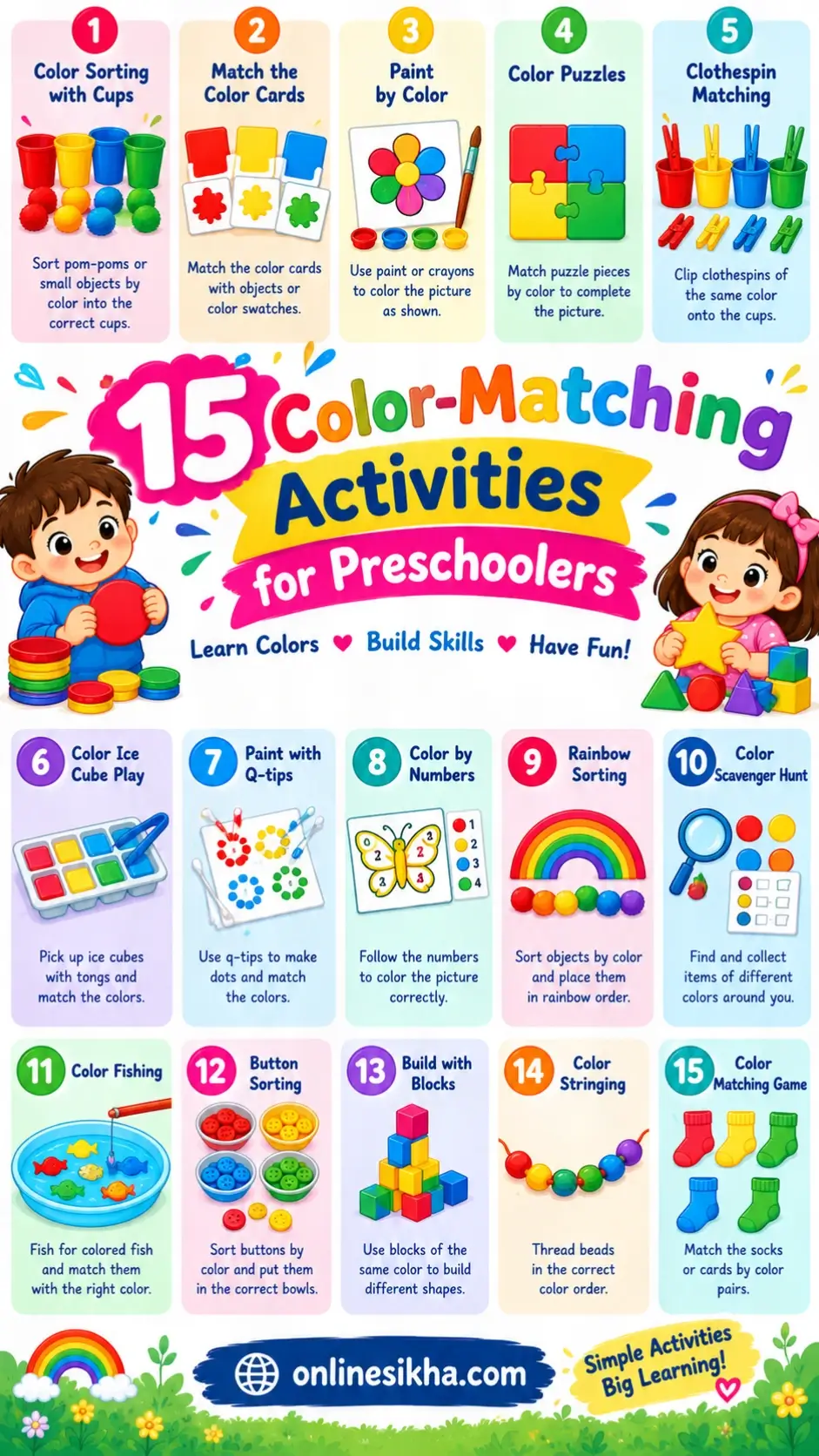
Learning colors gets much easier when children can actually see and touch what they’re matching.
A red cup beside a red card makes sense to a 3-year-old. So does putting a yellow lid on a yellow container. These little moments give children repeated practice with noticing color, comparing objects, and saying color names.
I like color matching because you can do it with things you already have at home. You don’t need a special toy box or a long lesson.
Here are 15 color matching activities for preschoolers that you can try with children around ages 3 to 5. So, let’s see how to Teach Colors to Preschoolers.
Why are color matching activities useful for preschoolers?
Color matching helps children notice whether two things look alike based on color. As children compare objects, they’re also practicing visual attention, classification, vocabulary, and following simple directions.
It also gives you plenty of chances to talk.
You might say, “You found the blue one. Can you find another blue?” Then let your child search, touch, move things around, and make the match.
For younger preschoolers, start with 2 or 3 familiar colors. Once those become easy, add more colors or make the objects look different in size and shape.
That last part is useful. A child who can match two identical red blocks may need more practice when the red objects are a block, a spoon, and a piece of paper.
15 color matching activities for preschoolers
1. Match the lids to the containers
Collect a few safe plastic containers and their lids.
Place the containers in front of your child and mix up the lids. Ask your child to find the lid that matches each container by color.
Start with 3 or 4 pairs. If your child enjoys it, add more.
This is a nice kitchen activity because the matching has a real purpose. Your child can see that the red lid belongs with the red container.
2. Make a color mailbox
Make 3 or 4 small paper “mailboxes” from boxes or containers. Give each one a different color.
Now make little pieces of pretend mail from colored paper. Your child posts each piece into the mailbox with the matching color.
Try saying, “This letter is green. Where should it go?”
For older preschoolers, mix the colors more carefully and let them check their own matches.
3. Match colored paper to real objects
Put several sheets of colored paper on the floor.
Now walk around the room together and find one safe object that matches each sheet. A blue cup can go beside blue paper. A yellow toy can sit on the yellow sheet.
You can turn this into a short color hunt. Give your child one color at a time and see what they find.
Color hunts are also useful for helping children connect color words with objects they see every day.
4. Color parking spaces for toy cars
Draw several large parking spaces on paper. Give each space a different color.
Now provide toy cars in the same colors.
Your child drives each car to its matching parking space.
I like this one for children who aren’t interested in sitting at a table. The matching happens while they’re moving cars around.
You can also add simple language: “The red car needs the red space.”
5. Match the colored spoons
Place colored plastic spoons or paper spoons in a row.
Make matching color cards and mix them up. Your child picks one card and places it beside the spoon with the same color.
If you don’t have colored spoons, wrap small pieces of colored paper around the handles of ordinary spoons.
Keep the first round easy. Later, add similar shades such as light blue and dark blue.
6. Build a color bridge
Use colored craft sticks, paper strips, or blocks.
Make a small “bridge” using one color and place a matching color card at the end. Your child has to choose the correct pieces to continue the bridge.
For example, place a red card down and ask your child to find the red pieces.
You can make the bridge long enough for a toy animal or car to cross.
7. Color puzzle halves
Cut colored paper into simple halves.
A red circle becomes 2 red pieces. A blue square becomes 2 blue pieces. Mix the pieces together and ask your child to find the 2 pieces that belong together.
Keep the shapes simple so the color remains the main clue.
For a harder version, use the same shape in several different colors. Your child has to pay attention to both the shape and the color.
If your child enjoys shape work too, you can follow this with more shape recognition activities for preschoolers.
8. Color card and crayon match
Put several crayons on the table.
Make small color cards that match the crayons. Mix the cards and ask your child to place each card beside the correct crayon.
Then reverse it. Hold up a card and ask, “Which crayon matches this?”
This gives your child practice moving from matching to remembering the color name.
It’s also an easy way to bring color learning into drawing time.
9. Match the socks
Take a small basket of clean children’s socks in different colors.
Mix them up and ask your child to find the socks that match by color.
You can use pairs with the same color but different patterns. A plain red sock and a red sock with tiny stars still give your child a reason to focus on color.
And when the activity is finished, the socks can actually go back into the drawer.
10. Make a color delivery game
Set up 3 or 4 “houses” using colored paper.
Give your child small objects or cards that match the house colors. Tell your child they need to deliver each item to the correct house.
“Who gets the yellow package?”
Your child finds the yellow house and makes the delivery.
Older preschoolers can remember 2 deliveries at once: “Take the blue package to the blue house, then bring the red one to me.”
11. Match colors in a picture book
Choose a picture book with clear, colorful illustrations.
Pick one color and ask your child to find something in the picture that matches it. If you have a red card nearby, your child can hold the card next to the red object.
You can also ask, “Can you find something that matches this blue card?”
This turns reading time into a quick color activity without interrupting the story too much.
It works especially well when you’re already doing alphabet activities for preschoolers or other picture-based learning.
12. Color wheel match
Draw a large circle and divide it into 4 or 6 sections.
Color each section differently.
Now give your child small pieces of paper, stickers, or safe household items in those colors. Ask them to place each item on the matching section.
You can make the wheel smaller for table work or draw a huge one on the floor for a movement activity.
13. Match the color cards to clothes
Put several children’s clothing items on the floor, such as a red shirt, blue shorts, yellow socks, and green hat.
Make matching color cards.
Your child places each card beside the clothing item with the same color.
Then ask your child to choose what they’d wear if you said, “Today we’re looking for something blue.”
This adds useful everyday vocabulary to the activity.
14. Color stepping path
Make colored circles from paper and place them around the room.
Hold up one color card. Your child finds the matching circle and steps on it.
Try different instructions:
“Find red.”
“Step on yellow.”
“Can you find blue?”
For older preschoolers, give 2 colors in sequence. “Blue, then green.”
This adds memory and listening practice while keeping the activity active.
15. Make a color match book
Give your child a few pages of paper.
Put one large color square at the top of each page. Your child finds pictures from old magazines, packaging, or safe paper scraps that match that color and glues them onto the correct page.
For example, the red page might have a red apple, a red car, and a red shirt.
Write the color name at the top after your child finishes each page.
You can keep the finished book and bring it back out later. Children often enjoy looking at something they made themselves.
How do you teach color matching to a 3-year-old?
Start small.
Put 2 colors in front of your child. Use objects that are clearly different in color, such as a red ball and a yellow ball.
Show your child a red card and say, “Find red.” Help if needed.
Once your child can match those colors comfortably, add a third color.
You don’t need to test every color in one sitting. A few minutes of matching during play is enough.
If your 3-year-old is still learning color names, you can say the word while your child makes the match: “Red goes with red.”
For more ideas at this age, see these preschool learning activities for 3-year-olds.
Color matching activities by age
Age 3
Keep the choices small.
Use 2 to 4 colors and familiar objects. Large cards, cups, toys, clothes, and paper pieces are easier to handle than tiny pieces.
Good choices include:
- Matching container lids
- Color mailboxes
- Toy car parking
- Color stepping paths
- Matching spoons
A short activity is plenty. If your child wanders off after 5 minutes, that’s fine.
Age 4
Add more colors and make the objects less alike.
For example, match a blue card to a blue toy, blue spoon, or blue piece of paper. Your child has to pay attention to color instead of relying on the objects being identical.
You can also add simple instructions, such as “Find the yellow one and put it beside the yellow card.”
For more ideas, see these preschool learning activities for 4-year-olds.
Age 5
Give older preschoolers more complicated matching tasks.
Use similar shades, mixed objects, or several matching choices. Ask your child to explain their choice: “How did you know these matched?”
You can also combine color with another feature.
“Find the small blue object.”
“Find something round and red.”
These activities encourage children to pay attention to more than one piece of information at a time.
If you’re building a broader learning routine, these preschool learning activities for 5-year-olds can give you more age-specific ideas.
What if my child keeps confusing colors?
Give the child more practice with a smaller set of colors.
If red, blue, yellow, green, orange, and purple are all on the table, take away half of them. Work with 2 colors first.
Use the same words every time. “This is red. Find another red.”
Real objects can help because your child sees the colors in everyday situations. You might talk about a red cup at breakfast, a green leaf outside, or a blue shirt while getting dressed.
Avoid turning the activity into a quiz every time you see a color. Some children need repeated exposure before the names stick.
Color matching and other preschool skills
Color matching connects naturally with several early learning skills.
Children practice visual discrimination when they look closely at colors and decide whether they match.
They practice classification when they put objects into groups based on a shared color.
They practice language when they hear and use words such as red, blue, light, dark, same, and different.
And some activities involve hand control too, especially when children place cards, glue pictures, move small objects, or draw lines between matching colors.
If you’re working on hand skills at the same time, you may also like these fine motor activities for preschoolers.
For pencil-based matching worksheets, number tracing activities for preschoolers can be another way to practice controlled marks.
Can color matching lead into math?
Absolutely.
Once children can group things by color, you can start asking simple comparison questions.
“Which group has more?”
“Which has fewer?”
“Do these groups have the same number?”
You can explore those ideas through which has more preschool activities, then move into other math activities for preschoolers.
You can also count the objects in each color group. “There are 3 red buttons and 2 blue buttons.”
That gives counting a real reason to happen, which is why counting activities for preschoolers fit nicely alongside color play.
Can you use color matching with letters and numbers?
Yes.
Give your child colored letter cards and ask them to match cards with the same color. You can do the same with number cards.
For example, place a red number 3 beside another red number 3. Later, mix color and number so your child has to pay attention to both.
You can continue with number recognition activities for preschoolers once your child is ready.
Color can also become part of literacy play. Ask your child to find all the blue letters on a page or match colored letter cards before trying some Bengali alphabet learning activities for preschoolers.
Use color matching during everyday activities
You don’t need to set aside a special learning period every time.
Try color matching while:
- Putting away toys
- Folding children’s clothes
- Organizing crayons
- Setting the table
- Choosing clothes
- Cleaning up craft supplies
- Looking through picture books
- Packing a small bag
- Playing with toy cars
If you already use preschool cooking activities, you can talk about the colors of fruits, vegetables, bowls, cups, and other safe ingredients while your child helps.
A walk outside can work too. Find something green, then something yellow. Look for a red flower, a blue sign, or another familiar color.
You can even connect it to where does food grow preschool activities by matching pictures of foods to their natural colors.
A simple 5-day color matching plan
You don’t need to repeat the same game every day.
Day 1: Match 3 colored containers with their lids.
Day 2: Play the color mailbox game.
Day 3: Use toy cars and colored parking spaces.
Day 4: Make a color stepping path.
Day 5: Create a simple color match book.
Keep each session short. If your child is enjoying the activity, you can continue. If they’re done, stop there.
A preschooler’s day has plenty going on already. If you’re planning the rest of the routine, this guide on how many hours a preschooler should study can help you keep structured learning reasonable.
More preschool activities to try
Color matching can easily become part of a wider preschool routine.
For language, try fun rhyming activities for preschoolers or Who Am I preschool activities.
For themed learning, you can try Where the Wild Things Are preschool activities, where do animals live preschool activities, or Arctic animals activities for preschoolers.
You can also work on simple addition activities for preschoolers and subtraction activities for preschoolers once your child is ready for those ideas.
And if your child enjoys arranging objects by color, pattern activities for preschoolers are a natural next step.
For a bigger collection, start with these best educational activities for preschoolers.
Frequently asked questions
What is a color matching activity?
A color matching activity asks a child to find 2 objects, cards, pictures, or other items that have the same color.
For example, a child might match a red card to a red cup.
At what age can children start color matching?
Many children can begin simple color matching around age 2 or 3. Preschoolers can gradually handle more colors, different objects, and more complicated matching tasks.
Children develop at different rates, so the number of colors your child can match isn’t a race.
How many colors should a 3-year-old know?
There’s no single number that every 3-year-old should know. Start with a few familiar colors and give your child plenty of chances to see, hear, match, and use the color names.
How can I teach colors without worksheets?
Use toys, clothes, containers, books, food, crayons, paper, and objects around your home.
Ask your child to find matching colors, group objects, choose a color, or tell you what color they see.
Are color matching worksheets good for preschoolers?
They can be useful when a child is ready for table work, especially for practicing visual matching and pencil control. Hands-on activities are also worth including because children can move and compare real objects.
What should I do if my preschooler mixes up colors?
Reduce the number of choices and practice 2 colors at a time.
Use the same color words repeatedly during normal routines. If you’re concerned about your child’s overall development or ability to distinguish colors, talk with your child’s pediatrician or teacher.
Final thoughts
Color matching can be very simple.
Give your child 2 things that match, ask them to find the connection, and talk about what they see. Then do it again tomorrow with different objects.
That’s enough to build useful practice without turning playtime into a classroom.
And once your child starts spotting colors everywhere, you’ll probably find yourself hearing things like, “Look, Mommy, that’s red!” while you’re trying to finish making breakfast.
That’s preschool learning too.
https://www.pinterest.com/ideas/colour-matching-activities/943628400215/
https://www.prekprintablefun.com/blog/fun-and-easy-color-activities-for-preschoolers
https://pocketofpreschool.com/color-activities-for-toddler-preschool-pre-k/
https://www.simplefunforkids.com/color-matching-activities-for-kids.html/