
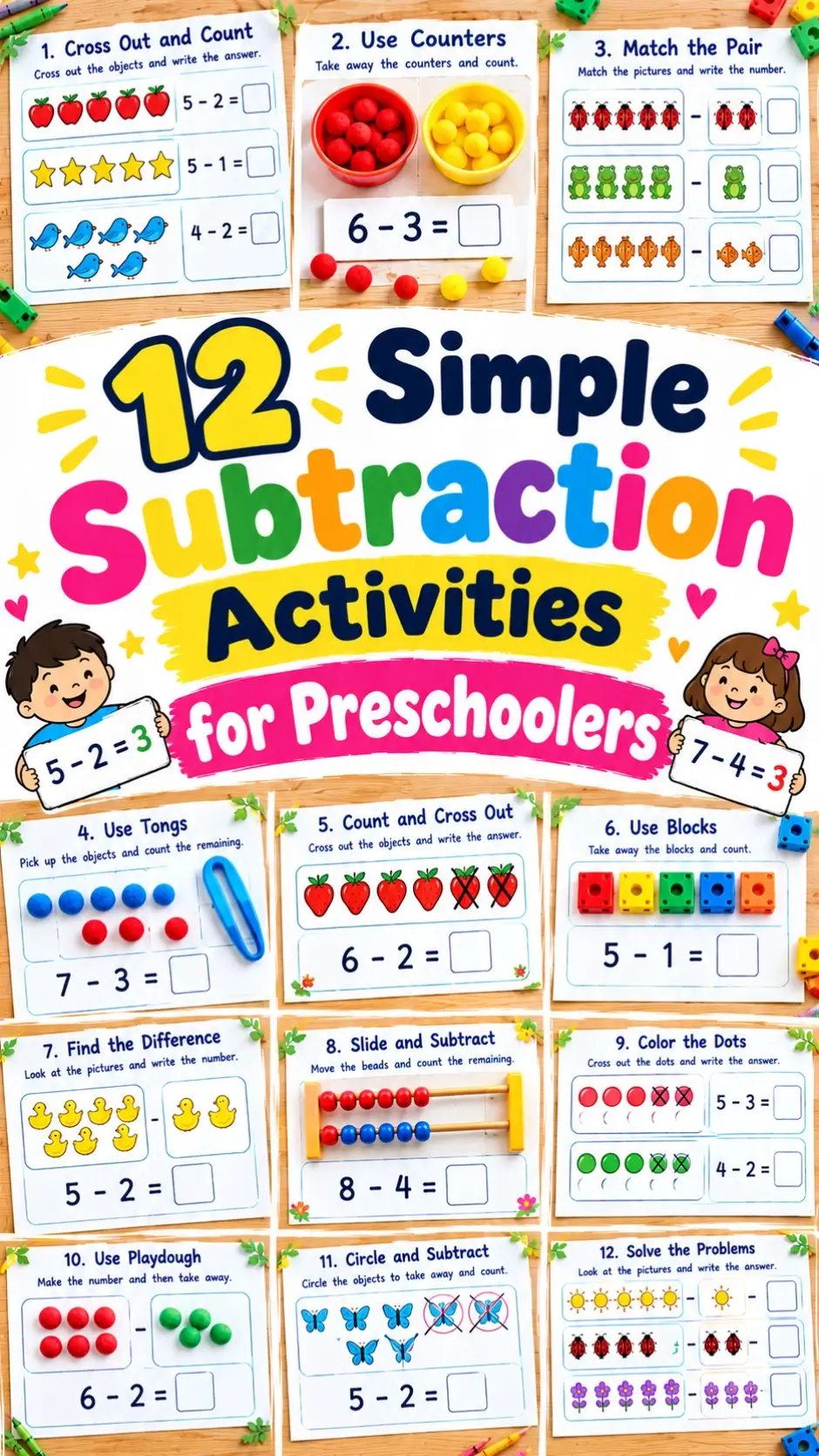
Subtraction is much easier for a preschooler when they can actually see something disappear.
Put 4 toy animals on the floor. Take 1 away. Then ask, “How many are left?”
That little action is subtraction.
For young children, I’d keep the numbers small and use things they can touch, move, hide, remove, or eat. Children can build the idea of subtraction before they ever need to solve a page full of written equations. NAEYC recommends using concrete objects and small numbers as children develop early number concepts.
Here are some simple subtraction activities for preschoolers that you can try at home with everyday materials.
What is subtraction for preschoolers?
At the preschool level, subtraction usually starts with taking something away.
For example:
4 − 1 = 3
You begin with 4 objects.
Take 1 away.
Count what remains.
That’s the whole idea.
You can use phrases such as:
- Take away
- How many are left?
- How many remain?
- We had 4 and took away 1
- There are 3 left
NAEYC also recommends using everyday math language such as “take away,” “subtract,” “more,” and “less” during children’s daily experiences.
When should preschoolers learn subtraction?
There’s no need to rush a preschooler into formal subtraction.
Around ages 4–5, many children are ready to play with very small subtraction problems when they’re already comfortable counting small groups. Some children will be ready earlier, while others need more time with counting and quantity.
Start with numbers 1–5.
If your child is still learning to recognize numbers, spend some time with these number recognition activities for preschoolers first.
And if counting objects is still difficult, my counting activities for preschoolers can give you some useful practice ideas.
Once your child understands the idea of taking away, you can slowly introduce the minus sign.
12 simple subtraction activities for preschoolers
1. Toy rescue game
Put 5 small toy animals in a basket.
Tell your child that 5 animals are waiting for a ride.
“2 animals get picked up.”
Take 2 animals out of the basket.
“How many animals are still waiting?”
Your child counts the remaining 3.
You can change the story each time. Maybe the animals go home, fly away, take a nap, or go into another room.
The story gives the subtraction a reason.
2. Snack take-away
Put 4 pieces of a safe snack on a plate.
You might use banana slices, cereal pieces, or another food your child already eats.
“Here are 4 pieces. Eat 1.”
After your child eats it, ask:
“How many are left?”
This is one of my favorite ways to introduce subtraction because the child immediately understands what “take away” means.
And yes, sometimes the answer mysteriously disappears before we get to count it.
You can find more food-based learning ideas in my preschool cooking activities.
3. Disappearing socks
Grab 5 clean socks and place them in a small pile.
“5 socks are here.”
Hide 1 sock behind your back.
“How many can you see now?”
Let your child guess, then reveal the hidden sock.
For the next round, hide 2.
This gives your child a chance to think about the missing quantity instead of simply counting objects that are sitting in front of them.
4. Toy parking lot
Make 5 parking spaces with pieces of paper.
Place 5 toy cars in the spaces.
“5 cars are parked.”
Move 2 cars away.
“How many cars are still parked?”
Your child can count the remaining cars.
Then bring the cars back and make another problem.
You can make the story more playful by saying the cars are going to the grocery store, the park, or home.
5. Hide the counters
Place 5 large counters on a table.
Ask your child to close their eyes.
Remove 2 counters and hide them in your hand.
Your child opens their eyes and counts how many are still on the table.
Ask:
“How many did I take away?”
This can become a thinking game once your child is comfortable.
If there were 5 and 3 are still visible, your child can work out that 2 disappeared.
For very young children, keep the starting number at 3 or 4.
6. Feed the puppet
Use a stuffed animal, puppet, or even a paper face with a large mouth.
Give the puppet 4 pretend cookies.
“Bear has 4 cookies.”
Make the puppet eat 1.
“Now how many cookies does Bear have?”
Move the eaten cookie away from the group.
Your child counts what’s left.
This works especially well when the puppet makes silly noises. Preschool math doesn’t have to look serious.
7. Subtraction with a muffin tray
Take a small muffin tray and place 5 large objects in the cups.
You can use toy food, large pom-poms, or other age-safe materials.
Ask your child to remove a certain number.
For example:
“Take away 2.”
Your child removes 2 objects.
Then count the empty and filled cups to see how many remain.
The empty spaces make the change easy to see.
8. Animal footprints
Draw 5 simple animal footprints on paper.
Cover 2 with small pieces of paper.
Ask:
“There were 5 footprints. 2 are covered. How many can we still see?”
Your child counts the visible footprints.
Then let them uncover the hidden ones and check.
This is a nice option when your child likes animals but has had enough of counting toy animals for one day.
For more animal-themed preschool learning, you can try my where do animals live preschool activities.
9. Take-away tower
Build a tower with 5 large blocks.
Tell your child:
“We have 5 blocks.”
Ask them to take 1 block off.
“How many blocks are left?”
Then try 2.
Your child can physically remove the blocks and count the shorter tower.
Keep the tower low enough that blocks don’t fall onto little fingers.
You can later ask your child to build the starting tower themselves.
10. Subtraction with paper leaves
Cut out 5 simple leaf shapes from paper.
Place all 5 on the table.
“5 leaves are on the ground.”
A pretend wind blows 2 leaves away.
Move 2 aside.
“How many leaves are still here?”
For a nature-themed session, you can use real large leaves instead, as long as they’re clean and safe to handle.
You can also connect this with my where does food grow preschool activities for more nature and plant-related learning.
11. Bath-time take away
Put 4 floating bath toys in the water.
“4 toys are swimming.”
Take 1 toy out of the tub.
“How many toys are still swimming?”
Your child counts the remaining toys.
You can make the toy “go home” each time you remove one.
Keep water play supervised, as always.
12. Make a subtraction story
Give your child 5 small objects.
Then make up a tiny story:
“5 birds are sitting on a branch. 2 birds fly away.”
Move 2 birds away.
“How many birds are still on the branch?”
Let your child make the next story.
Maybe 4 fish have 1 swim away. Maybe 3 puppies are playing and 1 goes inside.
This helps children connect subtraction with something happening in a story rather than treating it as a row of symbols.
Simple subtraction examples for preschoolers
Keep the first problems small.
Try:
- 2 − 1 = 1
- 3 − 1 = 2
- 3 − 2 = 1
- 4 − 1 = 3
- 4 − 2 = 2
- 5 − 1 = 4
- 5 − 2 = 3
- 5 − 3 = 2
Your child doesn’t need to memorize all of these.
Put out the objects. Let them take some away. Then count what’s left.
That’s enough.
Subtraction activities for 3-year-olds
For most 3-year-olds, keep subtraction playful.
Use:
- 2 or 3 objects
- “Take 1 away”
- Toy animals
- Snacks
- Fingers
- Very short stories
You don’t need to introduce the minus sign.
A simple question such as “You had 3 crackers and ate 1. How many are left?” is already meaningful subtraction practice.
If you’re looking for more learning ideas for this age, see my preschool learning activities for 3-year-olds.
Subtraction activities for 4-year-olds
A 4-year-old who is comfortable counting small groups can start working with subtraction within 5.
Try:
- Hidden objects
- Toy parking
- Puppet stories
- Take-away towers
- Simple subtraction stories
- Picture-based problems
You can begin showing the minus sign once the child understands the action.
My guide to preschool learning activities for 4-year-olds has more age-appropriate ideas if you want to build a broader weekly routine.
Subtraction activities for 5-year-olds
By age 5, some children are ready to work with subtraction within 5 and gradually move toward 10.
Try asking:
“You have 5 blocks. How many will be left if we take away 2?”
Let your child build the 5-block group and remove 2.
Then write:
5 − 2 = 3
You can also give your child a simple story and ask them to choose the numbers.
For more activities at this stage, see my preschool learning activities for 5-year-olds.
When should you introduce the minus sign?
Introduce − after your child understands what taking away means.
For example, start with:
5 blocks
Take away 2
3 blocks remain
Then show:
5 − 2 = 3
The symbols are a written way of recording something your child has already acted out.
That makes much more sense than starting with the equation alone.
What if my child counts the wrong answer?
Let your child count again.
If you put out 5 objects and take away 2, ask your child to touch each remaining object as they count.
“Let’s check. Touch each one.”
If they still struggle, make the problem smaller.
Try 2 − 1.
Then 3 − 1.
There’s no prize for getting to 10 quickly.
A solid understanding of small quantities matters more.
Can worksheets help with subtraction?
Yes, but I’d use them after your child has had plenty of hands-on practice.
A simple worksheet might show:
🍎🍎🍎🍎
Cross out 2 apples.
How many are left?
The child can physically see what is being removed.
You can also use:
- Toy pictures
- Dots
- Shapes
- Animals
- Food pictures
- Simple number lines
Keep the page clean. Preschoolers can lose the math problem completely when the worksheet is packed with decorations.
If you also use worksheets for broader preschool learning, you can browse my best educational activities for preschoolers for more ideas.
Subtraction with fingers
Fingers are always available.
Hold up 5 fingers.
“Show me 5.”
Now fold down 2 fingers.
“How many are still up?”
Your child can count the 3 fingers that remain.
Finger games are useful for early number knowledge because children can physically represent quantities with their hands. NAEYC includes finger games among activities that support children’s understanding of composing and decomposing small numbers.
This is also a great activity when you have only a couple of minutes.
Subtraction during everyday routines
You don’t have to sit at a table for every math activity.
Try subtraction while:
- Putting away toys
- Setting the table
- Eating a snack
- Getting dressed
- Playing with toy cars
- Cleaning up blocks
- Bathing
- Looking at picture books
For example:
“There are 4 cups here. I put 1 away. How many are still here?”
Or:
“You have 3 socks. We put 1 in the drawer. How many are left?”
These tiny questions help children hear math language during ordinary activities. NAEYC recommends using everyday situations to support children’s early mathematical thinking.
How long should a subtraction activity last?
Usually, a few minutes is enough for a young preschooler.
If your child is interested, you can continue.
If the objects suddenly become flying airplanes and your child starts running around the room, the math session is probably over.
That’s fine.
You can come back to it tomorrow.
For a broader look at preschool learning time, see my guide on how many hours should a preschooler study.
And keep other kinds of learning in the week too. You can switch between math and alphabet activities for preschoolers, beginning sound activities for preschoolers, or fun rhyming activities for preschoolers.
Subtraction and comparison
Subtraction connects naturally with questions about quantity.
Suppose you have 5 toy cars and remove 2.
You can ask:
“How many did we start with?”
“How many did we take away?”
“How many are left?”
“Are there more cars now or fewer cars?”
That last question brings subtraction into everyday comparison.
For more practice with quantity comparisons, see my Which Has More preschool activities.
Subtraction and addition belong together
Once your child understands a problem such as:
5 − 2 = 3
you can show that the 3 left plus the 2 taken away make the original 5 again.
3 + 2 = 5
This connection can come later.
If you’re working on addition too, see my guide to simple addition activities for preschoolers.
The 2 skills support each other, but I’d still introduce them through real objects first.
More preschool math activities
If you’re building a preschool math routine, you can mix subtraction with other simple math ideas.
My math activities for preschoolers have more hands-on activities across early math skills.
You can also browse:
- Where the Wild Things Are preschool activities for story-based activities
- Who am I preschool activities for language and personal learning
You don’t need to turn every activity into a math lesson. A few well-chosen questions during play are plenty.
Frequently asked questions
What is the easiest way to teach subtraction to a preschooler?
Start with real objects.
Give your child 3–5 objects, physically take some away, and ask how many are left.
Once that makes sense, introduce the minus sign and simple equations.
What numbers should preschoolers use for subtraction?
Start with numbers from 1–5.
For a child who is still learning the idea, problems such as 2 − 1 and 3 − 1 are enough.
As understanding grows, you can work toward subtraction within 10.
Should a 3-year-old learn subtraction?
A 3-year-old can explore the idea of taking away during play.
You might say, “We have 3 blocks. I’m taking 1 away. How many are left?”
Keep it concrete and playful. Formal written subtraction isn’t necessary.
What materials can I use for preschool subtraction?
You can use toy animals, blocks, large buttons, paper shapes, toy cars, snacks, fingers, cups, socks, or other safe household objects.
The material doesn’t matter as much as the action of taking some away and counting what remains.
Should preschoolers memorize subtraction facts?
Memorizing facts isn’t the main goal at this stage.
Focus on understanding what subtraction means. Let your child physically remove objects and count the remaining group.
What if my child isn’t ready for subtraction?
Go back to counting and number recognition.
Make sure your child can count small groups and understands that a number represents a quantity.
Then try very small take-away problems again.
Final thought
Subtraction can start with something as ordinary as 3 toy cars on the floor.
Move 1 away.
Ask how many are left.
Your child watches the group get smaller, counts what remains, and slowly connects that action to the idea of subtraction.
That’s a good place to start.
https://www.pinterest.com/ideas/subtraction-activities-for-preschool/941111499262/
https://www.prekprintablefun.com/blog/beginning-operations-i-can-subtract
https://bhanzu.com/parents/subtraction-activities-for-kids
https://thekindergartenconnection.com/subtraction-activities-and-centers-for-pre-k-kindergarten/