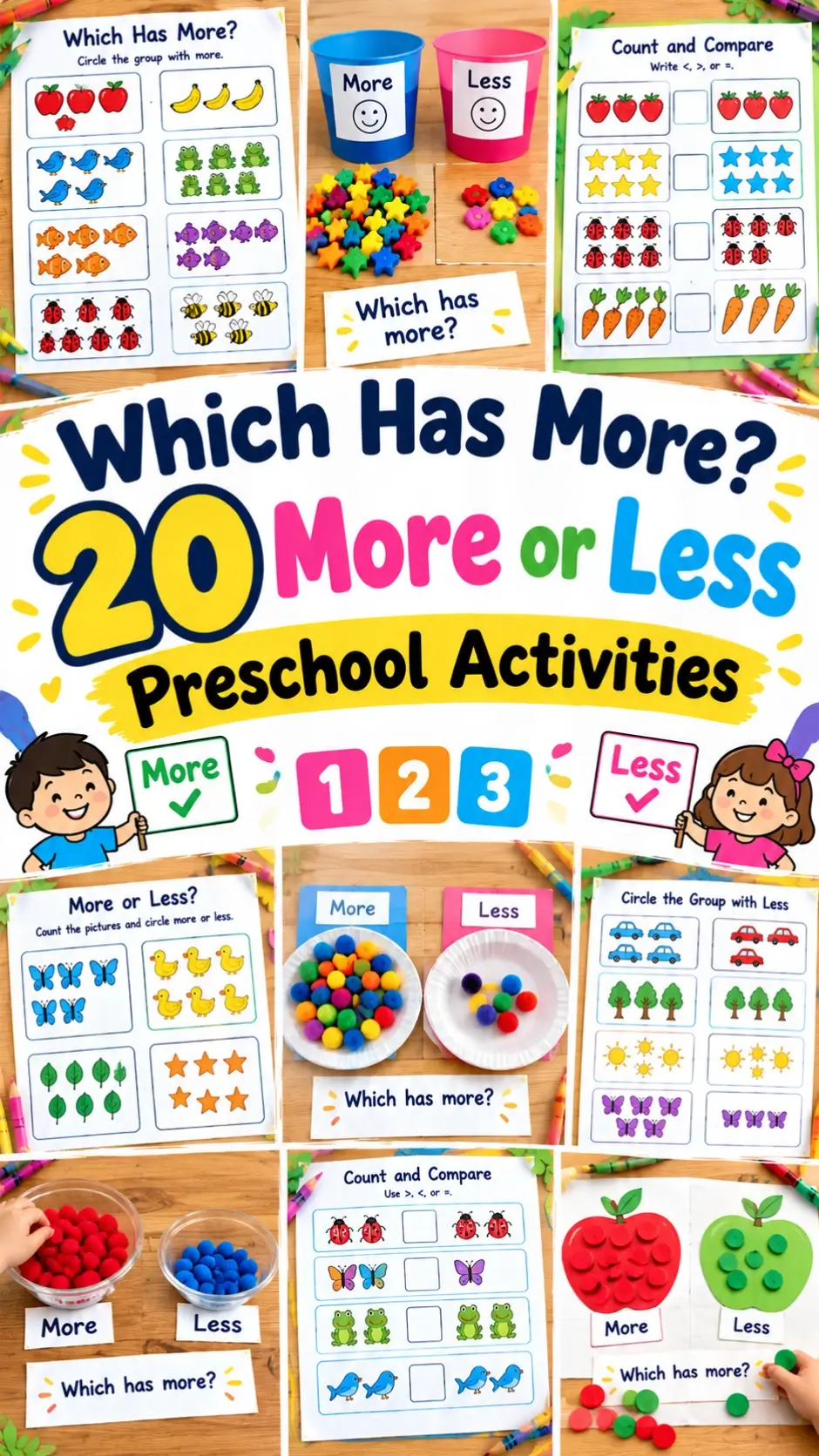
“Which plate has more?” “Which one has less?”
These questions can turn an ordinary play session into a little math lesson. Preschoolers are beginning to notice that one group can have more objects than another, even before they’re ready to work with written numbers.
Which has more preschool activities are especially useful for children who are learning to compare small groups. You can use toys, snacks, blocks, buttons, paper shapes, or almost anything you already have at home.
I like starting with real objects because the difference is easy to see. If I put 3 toy cars in one row and 5 in another, Hafsa can look at them, point, and make a guess before we count together.
For preschoolers, the main goal is to understand more, less, and the same. Activities can begin with comparing groups of objects and later move toward counting and simple number comparisons. PreKinders uses hands-on games, graphs, dice, cards, and building activities to teach these ideas in preschool.
What does more and less mean for preschoolers?
More means one group has a greater number of objects.
Less means one group has a smaller number of objects.
Same means both groups have an equal number.
For example:
- 🍎🍎🍎🍎 has more than 🍎🍎
- 🧸🧸 has less than 🧸🧸🧸🧸
- ⭐⭐⭐ has the same number as ⭐⭐⭐
At first, children can compare groups without seeing any numbers. K5 Learning uses this approach in its preschool and kindergarten materials, asking children to identify which group has more or fewer objects before moving toward number comparisons.
🔥 Related: Alphabet Activities for Preschoolers
1. Which plate has more?
Take 2 plates, bowls, or pieces of paper.
Put a small number of objects on each one. Try 2 crackers on one plate and 5 on the other.
Ask:
“Which plate has more?”
“Which plate has less?”
Then count the objects together.
Change the groups several times so your child can’t simply remember that the plate on the left always has more.
Use small numbers at first. Around 1–5 is plenty for a younger preschooler.
2. Give the teddy bears some food
Place 2 stuffed animals or toy animals in front of your child.
Give one animal 3 pretend food pieces and the other 5.
Ask your child which animal has more food.
Now change the amounts.
You can make the game funny by giving one teddy a huge “meal” and the other just one tiny piece.
This makes the comparison feel like play rather than a math drill.
🔥 Related: 12 Who Am I Preschool Activities
3. More or less parking spaces
Draw 2 small parking areas on the floor with tape.
Put 3 toy cars in one area and 6 in the other.
Ask:
“Which parking lot has more cars?”
“Which has fewer?”
Then move the cars around and compare again.
Once your child understands the idea, let them decide how many cars should go into each parking lot.
🔥 Related: 12 Fun Rhyming Activities for Preschoolers
4. Snack-time comparison
Use snack pieces during a normal meal or snack.
Put 2 banana slices on one side of a plate and 4 on the other.
Ask your child which side has more.
Then try an equal amount.
“Do they have the same?”
Food makes a useful comparison tool because children can see the objects clearly, count them, and then eat them when you’re finished.
Just keep the pieces appropriate for your child’s age and supervise eating.
🔥 Related: Where the Wild Things Are Preschool Activities
5. Which cup has more?
Use 2 transparent cups.
Put a few large, safe objects into each cup, such as large pom-poms or toy counters.
Ask your child which cup has more.
Then empty both cups and start again.
You can make the comparison harder by using objects of different sizes. A cup with 3 large objects may look fuller than a cup with 5 small ones, so your child has a reason to count instead of relying only on appearance.
6. More, less, or same?
Draw 3 large circles on paper.
Label them:
More
Less
Same
Now show your child 2 groups of objects.
For example:
🍓🍓🍓🍓
and
🍓🍓
Ask your child to point to the correct word.
You can also make picture cards for each group and let your child place them under the correct heading.
This gives children repeated practice with all 3 comparison words.
7. Hide the extra one
Put 4 blocks in front of your child.
Cover one block with your hand.
Ask, “How many can you see?”
Then reveal it.
“You found 1 more!”
Now start with 3 blocks and add one.
“How many do we have now?”
The activity quietly introduces the idea of one more through a small change in quantity. K5 Learning also connects one-more and one-less practice with counting physical objects.
8. More or less with toy animals
Choose a few toy animals.
Make 2 groups.
For example:
🐶🐶🐶
and
🐱🐱🐱🐱🐱
Ask:
“Which group has more animals?”
“Which group has less?”
Then switch the animals.
You can make up a little story:
“3 puppies are playing here. 5 kittens are playing over there. Which group is bigger?”
The story gives the numbers a reason to exist.
9. Make a taller tower
Give your child some building blocks.
Build a short tower with 3 blocks.
Then ask your child to build a tower with more blocks.
Count both towers.
Try again with a different number.
You can also ask for a tower with fewer.
This helps children connect the words more and less with a physical difference they can see. Hands-on block comparisons are also used in Pre-K’s preschool math activities.
10. More or less treasure hunt
Hide small groups of safe objects around a room.
For example:
- 2 toy stars near a chair
- 4 toy stars under a table
- 3 toy stars beside a box
Let your child find 2 groups.
Bring them together and ask:
“Which group has more?”
“Which has less?”
You can keep the numbers small, so the focus stays on comparing rather than counting a large collection.
11. Make two shopping baskets
Pretend you’re going shopping.
Give your child 2 small baskets or containers.
Put a few pretend groceries in each.
For example:
Basket A: 4 pretend apples
Basket B: 2 pretend bananas
Ask which basket has more.
Then let your child add or remove items and tell you what changed.
“Now there are 3 bananas. Which basket has more?”
12. More or less with stickers
Draw 2 large boxes on a sheet of paper.
Put 3 stickers in one box and 5 in the other.
Ask your child which box has more.
Then give your child stickers and say:
“Can you make this box have more?”
Or:
“Can you make this box have less?”
This version lets the child create the quantities instead of only identifying them.
K5 Learning similarly uses activities where children draw more or fewer objects than the group shown.
🔥 Related: What Are the Best Preschool Cooking Activities
13. Compare two collections
Collect safe objects from around the house.
You might use bottle caps, large buttons, toy animals, blocks, or craft pieces.
Make 2 collections.
Ask your child to count each group and tell you which has more.
Then deliberately make the numbers close:
4 and 5
5 and 6
3 and 4
This is useful once your child has become comfortable comparing groups with bigger differences.
14. The more or less puppet
Use a stuffed animal or hand puppet.
Tell your child:
“Bear has 2 apples. Rabbit has 5 apples. Who has more?”
Let the puppet make silly guesses sometimes.
“Bear says he has more!”
Your child can correct the puppet.
You can also let your child control the puppet and ask you the questions.
This works nicely for children who enjoy pretend play more than table activities.
15. Fill the two boxes
Draw 2 large boxes on paper.
Give your child a pile of counters, paper circles, or large buttons.
Ask:
“Put more in the blue box.”
Then:
“Put less in the other box.”
Afterward, count both groups.
For a challenge, ask:
“Can you make them the same?”
Now your child has to add or remove objects to create an equal amount.
16. Which line has more?
Make 2 rows of objects.
For example:
🔵 🔵 🔵 🔵
🔵 🔵 🔵
Ask which row has more.
Then spread the 3 objects farther apart.
Ask again.
This can lead to an interesting conversation because preschoolers sometimes think the longer-looking row has more objects. Have your child count each row to check.
The counting step matters. It helps children connect the physical objects with their actual quantities.
17. More or less movement game
Give your child 2 movement choices.
For example:
“Do 3 jumps.”
Then:
“Do 5 jumps.”
Ask:
“Which group of jumps was more?”
You can try:
- Claps
- Stomps
- Hops
- Arm circles
- Toe touches
Your child can also choose the numbers.
Keep the numbers small and let the game stay silly.
18. Make the same amount
Put 4 counters in front of your child.
Give them another group with 2 counters.
Ask:
“Can you make this group the same?”
Your child adds 2.
Try again with different numbers.
This is a useful next step after your child understands more and less because they have to change one group to match another.
19. Which has more in the picture?
Draw 2 simple scenes.
For example, one picture has 4 balloons and the other has 6.
Ask:
“Which picture has more balloons?”
You can make new comparison pages with:
- Flowers
- Fish
- Stars
- Apples
- Cars
- Balloons
This can become a simple homemade worksheet when your child is ready for pencil-and-paper practice.
20. More or less number cards
Once your child can confidently compare small groups of objects, introduce number cards.
Place the number 3 beside the number 5.
Ask:
“Which number tells us about more?”
Start with numbers from 1–5.
Later, you can move toward 1–10.
At this stage, the goal is connecting the written number to the quantity your child already understands.
K5 Learning’s progression also moves from comparing groups of objects toward comparing numbers and, later, using comparison symbols.
When should preschoolers learn more and less?
There’s a wide range in when children become comfortable with comparison.
You can introduce the words naturally during the preschool years, especially through small groups of real objects.
A younger preschooler may simply point to the group with more.
An older preschooler may count both groups and explain, “5 is more than 3.”
Written symbols such as >, <, and = can come later. K5 Learning places these symbol-based comparisons alongside kindergarten number work, while its preschool materials begin with concrete groups of objects.
🔥 Related: How Many Hours Should a Preschooler Study
A simple 5-day more and less plan
You can introduce the idea over a few short sessions.
Day 1: Compare 2 groups of toys.
Day 2: Use snacks or pretend food.
Day 3: Build towers with different numbers of blocks.
Day 4: Practice more, less, and same.
Day 5: Introduce simple number cards.
Keep each activity short. If your child understands the idea after a few comparisons, move on to something else.
When your child is ready for a little more challenge
Try numbers that are close together.
Compare:
4 and 5
5 and 6
6 and 7
You can also ask your child to change a group.
“There are 3 cars. Can you make it 1 more?”
“There are 5 blocks. Can you make it 1 less?”
This connects comparison with simple changes in quantity. K5 Learning uses one-more and one-less tasks where children count objects, add 1, or take 1 away.
Common mistakes to avoid
Using numbers that are too large
A preschooler learning the basic idea doesn’t need groups of 20 or 30.
Keep the quantities small enough that your child can count them without losing track.
Moving to symbols too quickly
The symbols > and < can wait until the child understands what more and less mean.
Real objects give children something concrete to compare first.
Changing object size and quantity too soon
If one group has 2 giant blocks and another has 5 tiny buttons, the comparison can become confusing.
Use similar objects while your child is learning the basic idea.
Asking too many questions
A few comparisons are enough.
Stop while your child is still interested. You can come back to it another day.
Can worksheets help with more and less?
Yes, especially after your child has had plenty of hands-on practice.
A preschool worksheet might show 2 groups of pictures and ask the child to circle the group with more or fewer objects.
Another option is asking the child to draw more objects than the example.
These are common formats in preschool and kindergarten materials. K5 Learning, for example, uses group comparisons and drawing more or fewer objects before introducing number symbols.
For a younger preschooler, keep the worksheet visual and use only a few questions.
Frequently asked questions
What are some easy preschool activities for learning more and less?
Try comparing toy groups, building towers, filling baskets, using snack pieces, making sticker groups, or comparing two rows of objects.
Should preschoolers learn greater than and less than symbols?
You can introduce the symbols when your child already understands quantity and can compare numbers. Hands-on comparisons with objects are a useful starting point.
What is the difference between more, less, and same?
More means one group has a greater number. Less means one group has a smaller number. Same means both groups have an equal number.
What numbers should preschoolers use for more and less activities?
Start with small quantities, often 1–5, and increase toward 10 as your child becomes comfortable counting and comparing.
Final thoughts on Which Has More Preschool Activities
More and less can become part of everyday play very easily.
Put 2 toy cars beside 5 toy cars and ask, “Which has more?” Count them together. Then change the groups and ask again.
Those little comparisons give preschoolers a chance to see what numbers mean before they have to work with numbers on a page.