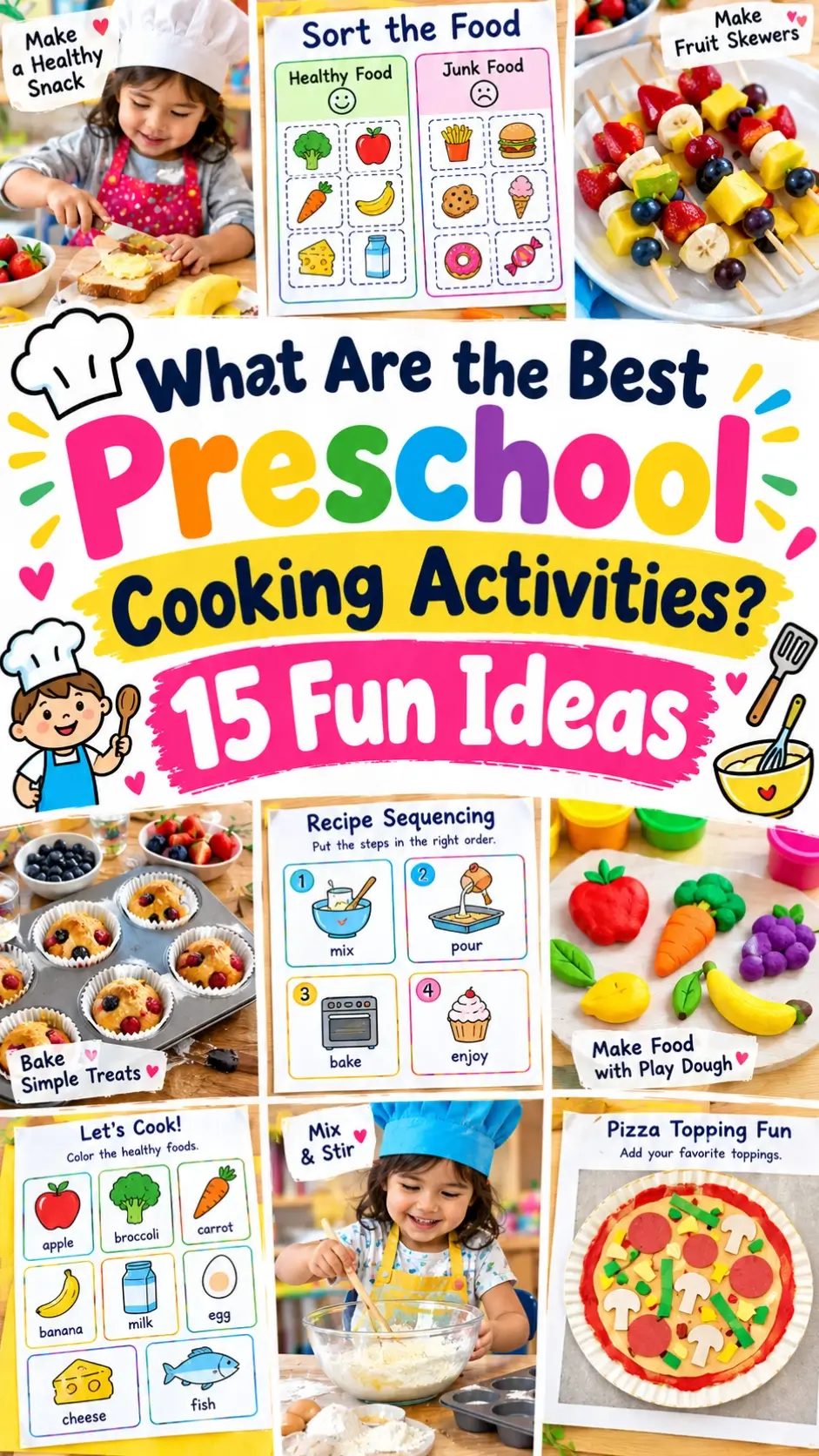
Cooking with a preschooler can turn an ordinary snack into a little learning session.
Your child can pour, scoop, stir, mash, squeeze, spread, count, and follow simple directions while you work together. I see this with my little girl, Hafsa. Give her a small job she can actually do, and she becomes much more interested in what I’m making.
The best preschool cooking activities are simple enough for little hands and interesting enough to keep them involved. You don’t need a complicated recipe or a kitchen full of special equipment.
Here are some easy cooking activities for preschoolers that you can try at home or in a classroom.
What can preschoolers learn from cooking?
Cooking gives preschoolers plenty of chances to practice everyday skills.
When children measure flour, pour milk, stir a mixture, or arrange food, they’re working on hand control and coordination. Following recipe steps also introduces sequencing and early math concepts.
Cooking can also build vocabulary. Words such as mix, pour, soft, hard, hot, cold, full, and empty become much easier to understand when children can see and touch what you’re talking about.
A preschool cooking lesson can include:
- Counting ingredients
- Measuring
- Following 2 or 3 simple steps
- Naming foods and kitchen tools
- Comparing sizes and amounts
- Practicing fine motor movements
- Trying new textures and flavors
- Cleaning up after cooking
Preschool cooking resources also recommend giving children real, age-appropriate tasks while adults handle unsafe equipment and steps.
🔥 Related: 19 Fun Where Do Animals Live Preschool Activities
15 best preschool cooking activities
1. Shake your own butter
This one feels like a tiny science experiment.
Pour heavy cream into a clean jar with a tight lid. Let your child shake the jar while you take turns. After several minutes, the cream changes into butter and liquid separates from it.
Let your child look at both parts and talk about what happened.
Ask:
- What did we put in the jar?
- What happened after we shook it?
- Is the butter soft or hard?
- What could we spread it on?
Keep the jar sealed well because vigorous shaking can get messy.
🔥 Related: Where the Wild Things Are Preschool Activities
2. Make banana oat bites
Mash a ripe banana in a bowl and let your child add oats. Mix everything together and form small balls with clean hands.
You can add a little cinnamon or another child-friendly ingredient your family uses.
This activity gives preschoolers a nice combination of mashing, scooping, mixing, and shaping.
And there’s no stove involved.
🔥 Related: 12 Fun Rhyming Activities for Preschoolers
3. Squeeze fresh lemonade
Give your child lemon halves and a child-safe citrus squeezer.
Let them squeeze the juice into a bowl or pitcher, then help measure water and add it. An adult can handle any cutting.
Talk about the taste before and after adding water.
You can ask, “Is the lemon juice sour?” Then let your child taste the finished drink and describe it.
🔥 Related: 12 Who Am I Preschool Activities
4. Make homemade popsicles
This is an easy warm-weather cooking activity.
Let your preschooler pour yogurt or a fruit mixture into popsicle molds. They can add small pieces of soft fruit if appropriate for their age.
Place the molds in the freezer yourself.
The next day, your child gets to see a liquid mixture turn into something solid. That’s a simple way to introduce the idea of freezing.
🔥 Related: 10 Beginning Sound Activities for Preschoolers
5. Build a yogurt cup
Give your child a small bowl of yogurt and several toppings in separate containers.
You might use soft fruit, oats, coconut, or another topping your child already eats safely.
Let them decide what goes in first, then spoon each ingredient into the cup.
This is a good chance to practice words such as first, next, and last.
🔥 Related: Alphabet Activities for Preschoolers
6. Make a simple dip
Choose a soft dip that doesn’t require cooking.
For example, you can mix plain yogurt with mashed avocado or another familiar ingredient. Let your child scoop, mash, and stir.
Give them soft vegetables or crackers to dip afterward.
This activity works well for children who enjoy having control over what they put on their plate.
7. Make homemade applesauce
Peel and cook the apples yourself first.
Once the apples are soft and cool enough to handle, let your preschooler mash them with a potato masher.
Add a little cinnamon if your family likes it.
The texture gives children something interesting to notice. You can compare a whole apple with the soft cooked apple and ask what changed.
8. Make tortilla pinwheels
Spread a soft filling over a tortilla and let your child help add another ingredient.
Roll it tightly yourself if needed, then cut it into small pieces.
Your child can arrange the pieces on a plate and count them.
This also gives you a chance to talk about shapes. When you slice the roll, what shape do you see?
9. Make a simple oat breakfast
Put oats, milk, yogurt, and soft fruit on the table.
Let your child measure and pour each ingredient into a bowl. They can stir everything together with a spoon.
You can make it warm or cold depending on the recipe and your child’s age. An adult should handle anything involving a hot stove or microwave.
10. Make a homemade salad dressing
Preschoolers can help pour ingredients into a small jar while an adult holds the container steady.
Try a simple mixture such as oil and lemon juice.
Close the jar tightly and let your child shake it. Then look at the mixture together.
After a while, the ingredients separate again.
Ask, “Did they stay mixed?”
That’s a nice little observation activity without turning cooking time into a formal science lesson.
11. Shape soft dough with cookie cutters
Prepare a simple dough and give your child a small piece.
Let them flatten it with their hands and press cookie cutters into it.
Choose large, easy-to-hold shapes such as circles, stars, or hearts.
You can count the shapes, name them, or ask your child to find all the circles.
An adult should handle the oven and hot baking trays.
12. Make a simple fruit sauce
Choose a soft fruit such as strawberries, bananas, or peaches.
Let your child mash the fruit with a fork. You can mix the finished fruit with plain yogurt or use it as a topping for another snack.
The goal here is the process.
Your preschooler gets to see a whole piece of fruit turn into a soft mixture right in front of them.
13. Make homemade lemonade ice cubes
Make lemonade together, then let your child help pour it into an ice cube tray.
You can add a tiny piece of soft fruit to some of the sections if appropriate.
Place the tray in the freezer yourself.
The following day, compare the liquid from yesterday with the frozen cubes.
This is especially fun when your child already understands hot and cold.
14. Make a no-bake cereal mix
Put several dry ingredients into separate bowls.
You could use cereal, oats, raisins, shredded coconut, or another food your child already eats safely.
Let your preschooler scoop one ingredient at a time into a large bowl and stir the mixture.
You can turn it into a counting game:
“Can you add 3 spoonfuls?”
“How many raisins are in your bowl?”
Keep portions and ingredients appropriate for your child’s age.
15. Make your own snack plate
This is one of my favorite simple activities because your child gets to make choices.
Put several familiar foods on the table. Your preschooler can choose a few items and arrange them on their own plate.
Ask them to put the foods in a certain order, make a simple pattern, or divide them into groups.
For example:
“Can you put the fruit on one side?”
“Which food is crunchy?”
“Can you put 3 pieces here?”
The cooking is simple, but the conversation can go in many directions.
How to make preschool cooking easier
You don’t need to prepare everything from scratch before your child joins you.
Set out the ingredients first. Put the measuring cups, spoons, bowls, and other safe tools within reach. Then bring your child into the process.
Growing Minds recommends preparing ingredients and equipment ahead of time, using a simple recipe chart, talking through each step, and involving children in cleanup.
Keep the recipe short.
For a 3-year-old, 2 or 3 active steps can be plenty. A 4- or 5-year-old may be ready to follow a few more steps with your help.
And expect some mess. Flour on the counter isn’t a cooking emergency.
Simple preschool cooking safety rules
Cooking with young children needs close adult supervision.
Let your child work with safe tasks such as pouring, stirring, mashing, measuring, spreading, and decorating. Keep knives, hot pans, boiling water, ovens, stovetops, and other dangerous equipment with the adult.
For some recipes, it’s easiest to prepare the hot parts yourself and invite your child back once the food has cooled.
Also check ingredients for allergies and choking risks before choosing an activity.
Growing Minds recommends discussing safety rules before each recipe and having children take part in cleanup afterward.
Cooking activities by age
| Cooking activities for 2-year-olds | Cooking activities for 3-year-olds | Cooking for 4- and 5-year-olds |
|---|---|---|
| Keep the tasks very simple. Try: – Washing produce – Tearing soft foods – Pouring pre-measured ingredients – Stirring – Mashing soft foods – Adding ingredients to a bowl At this age, the adult should do most of the preparation. | A few more steps. Try: – Measuring with cups – Scooping – Mixing – Spreading soft foods – Shaping dough – Squeezing citrus – Decorating Give one direction at a time when needed. | Older preschoolers can practice: – Measuring dry ingredients – Pouring liquids – Kneading soft dough – Using cookie cutters – Following picture recipe cards – Counting ingredients – Helping clean the workspace Focus on individual readiness & ability rather than age. |
A simple preschool cooking lesson plan
You can turn one recipe into a 20- to 30-minute activity.
Before cooking: Put out the ingredients and safe tools.
Start: Name the ingredients and explain what you’re making.
Cook: Let your child complete the jobs they can safely handle.
Talk: Ask simple questions while you work.
Taste: Let your child describe the finished food.
Clean up: Give them a small job, such as wiping the table or putting spoons in the sink.
That’s enough.
You don’t need to squeeze a formal lesson into every cooking session. The measuring, talking, touching, tasting, and following directions are already giving your child plenty to work with.
How to add preschool learning to cooking
A recipe can become a small math activity without feeling like school.
Ask your child to count 4 spoonfuls, compare 2 bowls, or tell you which cup is full.
For language practice, introduce words such as pour, stir, spread, soft, sticky, cold, and smooth.
For science, talk about changes you can see. Dough changes when it’s mixed. Butter changes when cream is shaken. Ice changes when it warms up.
You can also use a picture recipe. Growing Minds recommends simple illustrated recipe charts so young children can follow the sequence of steps.
What if my child doesn’t want to taste the food?
That’s okay.
Cooking together can still be useful even when your child doesn’t want to eat the finished recipe.
Let them smell it, touch it, stir it, or serve it. Keep the pressure low.
Some children need repeated exposure before they’ll try an unfamiliar food. You can keep offering familiar foods alongside anything new.
Frequently asked questions
What are the best preschool cooking activities?
The best activities are simple, safe, and hands-on. Try butter shaking, banana oat bites, lemonade making, homemade popsicles, yogurt cups, simple dips, applesauce, tortilla pinwheels, and cookie-cutter dough.
What can a 3-year-old cook?
A 3-year-old can help with tasks such as pouring pre-measured ingredients, stirring, mashing soft foods, squeezing citrus, measuring, spreading, and shaping soft dough. An adult should handle hot surfaces, sharp tools, and other unsafe steps.
What are easy no-cook cooking activities for preschoolers?
Try yogurt cups, banana oat bites, simple dips, homemade popsicles, fruit sauces, cereal mixes, and snack plates. These activities let children participate without using a stove or oven.
How long should a preschool cooking activity take?
Around 15 to 30 minutes is usually enough for a young child, especially when the recipe has only a few active steps. You can stop sooner if your child loses interest.
Is cooking good for preschool learning?
Yes. Cooking gives children practical experience with measuring, counting, sequencing, language, fine motor movements, and sensory exploration. Preschool cooking resources also use kitchen activities to introduce children to tools and simple food preparation.
More preschool learning ideas
If you’re building a collection of hands-on activities for young children, these topics would fit naturally alongside preschool cooking:
- Preschool learning activities for 3-year-olds
- Preschool learning activities for 4-year-olds
- Preschool learning activities for 5-year-olds
- Where does food grow preschool activities
- Healthy food activities for preschoolers
Final thoughts
Cooking gives preschoolers a chance to do real things with real ingredients.
Start with one small job. Maybe your child measures the oats today. Next time, they might stir the bowl or squeeze a lemon.
And don’t worry if the finished food looks a little funny. Preschool cooking is about the experience as much as the recipe.