
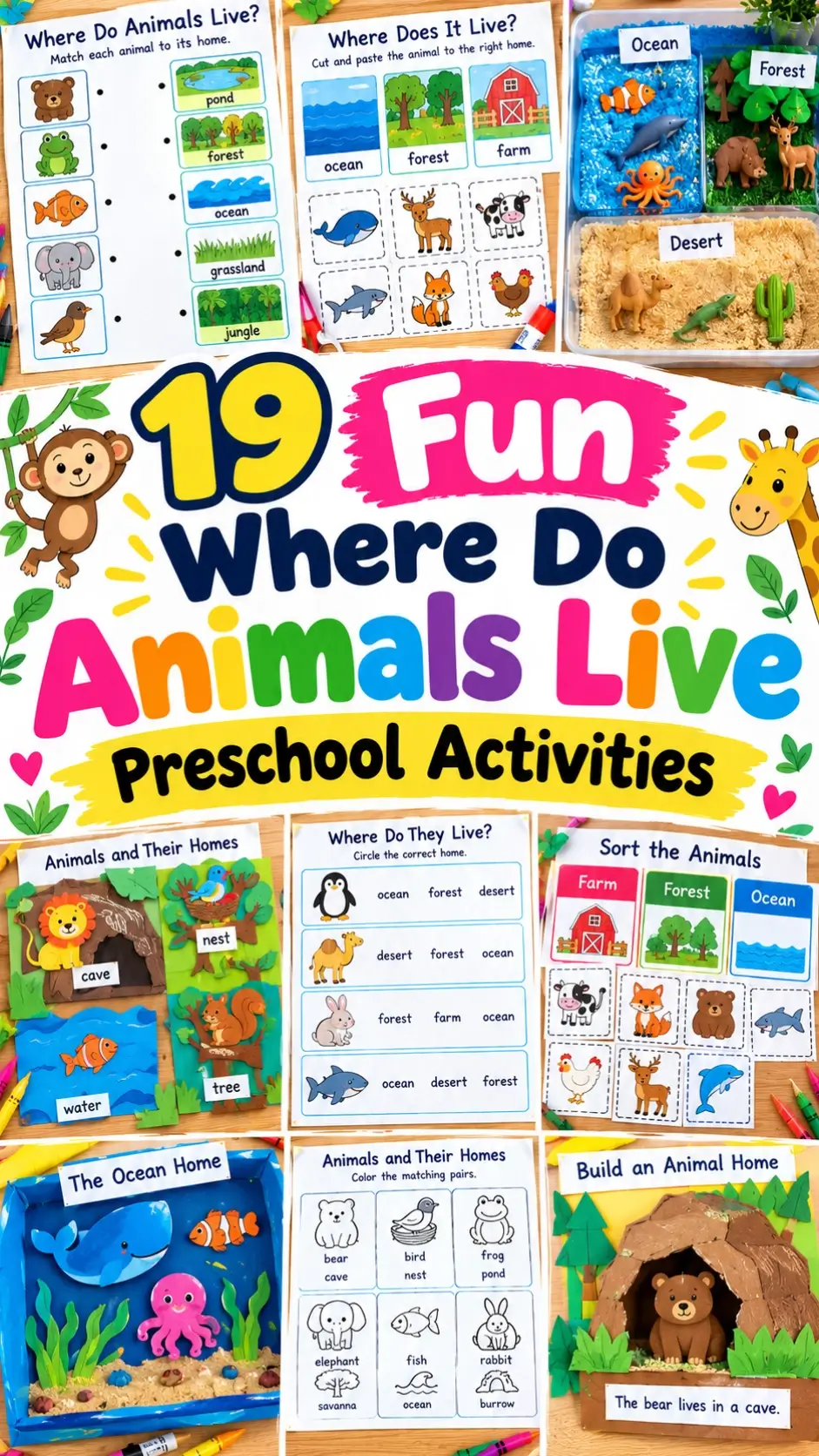
Where does a bird sleep? Where does a rabbit hide? Does a fish have a home? What about a bee?
Preschoolers ask questions like these all the time, like my little girl Hafsa. A simple where do animals live preschool activities theme gives you plenty of ways to turn those questions into play, conversation, movement, and early science learning.
The idea of a habitat can be very simple for young children: it is a place where an animal lives and gets what it needs. Preschoolers can begin by noticing different animal homes, such as nests, burrows, ponds, trees, caves, and oceans. Early Science Matters uses animal sorting and conversations about local animals to help preschoolers observe, describe, and classify where animals live.
I like starting with animals children already know. When I ask my little girl, Hafsa, where an animal lives, she usually has an answer ready, even when she’s guessing. That guess gives us something to talk about.
What can preschoolers learn about animal homes?
A habitat theme can introduce several simple science ideas:
- Animals live in different places.
- Some animals live on land, while others live in water.
- Some animals make homes in trees or underground.
- Animals need food, water, shelter, and space.
- Different animals can share the same habitat.
- Animal homes can look very different from human homes.
- Animals have body parts and behaviors that help them live where they do.
You don’t need to teach all of these ideas at once. Pick one question, explore it, and let your child’s questions take the activity somewhere else.
🔥 Related: 12 Fun Rhyming Activities for Preschoolers
1. Who lives here?
Choose a few animal pictures and several pictures of places.
You might use:
- Tree
- Pond
- Ocean
- Forest
- Underground
- Farm
Show your child one animal at a time.
“Where do you think the frog lives?”
“Where would you find a bird?”
“Which place could be a rabbit’s home?”
Let your child explain their choice, even if the answer needs a little help.
This type of sorting and discussion is close to the approach used by Early Science Matters, where preschoolers classify animals according to places where they might live and talk about what animals need in those places.
🔥 Related: 12 Who Am I Preschool Activities
2. Animal home picture hunt
Look through old magazines, children’s books, or printed animal pictures.
Ask your child to find an animal home.
They might spot a bird’s nest, a spider web, a rabbit burrow, or a beehive.
Cut out a few pictures and make a little animal homes collection.
Then ask:
“Who lives here?”
“What is the home made from?”
“Would you like to live there?”
The last question usually gets some funny answers.
3. Make a home for a toy animal
Give your child a toy animal and a few safe household materials.
A rabbit might get a small box with paper grass.
A bird might get a basket filled with strips of paper.
A bear might get a cardboard cave.
A turtle might get a little pond made from blue paper.
Let your child decide what the animal needs.
As they build, ask:
“Where will your animal sleep?”
“Where will it find food?”
“Where can it hide?”
Children can begin thinking about animal needs while creating something with their hands. Hands-on habitat building is also used in preschool habitat resources, including educational activities where children create animal homes from simple materials.
4. Build a bird nest
Go outside and collect safe, loose materials such as small twigs, dry grass, leaves, and fallen pieces of bark.
Then invite your child to make a pretend bird nest.
You can also do this indoors with strips of paper, yarn, and other safe materials.
Ask your child to imagine that a bird has eggs inside.
“What would make the nest comfortable?”
“How could the nest keep the eggs safe?”
The University of Oregon Museum of Natural and Cultural History uses nest-building as a preschool activity and explains that birds build nests to keep eggs and chicks safe and warm.
5. Animal home walk
Take a short walk around your yard, street, garden, or nearby outdoor space.
Look for signs of animal homes.
You might find:
- A bird nest
- An insect hiding under a leaf
- A spider web
- A hole in the soil
- Ant activity
- A bird sitting in a tree
You don’t have to find a wild animal itself. The home or evidence of an animal is enough.
Ask, “Who do you think lives here?”
A neighborhood walk is specifically suggested as an extension for preschoolers learning about animal homes.
6. Make an animal home map
Draw a simple map on a large sheet of paper.
Add places such as:
Tree → Pond → Grass → Underground → House
Give your child animal pictures or small toy animals.
Ask them to place each animal where they think it lives.
Then add a few questions:
“Can the frog live in the tree?”
“Where could the bird build a nest?”
“Where could the rabbit hide?”
You can make the map as simple or silly as your child likes.
🔥 Related: 30 Best Preschool Learning Activities for 3-Year-Olds
7. Underground animal homes
Some animals spend time underground, which can be fascinating for preschoolers.
Talk about animals such as rabbits, moles, ants, and some rodents.
Draw a line across a piece of paper to show the ground.
Above the line, draw grass and plants.
Below the line, draw tunnels.
Now let your child draw an animal inside its underground home.
Ask:
“What do you think the tunnel looks like?”
“Where would the animal sleep?”
“What could it find underground?”
This gives children a first look at the idea that an animal’s home can be hidden from us.
8. Animal home hide-and-seek
Place several “homes” around the room.
A box can be a burrow.
A chair can become a tree.
A blue blanket can become a pond.
A table can become a cave.
Give your child an animal toy and say:
“Find your home!”
Then switch roles.
Your child chooses an animal and tells you where it should go.
This turns habitat vocabulary into a simple game of movement and pretend play.
🔥 Related: 25 Best Preschool Learning Activities for 4-Year-Olds
9. Who lives in the tree?
Pick one tree in your yard or neighborhood.
Look carefully at its branches and trunk.
Ask your child what animals might use the tree.
Depending on your area, you might talk about birds, squirrels, insects, spiders, or other small creatures.
You can then draw a large tree on paper and let your child add animals to different parts.
“Who lives in the branches?”
“Who might crawl on the trunk?”
“Who could hide under the tree?”
10. Animal home building challenge
Give your child a small collection of building materials such as cardboard pieces, blocks, paper cups, and craft sticks.
Choose one animal.
Then give your child a simple challenge:
“Can you build a home for a turtle?”
Or:
“Can you make a safe place for a bird?”
Once the home is finished, ask your child to explain it.
“What is the door?”
“Where does the animal sleep?”
“How can it get inside?”
This activity encourages children to think about an animal’s needs while also giving them freedom to design.
11. Match the animal to its home
Make pairs of cards.
One card has an animal.
The other has its home.
Try simple pairs such as:
- Bird → nest
- Rabbit → burrow
- Bee → hive
- Spider → web
- Fish → water
- Bear → den
Put the cards face up at first.
Later, turn them over and play a simple memory game.
Animal-home matching is a common preschool approach because children can practice classification while talking about why an animal belongs in a particular place.
12. Make a cozy bear den
Turn a blanket-covered corner into a pretend bear den.
Your child can crawl inside with a stuffed bear.
Talk about why an animal might want a sheltered place.
“Is the den warm or cold?”
“Is it bright or dark?”
“Where would the bear rest?”
The University of Oregon’s preschool animal-homes activities also include building a bear den as a way for children to think about animal shelter.
13. Animal home sound game
Choose an animal and make its sound.
Then ask your child:
“Where does this animal live?”
For example:
Quack, quack!
“Where does the duck live?”
Buzz, buzz!
“Where does the bee live?”
Hoot, hoot!
“Where does the owl live?”
Let your child make the sound while you guess the animal and its home.
It’s a quick activity for car rides, waiting rooms, or those five minutes before dinner.
14. Build a pond home
Use blue paper or a shallow tray to make a pretend pond.
Add toy animals or drawings of frogs, ducks, fish, turtles, and insects.
Ask your child which animals belong near the water.
Then ask:
“What does the frog need?”
“Where does the fish swim?”
“Which animal can live both in water and on land?”
River and pond small-world activities are used in preschool habitat learning because children can create a physical environment and then explore which animals might live there.
15. Make a spider web
Give your child a piece of paper and white crayons.
Ask them to draw lines that cross over one another to make a spider web.
Then add a small paper spider.
Talk about where spiders make webs and what the web is used for.
For a movement version, use yarn to make a pretend web across a small area and let your child carefully move around it.
Keep the setup simple and supervise younger children around string or yarn.
16. Habitat movement game
Give different areas of the room a habitat name.
For example:
Tree: reach up high.
Pond: pretend to swim.
Burrow: crouch down.
Ocean: move your arms like fins.
Nest: curl up small.
Call out an animal.
Your child moves to the place they think is its home and acts like that animal.
Active animal-home games are a familiar preschool approach. Hands On As We Grow uses land, water, and air as movement categories, asking children to change their bodies based on where an animal lives.
17. What does the animal need?
Choose one animal.
For example, choose a rabbit.
Draw a rabbit in the middle of a piece of paper.
Around it, draw or place pictures of things it might need:
- Water
- Food
- Shelter
- Space
Then add a few silly choices, such as a television or a bicycle.
Ask your child which things belong in the rabbit’s habitat.
This helps preschoolers connect the idea of a home with the basic things animals need to live.
18. Create an animal home book
Fold several pieces of paper together.
Give each page a simple sentence:
A bird lives in a ______.
A rabbit lives in a ______.
A fish lives in ______.
A bee lives in a ______.
Your child can draw the answer on each page.
If your preschooler is beginning to recognize letters, you can write the missing word and let them trace it.
You can also keep the book entirely picture-based for younger children.
19. Design a home for a pretend animal
Now make the activity a little more imaginative.
Invent an animal together.
Maybe it has long ears, tiny feet, and a huge tail.
Ask:
“Where does our animal live?”
“What does its home look like?”
“What does it eat?”
“Does it sleep in a tree, underground, or near water?”
Let your child draw the animal and its home.
This combines habitat vocabulary with pretend storytelling, and children can come up with some wonderfully strange homes.
How to make animal habitat activities easier for preschoolers
Start with familiar animals.
A child who knows birds, dogs, cats, fish, frogs, and rabbits has a useful starting point.
Use photographs or real observations when you can. Early Science Matters recommends discussing animals children have actually seen in their neighborhood before extending the conversation to other habitats.
Keep the number of habitats small at first.
You could begin with:
- Land
- Water
- Trees
- Underground
Once your child understands those categories, introduce places such as forests, deserts, oceans, or polar regions.
A simple 5-day Where Do Animals Live Preschool Activities List
You can spread these activities across a week without turning the theme into a long school lesson.
Day 1: Animal homes
Try the animal picture hunt and “Who lives here?” activity.
Day 2: Homes animals build
Make a bird nest and a bear den.
Day 3: Hidden homes
Explore underground homes and make a simple animal home map.
Day 4: Water homes
Build a pretend pond and talk about animals that live in or near water.
Day 5: Build and pretend
Let your child design a home for a toy animal or an imaginary animal.
A short activity each day is plenty for most preschoolers.
🔥 Related: How Many Hours Should a Preschooler Study
Should you use animal habitat worksheets?
Worksheets can work well as a short follow-up after hands-on learning.
For example, you could make a page with four large habitat pictures and ask children to draw or paste an animal in each one.
Other simple worksheet ideas include:
- Match animals to their homes
- Circle the animal that lives in the water
- Draw an animal in its home
- Trace habitat words
- Color an animal’s home
- Complete a simple animal-home maze
Little Bins for Little Hands includes habitat-themed preschool printables such as mini-books, tracing cards, clip cards, writing activities, coloring activities, and habitat dioramas.
For younger preschoolers, I’d keep the page large and visual. One or two tasks are enough.
Books that pair well with an animal homes theme
A picture book can give you a natural starting point before an activity.
Look for books about:
- Animal homes
- Nests
- Burrows
- Forest animals
- Ocean animals
- Farm animals
- Insects and their homes
Early Science Matters suggests Who Lives in a Tree? by Christie Matheson along with other books connected to animal homes.
You can also pause while reading and ask, “Where does this animal live?” That one question can turn story time into a short science conversation.
Common mistakes when teaching animal habitats
Trying to teach too many habitats at once
Preschoolers can learn a lot, but a long list of habitats can quickly become a memory exercise.
Start with places your child already understands.
Focusing only on memorizing matches
“Fish equals water” is useful, but asking “Why does the fish live there?” leads to a richer conversation.
Your child’s answer can be simple: “Because it swims.”
That’s enough to keep the conversation going.
Correcting every answer immediately
If your child says a squirrel lives in a nest, ask what they’ve seen before explaining that squirrels can make homes such as nests or use tree cavities.
The conversation matters more than getting every answer perfect on the first try.
Frequently asked questions
What animals live underground?
Rabbits, moles, ants, and some other animals use underground spaces. You can introduce this idea with drawings or a pretend tunnel rather than expecting preschoolers to memorize a long list.
What animals live in trees?
Birds, squirrels, some insects, and many other animals use trees for shelter, food, nesting, or resting. The exact relationship varies by animal.
What animals live in water?
Fish live in water, and many other animals spend part or all of their lives in aquatic habitats. Frogs, turtles, ducks, and some insects can also be associated with ponds, rivers, lakes, or other freshwater environments.
What is the best age to teach animal habitats?
Preschool is a good time to begin simple habitat concepts. Early Science Matters specifically provides a “Where do Animals Live?” lesson for toddlers and preschoolers focused on observing, describing, and categorizing animals and their homes.
Final thoughts
Animal homes are everywhere once you start looking.
A nest in a tree, a hole in the soil, a spider web in the corner, or a frog near a pond can all become part of a preschool science conversation.
Start with one animal your child loves. Ask where it lives, look for clues, and then let your child build, draw, move, or pretend.
That’s usually enough to turn a simple question into a good afternoon of learning.