
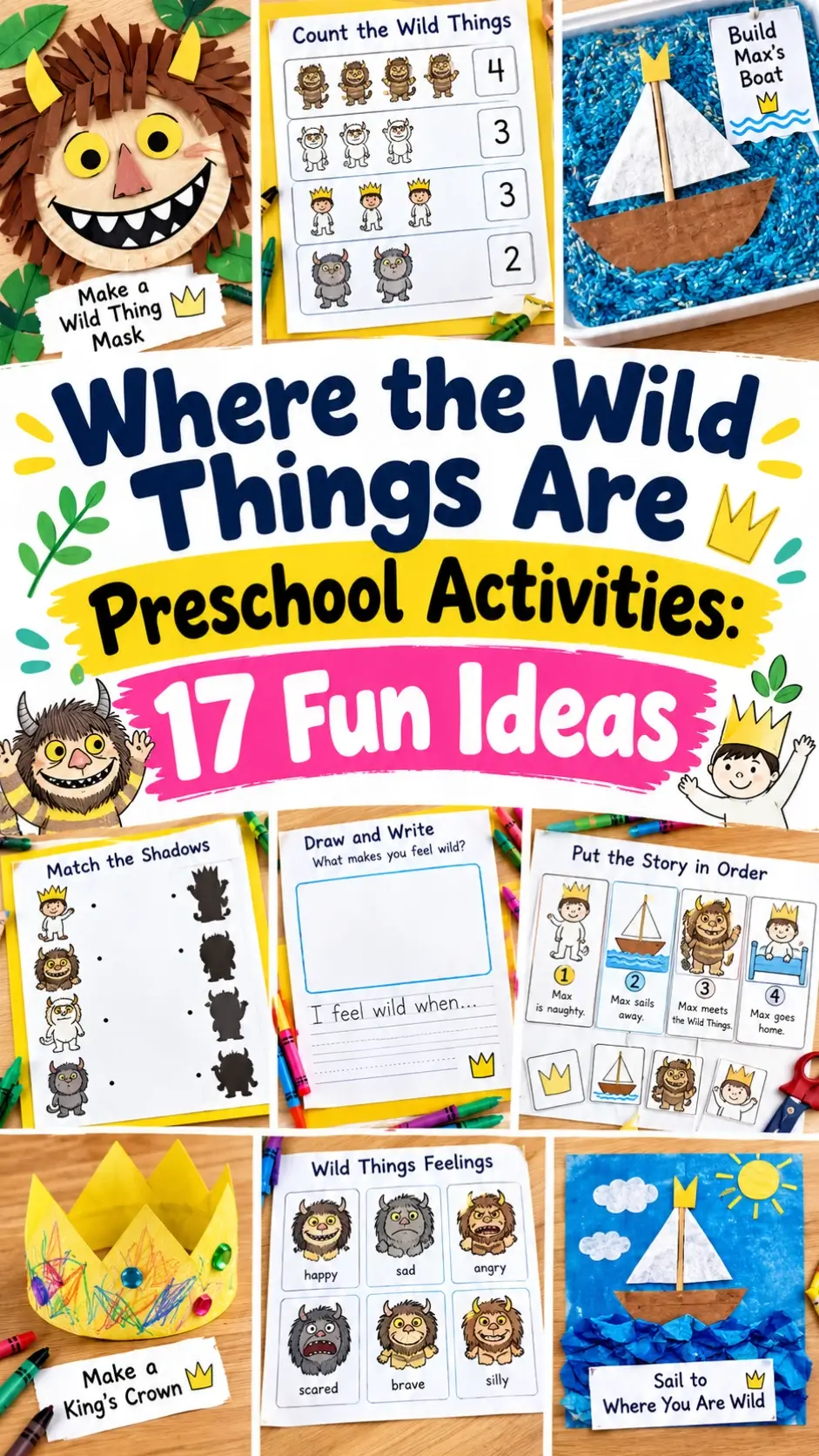
Where the Wild Things Are by Maurice Sendak is the kind of book that gives preschoolers plenty to talk about. Max sails away to an island, meets the Wild Things, becomes their king, has a wild rumpus, and eventually decides that home is where he wants to be.
That makes the story useful for much more than story time. You can turn it into simple preschool activities that build language, early literacy, imagination, movement, emotional awareness, and fine motor skills.
I like preschool activities that let children play with a story instead of turning every book into a worksheet. I see this with my little girl, Hafsa. When a story gives her something to pretend, act out, touch, or create, she stays interested much longer.
Here are some Where the Wild Things Are preschool activities you can try after reading the book.
Why Where the Wild Things Are Preschool Activities work so well
The story has several ideas that young children can understand through play.
Max experiences anger, excitement, loneliness, comfort, and the feeling of returning home. Children can talk about those feelings without needing complicated explanations.
The book also gives them plenty of opportunities to use their imagination. A bedroom becomes a forest, a boat travels across the sea, and strange creatures become Max’s friends.
You can use those ideas for short activities rather than trying to teach everything in one sitting.
1. Make a Wild Thing sound
Ask your preschooler to invent a sound for an imaginary Wild Thing.
Maybe it growls.
Maybe it goes, “Roar-roar!”
Maybe it makes a tiny squeak instead.
Take turns making a sound while the other person guesses what kind of creature could make it. Then change the sound and create another creature.
This is a simple way to encourage listening, speaking, and imaginative language.
🔥 Related: 12 Fun Rhyming Activities for Preschoolers
2. Max’s journey with picture cards
Create five simple picture cards:
- Bedroom
- Forest
- Boat
- Island
- Home
Mix them up and ask your child to put them in the order of Max’s journey.
Once the cards are arranged, ask questions such as:
“Where did Max start?”
“What did he travel in?”
“Where did he meet the Wild Things?”
“What happened at the end?”
This gives preschoolers practice with story order and remembering important events. Sequencing activities are also commonly used as extensions to this story for young learners.
3. Build Max’s boat
Give your child cardboard, paper tubes, craft sticks, paper cups, or small boxes.
Ask them to build a boat that Max could use to travel across the sea.
There’s no need for the boat to look perfect. Let your child decide where the seat, sail, and flag should go.
After building it, ask, “Where would you sail if you were Max?”
You may get some wonderfully unexpected answers.
🔥 Related: 12 Who Am I Preschool Activities
4. Will the boat float?
Take the boat from the previous activity and test it in a shallow container of water.
Before putting it in the water, ask:
“Do you think it will float?”
Then test it.
If it sinks, change the design and try again. Add or remove materials and see what happens.
Keep this activity supervised and use only materials that are safe around your child.
The goal isn’t to teach complicated physics. Preschoolers are simply noticing that different objects behave differently in water.
🔥 Related: 10 Beginning Sound Activities for Preschoolers
5. Design your own Wild Thing
Give your child a blank sheet of paper and invite them to invent a creature that Max might meet.
Ask simple questions:
“What does your Wild Thing look like?”
“Does it have horns?”
“How many eyes does it have?”
“What does it like to eat?”
“What is its name?”
Write down your child’s answers underneath the drawing.
This turns a simple monster picture into a language activity. The child creates the ideas, while you help put those ideas into words.
🔥 Related: 12 Fun Alphabet Activities for Preschoolers
6. Wild Thing body-part game
Call out a body part and ask your child to move it like a Wild Thing.
For example:
“Wiggle your Wild Thing fingers.”
“Stomp your Wild Thing feet.”
“Turn your Wild Thing head.”
“Open your Wild Thing mouth.”
Then let your child become the caller.
This works well for preschoolers because they have to listen carefully and connect a spoken word with a body movement.
7. Make a Wild Thing habitat
Use blocks, cardboard, paper, or other safe loose parts to create a home for an imaginary Wild Thing.
Your child might build a cave, forest shelter, castle, or tiny island.
Once it’s finished, ask:
“Where does your Wild Thing sleep?”
“Where does it eat?”
“Where does it hide?”
“What can it see from its home?”
You can then introduce simple location words such as inside, behind, beside, under, and on top as your child explains the habitat.
8. Max’s crown decorating
Max becomes King of the Wild Things, so a crown fits naturally into the story.
Cut a simple crown shape from paper or cardstock and let your child decorate it with crayons, stickers, paper shapes, or drawings.
Once it’s finished, put it on and ask:
“If you were King or Queen of the Wild Things, what would your first rule be?”
Keep the question playful. One child might say, “Everyone gets bananas,” while another might declare that every Wild Thing has to dance before breakfast.
9. Wild feelings faces
Talk about how Max might have felt at different points in the story.
You can use simple facial expressions:
- Angry
- Excited
- Scared
- Lonely
- Happy
- Calm
Ask your child to make each face.
Then ask, “When might you feel like that?”
This gives preschoolers a chance to connect a fictional character’s experience with their own feelings. Teacher resources for the book also use Max’s experiences as a starting point for conversations about emotions and what helps children feel safe or better.
10. What would you pack for the island?
Pretend your child is sailing away to the island.
Give them a few picture cards or household objects and ask them to choose three things to take.
You could offer:
- A blanket
- A toy
- A spoon
- A book
- A flashlight
- A hat
- A teddy bear
Then ask, “Why did you choose that?”
There can be several good answers. The interesting part is hearing your child’s reasoning.
11. Wild Thing listening game
Have your child close their eyes while you make a sound somewhere nearby.
You could tap a table, shake a container filled with large safe objects, clap, knock on a door, or crumple paper.
Ask your little Wild Thing to guess what made the sound.
Then switch roles.
This is a quick listening game that doesn’t require any special materials.
12. Make a Wild Thing puppet
Instead of making a mask, create a simple paper puppet.
Draw a Wild Thing face on cardstock, cut it out, and attach it to a craft stick. Your child can add ears, hair, teeth, horns, or anything else they imagine.
Now use the puppet to have a short conversation:
“Hello, Wild Thing. Where do you live?”
“What do you like to do?”
“Are you hungry?”
“What happened today?”
Paper-bag puppets and puppet play are also commonly suggested as extensions of the story, but a simple stick puppet keeps this version manageable for preschoolers.
13. Wild Thing action cards
Make a few cards with simple actions:
- Stomp
- Crawl
- Tiptoe
- Stretch
- Spin
- March
Let your child pick a card and perform the action like a Wild Thing.
You can make the game harder by putting two cards together.
For example:
“Stomp, then tiptoe.”
Later, try three actions.
This gives children practice listening to and remembering short sequences.
14. Where is the Wild Thing?
Hide a Wild Thing toy, puppet, or drawing somewhere in the room.
Give your child clues using simple position words.
For example:
“The Wild Thing is under something.”
“The Wild Thing is beside the chair.”
“The Wild Thing is behind the pillow.”
Once your child finds it, let them hide it for you.
This turns the story theme into a playful way to practice positional language.
15. Create a Wild Thing snack
Make a simple snack together and give it a silly Wild Thing name.
For example, banana slices could become Wild Thing Teeth, while cucumber pieces could become Monster Eyes.
Let your child arrange the food on a plate and invent a name for the finished creation.
You can talk about colors, shapes, textures, and the different foods while preparing it.
Always choose foods that are appropriate for your child’s age and supervise eating.
16. My wild adventure drawing
Give your child a blank piece of paper and ask:
“If you could sail away like Max, where would you go?”
Maybe your child chooses a dinosaur island.
Maybe it’s a candy forest.
Maybe it’s a place filled with cats.
Let them draw the place and then tell you what happens there.
Write one or two sentences underneath their picture using their own ideas.
This makes a nice early storytelling activity without asking a preschooler to write a long story.
17. Quiet return-home activity
The story ends with Max returning home.
After all the noisy Wild Thing activities, end with something quiet.
Give your child a blanket and a favorite book. Talk about what makes home feel comfortable.
Ask:
“What makes you feel safe at home?”
“Who do you like to be with?”
“What is your favorite place to relax?”
It’s a gentle way to move from the excitement of the story back into a calm routine.
How to use these activities with preschoolers
You don’t need to complete all of these educational activities in one day.
Read the book first. Then choose one or two activities that match your child’s mood and attention span.
For a younger preschooler, a 5–10 minute activity may be enough. Older preschoolers may stay with building, storytelling, or pretend play longer.
And let your child take the activity in a different direction when they have an idea. Preschool learning often happens during those unexpected moments.
A simple Where the Wild Things Are activity plan
If you’re using the book for a small preschool theme, you could spread the activities over several days.
| Days | Activities |
|---|---|
| Day 1 | Read the story and make Wild Thing sounds. |
| Day 2 | Sequence Max’s journey and build a boat. |
| Day 3 | Test the boat in water and create a Wild Thing habitat. |
| Day 4 | Make a Wild Thing puppet and play with it. |
| Day 5 | Talk about feelings and draw a wild adventure. |
This gives children repeated exposure to the story while keeping the activities different.
Can you use worksheets with Where the Wild Things Are?
Yes, especially with older preschoolers who enjoy short table activities.
A worksheet could ask children to:
- Match Max to his boat.
- Count Wild Thing features.
- Trace simple monster-themed lines.
- Identify basic shapes.
- Match pictures from the story.
- Draw their own Wild Thing.
- Circle how a character might feel.
Keep worksheets short and hands-on. The book itself gives you plenty of opportunities for movement, conversation, pretend play, and creative work, so the worksheet doesn’t need to carry the whole lesson.
Tips for making the activities work
Follow your child’s interest. If your child wants to spend 20 minutes building the boat, let the boat activity become the main activity.
Keep questions simple. Preschoolers usually respond better to “Where would you go?” than a long list of comprehension questions.
Use ordinary materials. Paper, cardboard, crayons, blocks, toys, and household objects are enough for most of these preschool activities.
Let imagination lead. Your child’s Wild Thing doesn’t need to look like the creatures in the book.
Keep active and quiet activities together. A noisy movement game followed by drawing or reading can help the session feel balanced.
Frequently asked questions
What age is Where the Wild Things Are suitable for?
The book can work well with preschool and early elementary children. For preschoolers, focus on the illustrations, simple questions, movement, pretend play, and creative activities rather than formal literary analysis.
What can preschoolers learn from Where the Wild Things Are?
Children can practice listening, storytelling, sequencing, vocabulary, emotional expression, movement, fine motor skills, imagination, and simple problem-solving through activities connected to the story.
How can I make Where the Wild Things Are interactive?
Pause during the read-aloud and ask children what they notice in the pictures. After reading, let them act, build, draw, create puppets, make sounds, or invent their own adventure.
Final thoughts
Where the Wild Things Are gives preschoolers a lot to work with. Max’s adventure can become a boat-building challenge, a feelings conversation, a Wild Thing puppet, a movement game, or a completely new story invented by your child.
You don’t have to turn every idea into a formal lesson. Read the book, pick an activity your child finds interesting, and let the play take it from there.