
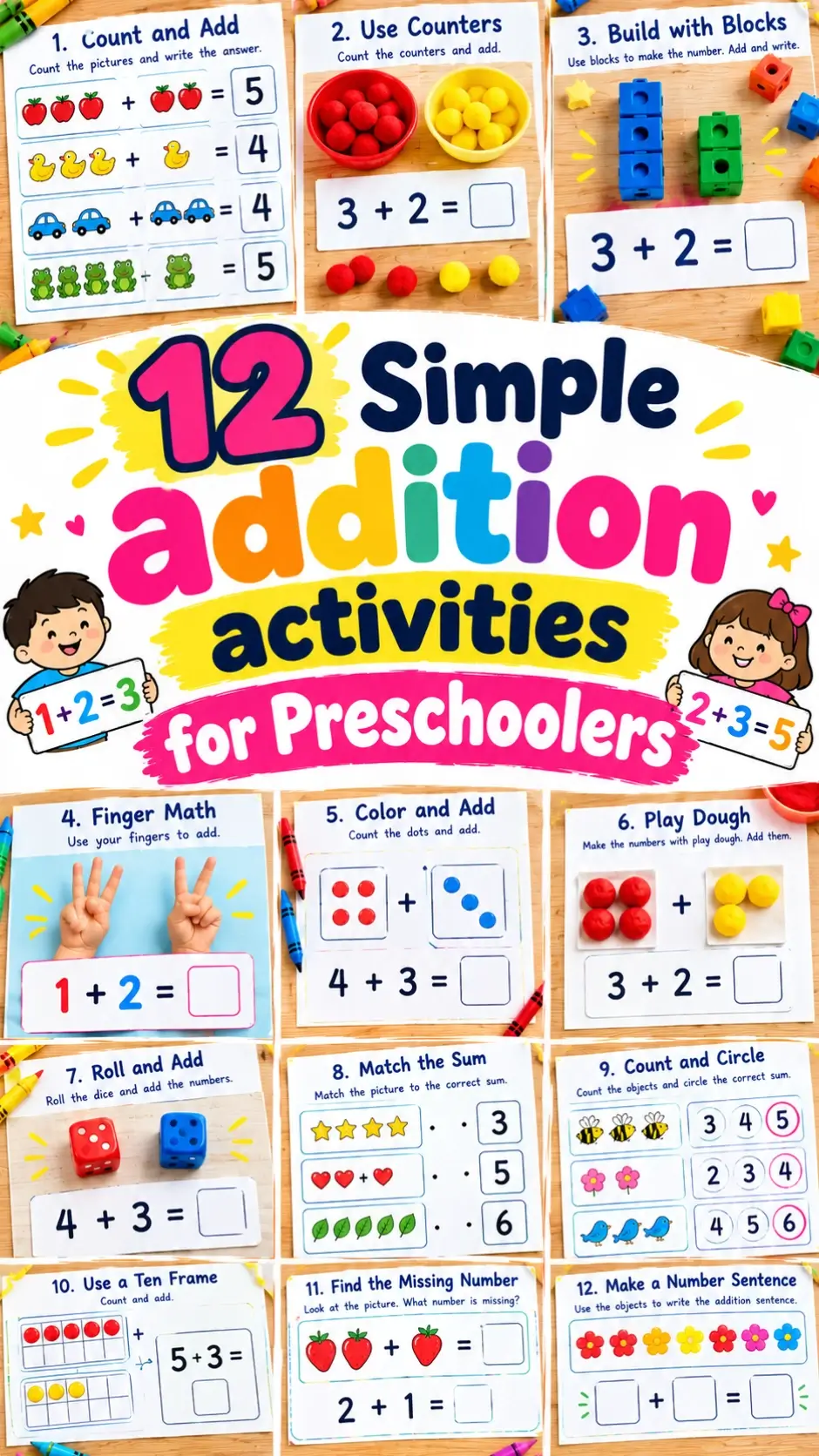
Simple addition can be surprisingly fun when a child gets to move the objects, make a little story, and find the answer for themselves.
For preschoolers, I like starting with very small numbers. Put 2 toy animals on the table, add 1 more, and ask, “How many animals are there now?” Your child can touch each one and count the whole group.
That physical part matters. Preschool children are still building the connection between a number and an actual quantity, so addition makes more sense when they can see and handle what is happening.
I use these simple addition activities for preschoolers when I want math practice to feel like ordinary play. Most need things you probably already have at home.
What does addition mean for a preschooler?
At this age, addition means putting groups together and finding out how many there are altogether.
For example:
2 + 1 = 3
You can place 2 buttons on one side of a table and 1 button beside them. Push the groups together, then count all 3 buttons.
The symbols can come later. First, your child needs to understand the action behind the equation.
A useful question is:
“We have 2 here and 1 more. How many do we have altogether?”
Words such as add, more, together, and altogether give children language for what they’re doing.
When should preschoolers start learning addition?
There isn’t one exact age when every child should start.
Around ages 4–5, many children are ready to explore very small addition problems if they can count small groups accurately and understand that numbers represent quantities. Some children will be ready earlier, while others need more time with counting first.
If your child is still working on recognizing numbers, start there. My number recognition activities for preschoolers can help build that foundation.
And if counting objects is still tricky, spend some time with these counting activities for preschoolers before asking your child to combine 2 groups.
You can also keep the rest of preschool learning varied. My guide to the best educational activities for preschoolers has ideas across early literacy, math, movement, and other skills.
12 simple addition activities for preschoolers
1. Two bowls, one total
Grab 2 small bowls and a handful of buttons, pom-poms, or large counters.
Put 2 objects in the first bowl and 1 in the second.
Ask your child to pour both bowls onto the table and push everything into one group.
“2 and 1 more. How many altogether?”
Start with totals up to 5. Once your child is comfortable, try combinations such as 3 + 2.
2. Finger addition
Your child’s hands are already right there, so use them.
Hold up 2 fingers on one hand. Then show 1 finger on the other.
Ask your child to count all the fingers.
2 + 1 = 3
Try different combinations within 5. You can even let your child make the problem for you.
“Show me 1 and then add 2.”
This is a nice activity for a few minutes while you’re waiting somewhere.
3. Domino addition
If you have dominoes at home, pick one with small numbers of dots.
Cover the middle line with your finger and look at the 2 sides separately.
For example:
2 dots + 3 dots = 5 dots
Let your child touch each dot as they count.
You don’t need to ask for written equations at first. The domino itself gives your child a picture of the 2 groups.
4. Clothespin addition
Draw 2 simple circles on a piece of paper.
Write a small number above each circle, such as 2 and 1.
Your child places the correct number of clothespins around each circle. Then bring the 2 groups together and count them.
You can use paper clips instead if clothespins are difficult for little hands.
For younger preschoolers, skip the written numbers and simply say the numbers aloud.
5. Animal family addition
Bring out a few toy animals.
Place 2 ducks in front of your child.
“2 ducks are swimming.”
Then add 1 more.
“1 more duck came over. How many ducks are swimming now?”
Your child can physically move the new animal into the group and count.
You can change the story each time. 2 cats get 1 more cat. 1 bear gets 2 more bears. 3 fish get 1 more fish.
If your child enjoys animal themes, you can pair this with my where do animals live preschool activities for a different kind of learning session.
6. Bead string addition
Take a piece of string or a shoelace and some large beads.
String 2 beads.
Then add 1 more.
Ask your child to count the beads from the beginning.
For another round, make 1 bead one color and 2 beads another color. The color change helps your child see that the total came from 2 separate groups.
Keep the beads large enough to avoid a choking risk, and supervise closely.
7. Addition with paper plates
Draw 2 small circles on a paper plate.
Place 1 sticker in the first circle and 2 stickers in the second.
Now draw a larger circle underneath them.
Your child moves the stickers into the larger circle and counts the total.
You can make several plates before starting and change the numbers each time.
This works well because the 2 starting groups stay visually separate until your child combines them.
8. Make an addition story
Preschoolers love stories, especially when the story involves something they can touch.
Put 2 toy cars on the floor.
“2 cars are at the house. 1 more car drives over.”
Move another car into the group.
“How many cars are here now?”
Then let your child create the next story.
Maybe 1 puppy has 2 bones. Maybe 3 dolls are having a picnic, and 1 more arrives.
The story gives the numbers a reason to exist.
9. Addition with dot cards
Make a few cards with groups of dots.
For one problem, use a card with 2 dots and another with 1 dot.
Place them side by side.
Your child counts both groups and then counts them together.
You can make the cards with a marker in a couple of minutes. Keep each group small and clearly spaced.
Once your child understands the idea, put a plus sign between the cards and an equals sign before the total.
●● + ● = ●●●
That little step helps connect the objects to the symbols.
10. Handprint addition
Trace your child’s hand twice on paper.
On one hand, draw 2 small dots on the fingers. On the other, draw 1 dot.
Ask your child to count the dots on both hands.
Then count all the dots together.
You can change the numbers on different days.
This one also makes a cute page for a preschool math folder. Hafsa would probably be more interested in choosing which finger gets the dots than listening to a long explanation, which is exactly why I like activities like this.
11. Add the toy food
Use pretend food from a toy kitchen, or cut simple food shapes from paper.
Put 2 pieces on a plate.
“Here’s 2 strawberries.”
Add 2 more.
“Now we have 2 more. How many strawberries are there altogether?”
Let your child move the pieces and count.
You can make this part of pretend cooking. If your child enjoys helping in the kitchen, you can also try some of these preschool cooking activities.
12. Build the answer with craft sticks
Put 2 craft sticks on the table.
Add 1 more.
Your child pushes the sticks together and counts 3.
Then ask, “Can you make 2 + 2?”
The child builds both groups and combines them.
You can eventually write the matching equation underneath:
2 + 2 = 4
This works especially well with a child who likes building things.
Simple addition examples to try
Keep your first problems small.
Try:
- 1 + 1 = 2
- 1 + 2 = 3
- 2 + 1 = 3
- 2 + 2 = 4
- 3 + 1 = 4
- 1 + 3 = 4
- 3 + 2 = 5
- 2 + 3 = 5
You don’t need to run through all of them in one sitting.
Pick 1 or 2 and let your child play with the objects. Repeating a problem in a new story can be more useful than rushing through 10 different equations.
Addition activities for 3-year-olds
For most 3-year-olds, I’d keep addition very informal.
Use:
- 1 + 1
- 1 + 2
- adding 1 more
- real objects
- fingers
- short stories
You don’t need written equations yet.
If you’re looking for more ideas at this age, see my preschool learning activities for 3-year-olds.
And remember that preschool learning doesn’t need to fill a large part of the day. My guide on how many hours a preschooler should study explains how short, age-appropriate learning sessions can fit into a child’s routine.
Addition activities for 4-year-olds
A 4-year-old who is comfortable counting small groups can start working with totals up to 5.
Try:
- domino addition
- dot cards
- animal stories
- paper plate addition
- finger addition
- simple + and = equations
Give your child time to solve each problem with objects.
You can find more age-appropriate ideas in my guide to preschool learning activities for 4-year-olds.
Addition activities for 5-year-olds
A 5-year-old who is ready for more can work with totals up to 10.
Try asking:
“Can you make 5 in 2 different ways?”
For example:
2 + 3 = 5
4 + 1 = 5
Your child can build each combination with counters or craft sticks.
You can also introduce simple addition stories and ask your child to choose the numbers.
My preschool learning activities for 5-year-olds have more ideas for children at this stage.
What if my child gets the answer wrong?
Keep the objects in front of them.
If your child says 4 when there are 3 objects, don’t immediately answer. Ask them to touch each object and count again.
You might say:
“Let’s check together. Touch each one.”
If the numbers are too large, make the problem smaller.
A child who needs to go back to 1 + 1 isn’t falling behind. They’re getting another chance to understand the quantity.
Simple addition worksheets for preschoolers
Worksheets can fit nicely after hands-on practice.
For example, show:
🍎🍎 + 🍎 = ?
Your child counts the apples and writes 3.
You can also use:
- dots
- toy pictures
- fingers
- shapes
- animals
- simple food pictures
Keep the page uncluttered. A preschooler should be able to see the 2 groups without hunting through a crowded worksheet.
If you’re creating your own preschool worksheets, I’d keep most problems within 5 at first. Move toward 10 when your child is ready.
How long should an addition activity last?
Short is usually enough.
For a young preschooler, 5–10 minutes can be plenty. If your child is still interested, keep going. If they’re wandering off, getting silly, or guessing every answer, stop and try another day.
Math doesn’t need to become a daily battle.
You can also rotate it with literacy activities such as alphabet activities for preschoolers, beginning sound activities for preschoolers, and fun rhyming activities for preschoolers.
That gives your child a little math without turning the whole afternoon into school time.
More preschool activities to try
Addition is only one small part of preschool math.
If you’re building a broader learning routine, you might also enjoy:
- Which has more preschool activities for comparing quantities
- Easy math activities for preschoolers for a wider mix of early math ideas
- Where does food grow preschool activities for food and nature learning
- Where the Wild Things Are preschool activities for story-based play
- Who am I preschool activities for personal and language development
You can also browse my math activities for preschoolers for more hands-on ideas.
Frequently asked questions
What is the easiest addition activity for preschoolers?
Start with 2 small groups of objects.
Give your child 1 object in one group and 1 or 2 in another. Push the groups together and count everything.
Fingers, buttons, toy animals, and paper dots all work.
What numbers should preschoolers add?
Start with very small numbers, usually combinations that make totals of 5 or less.
Once your child understands those, you can gradually work toward totals of 10.
Should preschoolers learn addition facts by memorizing them?
Memorization isn’t the first goal.
Preschoolers benefit from seeing and touching the quantities they are adding. Once the idea makes sense, simple equations become easier to understand.
Can I teach addition with everyday objects?
Yes.
Buttons, toy animals, craft sticks, large beads, paper pieces, and pretend food can all become math materials.
You don’t need special equipment to ask, “We had 2. We added 1. How many now?”
Should I use addition worksheets with a preschooler?
You can, especially after your child has worked with real objects.
Picture-based worksheets can give children practice connecting quantities to simple addition problems. Keep the pages short and uncluttered.
What if my preschooler isn’t ready for addition?
Spend more time with counting and number recognition.
A child who can count objects accurately and connect a number to a quantity will have a much easier time when addition comes along.
Final thought
Simple addition can happen anywhere.
Two toy animals join one more. Two fingers meet one finger. A few paper dots move into one group.
Those tiny moments give preschoolers a chance to see what addition actually means. Keep the numbers small, let your child move the objects, and give them enough time to figure it out.
https://www.pinterest.com/kristyrael/addition-activities-preschool/
https://www.abcmouse.com/learn/activities/addition-activities-for-early-elementary-students/28000
https://www.teachstarter.com/us/blog/10-easy-simple-addition-activities-kids-us/
https://www.k5learning.com/free-preschool-kindergarten-worksheets/addition