
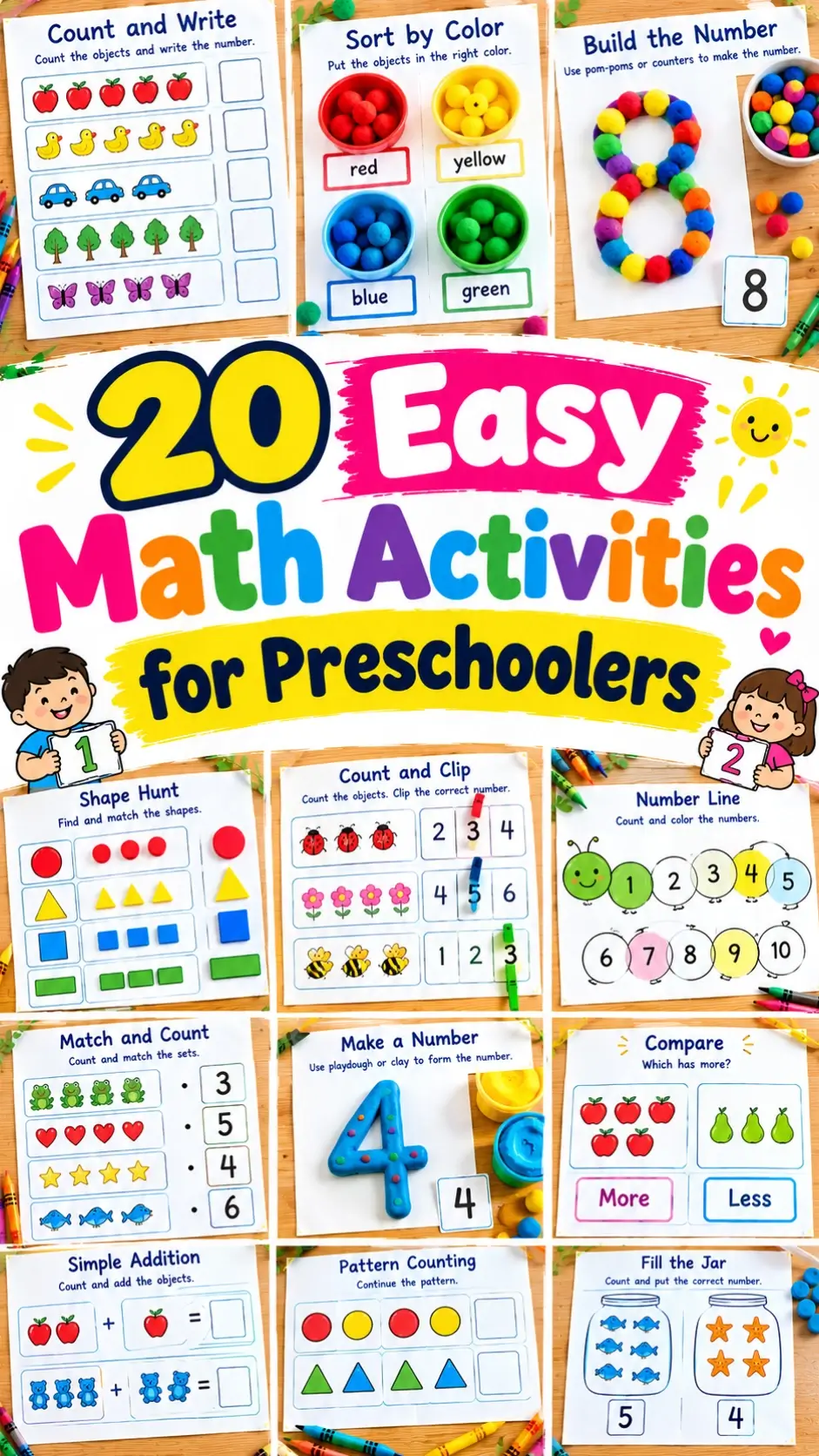
Math for preschoolers can happen almost anywhere.
You can sort laundry, compare the sizes of toys, build a tower, share snacks, look for shapes around the house, or figure out which container holds more water. These ordinary moments give young children a chance to use math without turning the day into a formal lesson.
I like educational activities that use things we already have at home. When my little girl Hafsa is playing with blocks, for example, I can sneak in a little math by asking which tower is taller or how many blocks she used.
Here are some easy math activities for preschoolers that you can try with very little preparation.
1. Sort the laundry
Give your child a small pile of clean laundry and ask them to sort it.
You can sort socks, shirts, towels, or anything else that’s easy to handle.
Start with one simple rule, such as putting socks in one pile and shirts in another. Later, try sorting socks by color or separating big towels from small ones.
Sorting is an early math skill because children have to notice similarities and differences and decide where each item belongs.
2. Make a shape picture
Cut out a few large circles, squares, rectangles, and triangles from paper.
Let your child use the shapes to make a picture.
A circle can become a sun. A triangle can become a roof. A rectangle can become a door.
Talk about the shapes while your child works.
“Which shape are you holding?”
“How many corners does it have?”
“Can you find a triangle?”
This gives shape learning a purpose instead of turning it into a memorization exercise.
3. Build towers and compare them
Give your child blocks and ask them to build 2 towers.
Make one tower short and another taller.
Then ask:
“Which tower is taller?”
“Which one is shorter?”
“Can you make this tower taller?”
“Can you make them the same height?”
You can use the same idea with cups, boxes, or magnetic tiles.
Comparing size is an important part of early math, and children can understand it much more easily when they can physically see and touch the difference.
4. Make a color pattern
Place 2 red blocks and 2 blue blocks in a repeating pattern:
Red, blue, red, blue.
Ask your child what should come next.
Once they understand that pattern, try something slightly harder:
Yellow, green, green, yellow, green, green.
Then let your child make a pattern for you to copy.
Patterns are a useful early math skill because children begin noticing what repeats and what comes next.
5. Find shapes around the house
Take a slow walk around your home and look for shapes.
A plate might be a circle.
A door might be a rectangle.
A window might be a square or rectangle.
A slice of pizza can look like a triangle.
You don’t need a worksheet. Your house already has plenty of math hiding in it.
If your child enjoys this kind of activity, you can also mix it into your other preschool learning activities.
6. Compare which container holds more
Take 2 safe containers and some water.
Ask your child which one they think will hold more.
Then let them test their guess by pouring water from one container into the other.
You can also use dry rice, beans, sand, or large safe objects if water isn’t convenient.
Preschoolers don’t need formal units such as liters or cups yet. They can begin by noticing that one container holds more, less, or about the same amount. Hands-on measuring with everyday containers is a common early math activity.
Stay close whenever water is involved, especially with younger children.
7. Make a pretend shop
Set up a tiny shop using toys, empty food containers, or pretend food.
Give each item a simple price such as 1, 2, or 3.
Your child can choose an item and hand you the matching number of pretend coins.
For example:
“Your apple costs 2 coins.”
Your child counts out 2 coins and gives them to you.
You can make the game more advanced for an older preschooler by giving them 5 coins and asking what they can buy.
8. Play with position words
Place a toy animal somewhere in the room.
Ask your child where it is.
“Is the teddy under the chair?”
“Can you put it on the table?”
“Now put it beside the box.”
You can also use words such as behind, in front of, inside, outside, above, and below.
These are early spatial math ideas. Children learn them through movement and real objects, which makes this an easy activity to repeat during normal play.
9. Make a simple shape puzzle
Draw a large house, car, flower, or person on paper.
Cut the picture into a few large geometric pieces.
Let your child put it back together.
You can make the pieces from circles, triangles, squares, and rectangles so your child also gets shape practice.
For a younger preschooler, use 2–4 large pieces. Older preschoolers can handle more.
10. Measure with blocks
Choose something in the room, such as a book or small table.
Ask your child to measure it using blocks.
Place the blocks end to end along the object.
Then ask:
“How many blocks long is the book?”
“What about this pencil?”
“Which one is longer?”
Using nonstandard units such as blocks helps children get a feel for length before they learn formal measurement units. Preschool math resources commonly use linking cubes and similar objects for this kind of hands-on measuring.
11. Make groups of the same size
Give your child a collection of large buttons, toy animals, blocks, or other safe objects.
Ask them to make groups.
For example:
“Can you make a group of 3?”
“Now make another group with 3.”
“Do both groups have the same amount?”
You can make the groups different sizes later and ask which group has more or fewer.
This connects naturally with your which has more preschool activities post.
12. Play a simple dice game
Use a large children’s die or a homemade paper die with dots.
Your child rolls it and moves a toy the same number of spaces.
If the die shows 4 dots, your child moves 4 spaces.
This combines counting, quantity, turn-taking, and following a simple rule.
Board games and dice games can give preschoolers practice with counting, ordering, matching, and sequencing while they’re playing.
For younger children, use a die with only 1–3 dots.
13. Make a snack pattern
Use 2 different foods that your child can safely eat.
For example:
banana, cracker, banana, cracker.
Ask, “What comes next?”
Then let your child make a pattern for you.
You can try:
grape, grape, cracker, grape, grape, cracker.
Food makes patterns surprisingly fun because your child gets to eat the finished activity.
If your child enjoys learning through food, you may also like my guide to preschool cooking activities.
14. Play “which one is bigger?”
Collect pairs of objects.
A large ball and a small ball.
A big box and a small box.
A long pencil and a short pencil.
Ask your child to compare each pair.
“Which is bigger?”
“Which is smaller?”
“Which is longer?”
“Which is shorter?”
Give your child plenty of chances to hold the objects. Preschoolers often understand comparison better when they can physically examine the things they’re talking about.
15. Make a simple addition story
You can introduce very early addition with toys.
Put 2 toy animals on the floor.
Then bring 1 more.
Say:
“Here are 2 animals. One more animal comes to visit. How many are there now?”
Let your child touch and count the toys.
Keep the numbers small. For many preschoolers, starting with totals up to 5 is enough.
Hands-on objects can help children understand that addition means putting quantities together before they work with written equations.
16. Fill the muffin tray
An empty muffin tray can become a little math station.
Give your child several large, safe objects such as blocks or pom-poms.
Ask them to put the same number of objects into each section.
Start with 1 in each cup.
Then try 2.
For older preschoolers, make some sections different and ask:
“Which cup has more?”
“Which has fewer?”
“Do these 2 have the same amount?”
17. Make a shape scavenger hunt
Give your child a simple challenge:
“Can you find 3 circles?”
Then walk around the house together.
Your child might find a plate, clock, lid, or bowl.
Next try squares or rectangles.
For older preschoolers, give them 2 shapes to find and compare how many they discovered.
ABCmouse and other preschool math resources also use scavenger-hunt style activities to get children looking for mathematical ideas in their surroundings.
18. Play with big and small
Put several objects in front of your child.
Ask them to put the biggest object on one side and the smallest on the other.
Then try arranging 3 objects from smallest to biggest.
Start with objects that have an obvious size difference.
You can use stuffed animals, boxes, balls, cups, or toy cars.
19. Make a simple graph with toys
Choose something your child has several of, such as toy cars.
Sort the cars by color.
Put the red cars in one row, blue cars in another, and yellow cars in another.
Then compare the rows.
“Which color has the most cars?”
“Which has the fewest?”
“Do 2 colors have the same number?”
You can do the same with blocks, toy animals, buttons, or even fruit.
20. Play a “same or different?” game
Put 2 objects beside each other.
Ask your child whether they are the same or different.
Start with obvious examples, such as a red block and a blue block.
Then make it harder.
Use 2 objects that are the same color but different sizes.
Or 2 objects that are different shapes but the same size.
This simple game helps children pay attention to attributes such as color, shape, and size.
Easy math activities for 3-year-olds
For 3-year-olds, keep the activities short and concrete.
Good choices include:
- Sorting laundry
- Shape pictures
- Big and small
- Simple patterns with 2 items
- Comparing 2 objects
- Position-word games
- Shape hunts
You can find more ideas in my guide to preschool learning activities for 3-year-olds.
Let your child handle the objects. A 3-year-old learns a lot from moving things around, making mistakes, and trying again.
Easy math activities for 4-year-olds
A 4-year-old can usually handle activities with a little more structure.
Try:
- Measuring with blocks
- Simple dice games
- Pretend shopping
- Shape scavenger hunts
- Simple graphs
- Longer repeating patterns
- Comparing several objects
My preschool learning activities for 4-year-olds has more activities for this stage.
Easy math activities for 5-year-olds
By 5, many children are ready for early addition, simple measurement questions, more complex patterns, and comparisons involving several objects.
You can ask questions such as:
“Which tower is tallest?”
“How many more blocks does this tower have?”
“What number comes next?”
“Can you make 5 using 2 groups?”
Give your child time to think before helping.
For more age-specific ideas, see preschool learning activities for 5-year-olds.
What math skills should preschoolers learn?
Preschool math covers much more than recognizing numbers.
Children can gradually work on:
- Counting
- Quantity
- Comparing amounts
- Sorting
- Matching
- Patterns
- Shapes
- Size
- Position and direction
- Measurement
- Simple addition and subtraction
- Spatial thinking
Hands-on preschool math centers commonly include materials for counting, sorting, patterns, shapes, sizes, matching, and comparisons.
Your child doesn’t need to master every skill at once.
How to make math part of everyday life
Look for little opportunities instead of setting up a formal math lesson every time.
Count the cups while setting the table.
Compare 2 shoes.
Sort socks.
Ask which bowl holds more cereal.
Look for rectangles while walking outside.
Make a pattern with blocks.
Ask how many apples you need from the grocery bag.
These moments add up.
And if you’re planning several learning activities during the week, keep the sessions reasonable for your child’s age. My guide on how many hours should a preschooler study covers practical preschool learning time.
Do preschoolers need math worksheets?
Worksheets can be useful for some children, especially when they’re ready to practice a skill they’ve already explored with real objects.
Hands-on activities should still have plenty of space in preschool math.
A child can learn what “more” means by comparing 2 bowls of blocks. They can learn shapes by handling them. They can understand patterns by making them.
Then a worksheet can give that learning another place to land.
Easy math activities don’t need expensive materials
You can do a lot with things already sitting around your home.
Use:
- Socks
- Cups
- Blocks
- Boxes
- Toy animals
- Buttons
- Paper
- Crayons
- Snacks
- Containers
- Leaves and sticks
A preschool math center can also use simple materials such as buttons, beads, blocks, sorting trays, dominoes, and measuring tools.
The activity matters more than having a shelf full of special math toys.
Frequently asked questions
What are some easy math activities for preschoolers at home?
Try sorting laundry, comparing toy sizes, making patterns with blocks, finding shapes around the house, measuring objects with blocks, playing simple dice games, and comparing which container holds more.
What math should a 3-year-old know?
A 3-year-old can begin working with counting, simple quantities, sorting, matching, shapes, patterns, size, and basic comparisons. Children develop at different rates, so focus on understanding and participation rather than a strict checklist.
How can I teach math to my preschooler without worksheets?
Use everyday objects and play. Sort toys, compare containers, build towers, make patterns, find shapes, measure with blocks, and use simple pretend-play situations such as a shop.
What are the most important preschool math skills?
Early counting, quantity, comparison, sorting, patterns, shapes, measurement, and spatial awareness are all useful preschool math skills.
Should I teach addition to preschoolers?
You can introduce very simple addition through objects and stories when your child is ready. Start with small quantities, such as putting 2 blocks together with 1 more, and let your child physically combine and count them.
Are counting activities and math activities the same?
Counting is one part of preschool math. Math also includes shapes, patterns, sorting, comparison, measurement, spatial ideas, and early addition.
If you’re specifically looking for counting ideas, see counting activities for preschoolers.
For written numeral practice, see number recognition activities for preschoolers.
More preschool activities
Math fits nicely alongside language, reading, and social learning.
You may also want to explore:
- Alphabet activities for preschoolers
- Beginning sound activities for preschoolers
- Who am I preschool activities
- Fun rhyming activities for preschoolers
- Where the Wild Things Are preschool activities
- Where does food grow preschool activities
- Where do animals live preschool activities
You don’t need a special math corner to get started.
Grab a few blocks. Find 2 different-sized cups. Sort some socks. Ask a question and let your child figure it out.
That’s preschool math, too.