
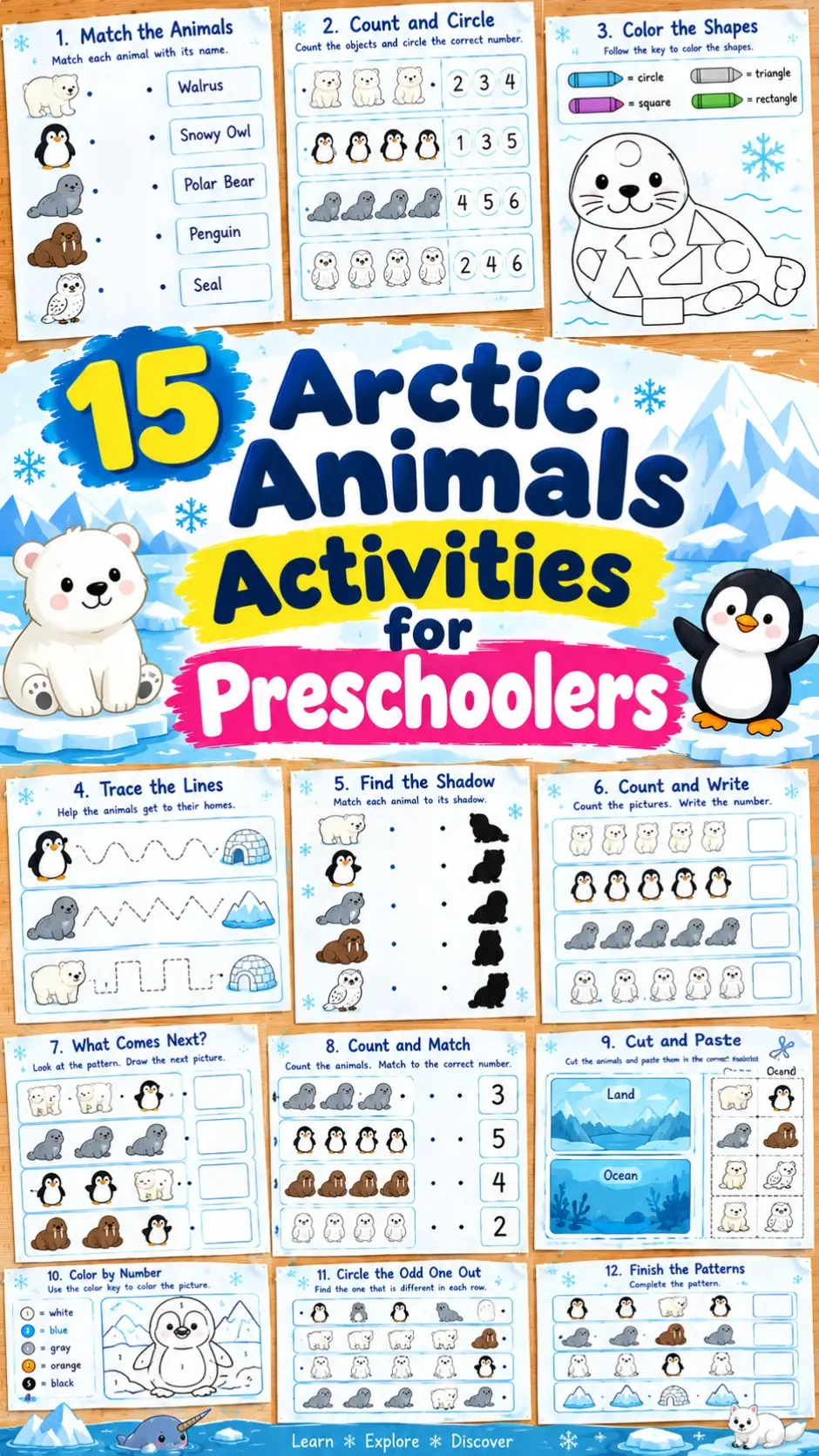
Arctic animals are a great way to bring science, sensory play, art, language, and early math into one preschool theme. A polar bear’s thick fur, a walrus’s tusks, or a narwhal’s long tusk gives your child something real to look at, talk about, and wonder about.
You can use simple things you already have at home. Cotton balls, ice cubes, paper, toy animals, plastic cups, crayons, and a few printed pictures are enough for most of these Arctic animals activities for preschoolers.
Which animals live in the Arctic?
Start with a few animals rather than showing your child 20 names at once.
Good preschool choices include:
- Polar bear
- Arctic fox
- Walrus
- Narwhal
- Beluga whale
- Seal
- Arctic hare
- Reindeer or caribou
- Musk ox
- Snowy owl
The Arctic is home to many different mammals and birds, both on land and in the surrounding ocean. Narwhals, walruses, polar bears, seals, and beluga whales are among the animals associated with Arctic waters.
One small fact is worth teaching correctly: penguins don’t live in the Arctic. They live in the Southern Hemisphere, including Antarctica. That makes a simple North Pole versus South Pole discussion a nice extension for older preschoolers.
15 Arctic animals activities for preschoolers
1. Make a blubber glove
This one gets a big reaction from little kids.
Put one hand inside a plastic bag or disposable glove. Cover the outside with a layer of shortening, then place another bag or glove over it. Let your child put the covered hand into a bowl of cold water.
Try it again with a bare hand.
Ask, “Which hand feels colder?”
Explain that some Arctic animals have a thick layer of fat called blubber that helps keep their bodies warm. For example, walruses use blubber as insulation in cold water.
Keep the explanation simple. Your preschooler doesn’t need a biology lecture.
2. Rescue the animals from the ice
Place small plastic Arctic animals in an ice cube tray, add water, and freeze.
Once they’re frozen, give your child a small bowl of warm water, a spoon, and a dropper. Let them work out how to free the animals.
Ask:
- What do you think will happen to the ice?
- Which part is melting first?
- Can you rescue the seal?
- What happens when you add warm water?
This is a simple way to talk about melting, temperature, and changes in materials.
Just supervise closely and don’t let young children put the small animals or ice in their mouths.
3. Arctic animal adaptation detective
Print or draw pictures of 5 Arctic animals.
For each one, talk about something that helps it live in a cold environment.
For example:
Polar bear: thick fur and a layer of body fat
Walrus: blubber and tusks
Arctic fox: thick fur
Narwhal: adapted to life in cold Arctic waters
Seal: body fat and features that help it live in cold water
Then ask your child, “What do you notice?”
This activity works well as a conversation rather than a quiz. You can point, name the animal, and let your child answer with a word, gesture, or sentence.
4. Make Arctic animal footprints
Draw several simple animal footprints on paper.
You can make large paw prints for a polar bear, smaller tracks for an Arctic fox, and different shapes for other animals.
Put the footprints around the room and let your child follow them.
At each stop, place a matching animal picture.
“Whose footprints did you find?”
This adds a little movement to a science activity without turning it into a complicated game.
5. Sort animals by body covering
Gather pictures of Arctic animals and make 3 simple groups:
- Fur
- Feathers
- Blubber
Talk about what each animal has.
A snowy owl belongs with feathers. An Arctic fox has fur. A walrus has blubber.
Some animals fit into more than one category, so don’t worry about making the categories perfect. You’re helping your child notice differences and use new words.
If your child enjoys sorting, you can connect this activity with the broader hands-on ideas in my guide to the best educational activities for preschoolers.
6. Build a snowy camouflage picture
Give your child white paper, gray paper, and a few animal pictures.
Have them glue a white Arctic animal onto a white background. Then place a darker animal picture against a darker background.
Ask, “Can you see it easily?”
Talk about camouflage and how colors can help animals blend into their surroundings.
For a 4- or 5-year-old, ask them to design their own hidden Arctic animal picture.
7. Make a polar bear with cotton balls
Draw a simple polar bear outline on paper.
Give your child cotton balls and glue. Let them fill the bear’s body with cotton.
When it’s dry, add eyes, a nose, and a few details with a crayon.
While you’re working, talk about the polar bear’s body.
“Where are its ears?”
“Where are its paws?”
“How many legs does it have?”
This gives you an easy opening for body-part vocabulary without making the craft feel like a worksheet.
8. Baby Arctic animal match
Make pairs of cards showing an adult animal and its baby.
Try:
- Polar bear and cub
- Arctic fox and pup
- Seal and pup
- Reindeer and calf
Mix the cards and let your child find the pairs.
For younger preschoolers, start with 2 or 3 pairs. Older children can handle more.
You can also ask, “Which baby belongs with the walrus?” and let your child point instead of naming everything.
9. Arctic animal observation page
Choose 1 animal.
Draw or print a large picture and give your child a blank page beside it.
Ask your child to tell you what they see.
You can write their words underneath:
Polar bear
White fur
Big paws
Black nose
Lives in the Arctic
Your child can add a drawing underneath.
This works especially well for children who enjoy talking about animals but aren’t ready to write sentences yet.
For more age-specific ideas, you can also see my guides to preschool learning activities for 3-year-olds, preschool learning activities for 4-year-olds, and preschool learning activities for 5-year-olds.
10. Make a narwhal tusk measuring game
Draw 3 or 4 narwhals with different-length paper tusks.
Give your child strips of yarn or paper.
Ask them to match each strip to the correct tusk.
Then put the tusks in order from shortest to longest.
For a younger child, use only 2 sizes. A 5-year-old can compare 4 or 5.
Narwhals are especially fun to talk about because their long tusk looks a little like a unicorn horn. The tusk is actually a long tooth, and narwhals live in Arctic waters.
11. Arctic animal body-part puzzle
Print pictures of 3 Arctic animals and cut each picture into 3 or 4 large pieces.
Mix the pieces.
Let your child rebuild the animals.
Once the pictures are complete, ask:
“Which animal has tusks?”
“Which animal has flippers?”
“Which one has paws?”
You can make the puzzle easier by cutting straight across the pictures. Older preschoolers can handle more irregular pieces.
12. Make an Arctic animal paper plate
Choose one animal and turn a paper plate into its face.
A polar bear is easy. Use a paper plate, white paper, black paper for the nose, and small pieces for the ears and eyes.
You could also make an Arctic fox or snowy owl.
Once it’s finished, let your child pretend to be the animal and tell you one thing about it.
This can turn into a short storytelling activity. If your child enjoys pretend play, my Where the Wild Things Are preschool activities post has more animal-themed ideas.
13. Arctic animal baby counting
Draw or print a few simple groups of Arctic animals.
For example:
- 2 polar bear cubs
- 4 seals
- 5 Arctic foxes
- 3 walruses
Ask your child to count each group.
Then ask questions such as:
“Which group has 4?”
“Which has fewer?”
“How many seals do you see?”
This is a good place to use real objects too. Put small animal toys in groups and let your child move each one while counting.
For more ideas, see my guides to counting activities for preschoolers and number recognition activities for preschoolers.
14. Arctic animal beginning sounds
Put 4 animal pictures in front of your child:
bear, fox, seal, walrus
Say each word slowly.
“Bear starts with /b/.”
“Fox starts with /f/.”
Then ask your child to find another picture that starts with the same sound.
You can keep this very simple for a 3-year-old. Older preschoolers can sort several animal pictures by their beginning sounds.
If you’re working on early phonics too, you can connect this activity with beginning sound activities for preschoolers and alphabet activities for preschoolers.
15. Tell an Arctic animal story
Put 3 animal pictures in front of your child.
Maybe you choose a polar bear, a seal, and a snowy owl.
Start with one sentence:
“One morning, the polar bear walked across the ice.”
Ask your child what happened next.
Let them decide where the bear went, who it met, and what happened at the end.
You can write their story down while they talk. Then read it back to them.
For a child who enjoys rhymes and word play, you can also connect the animal names to fun rhyming activities for preschoolers.
Arctic animals activities for 3-year-olds
Keep the activities short and hands-on at this age.
A 3-year-old can:
- Match 2 or 3 adult and baby animals
- Make a cotton-ball polar bear
- Rescue animals from ice
- Follow animal footprints
- Sort fur and feathers
- Name familiar Arctic animals
- Count small groups of animals
- Talk about what they see in an animal picture
You can repeat the same animal several times during the week. Repetition is useful here because the child gets more comfortable with the names and pictures.
If you want more ideas for this age, my preschool learning activities for 3-year-olds guide is a good place to continue.
Arctic animals activities for 4-year-olds
A 4-year-old can handle a little more sorting, comparison, and conversation.
Try:
- Sort animals by fur, feathers, or blubber
- Compare animal sizes
- Talk about animal adaptations
- Put animal footprints with the correct animal
- Complete simple animal puzzles
- Tell a short story from 3 animal pictures
- Compare 2 groups of Arctic animals
- Talk about North Pole and South Pole animals
You can also ask “why” questions.
“Why does a polar bear need thick fur?”
“Why does a walrus have tusks?”
There doesn’t have to be one perfect answer. Let your child think out loud.
Arctic animals activities for 5-year-olds
Older preschoolers can take the same theme a little further.
Ask them to draw an Arctic animal and label its body parts. They can also make a simple fact page, compare 2 animals, measure paper tusks, or create a short story.
You can add simple math too. Give your child groups of animals and ask which group has more, fewer, or the same number. My Which Has More? preschool activities post has more ideas for this kind of early math practice.
For children who enjoy numbers, you can also connect the theme to easy math activities for preschoolers, simple addition activities for preschoolers, or simple subtraction activities for preschoolers.
How I would do this with Hafsa
With my little girl, Hafsa, I’d keep an Arctic animal activity very hands-on.
I’d put a few animal pictures on the floor and let her choose one. If she picks a polar bear, we’d talk about its paws, fur, food, and icy home. Then I’d probably follow that conversation into a simple craft or counting game.
That’s usually enough for one sitting.
You can also make an Arctic animal basket with a few toy animals, white paper, cotton balls, and a small bowl of ice. Let your child decide what to do with the materials. Preschoolers sometimes come up with a better game than the adult planned.
What should preschoolers learn about Arctic animals?
You don’t need to teach a long list of facts.
Focus on a few basic ideas:
Animal names: polar bear, Arctic fox, seal, walrus, narwhal, beluga, snowy owl, Arctic hare.
Where they live: the Arctic is a cold region around the North Pole, with land, ocean, sea ice, and many different habitats.
Body features: fur, feathers, flippers, paws, tusks, whiskers, and blubber.
Adaptations: some animals have thick fur or body fat that helps them deal with cold conditions.
Food: different Arctic animals eat different foods, so avoid teaching the whole group as if they all eat the same thing.
The Arctic Ocean is a real ecosystem with fish, seals, whales, polar bears, and many smaller organisms living in connected food chains.
That last part can stay very simple for preschoolers. “Animals need food to live” is enough for most 3- and 4-year-olds.
Can worksheets help with Arctic animal learning?
Yes. A worksheet works well after your child has already played, talked, sorted, or explored.
For example, after learning 4 animal names, give your child a simple matching page. After counting toy seals, try an Arctic animal counting worksheet.
You can also use tracing, coloring, matching, cutting, and simple letter activities. Current preschool Arctic resources commonly combine animal pictures with early literacy, counting, tracing, sorting, and fine-motor work.
If you’re building a printable learning routine, my guide to number tracing activities for preschoolers can fit nicely alongside an animal theme.
How long should an Arctic animal activity last?
For a 3-year-old, 5 to 10 minutes may be plenty for one focused activity.
A 4-year-old might stay with it for 10 to 15 minutes, while a 5-year-old may happily spend 15 to 20 minutes on a craft, puzzle, story, or simple investigation.
Follow your child’s attention.
If you’re planning a daily preschool routine, my guide on how many hours a preschooler should study explains how short learning sessions can fit into a child’s day.
More ways to connect the Arctic theme
You can take the animal theme into other parts of your preschool routine without creating a separate lesson for everything.
Read an animal book and ask your child to find the polar bear. Practice shapes by building an ice scene from circles, rectangles, and triangles, then check out these shape recognition activities for preschoolers.
You can also use an Arctic snack to talk about food, color, size, and counting. My preschool cooking activities post has simple ideas that work well for young children.
For a broader animal theme, see Where Do Animals Live preschool activities. It fits naturally with an Arctic lesson because children can compare cold-weather habitats with homes of other animals.
And if you’re building a full preschool learning plan, you can also browse Who Am I preschool activities for language and self-awareness activities, or Where Does Food Grow preschool activities for a different science theme.
Frequently asked questions
What are some easy Arctic animals for preschoolers to learn?
Start with polar bears, Arctic foxes, seals, walruses, narwhals, and snowy owls. Their names and body features give you plenty to talk about.
Do penguins live in the Arctic?
No. Penguins live in the Southern Hemisphere, including Antarctica. They aren’t Arctic animals.
What is the easiest Arctic animal activity for a 3-year-old?
Try a simple animal picture match, cotton-ball polar bear craft, footprint hunt, or ice rescue. These activities need very little explanation.
What can preschoolers learn from Arctic animals?
They can learn animal names, habitats, body parts, adaptations, sorting, counting, vocabulary, observation, and simple science concepts such as melting.
How can I teach Arctic animal adaptations to preschoolers?
Keep it concrete. Talk about thick fur, blubber, paws, feathers, whiskers, and tusks. Show a picture and ask your child what they notice.
Are Arctic animals good for preschool science?
Yes. The theme naturally connects animals with cold habitats, body features, movement, food, and survival. You can keep the science very simple and build on your child’s questions.
Final thought
Arctic animals give preschoolers plenty to investigate.
Start with 1 animal. Look at it closely. Talk about its body, where it lives, and what it might eat. Then turn that conversation into a craft, sorting game, story, or little science experiment.
That’s enough.
Your child doesn’t need a giant Arctic unit to learn something useful. One curious question about a polar bear can be the start of a very good afternoon.