
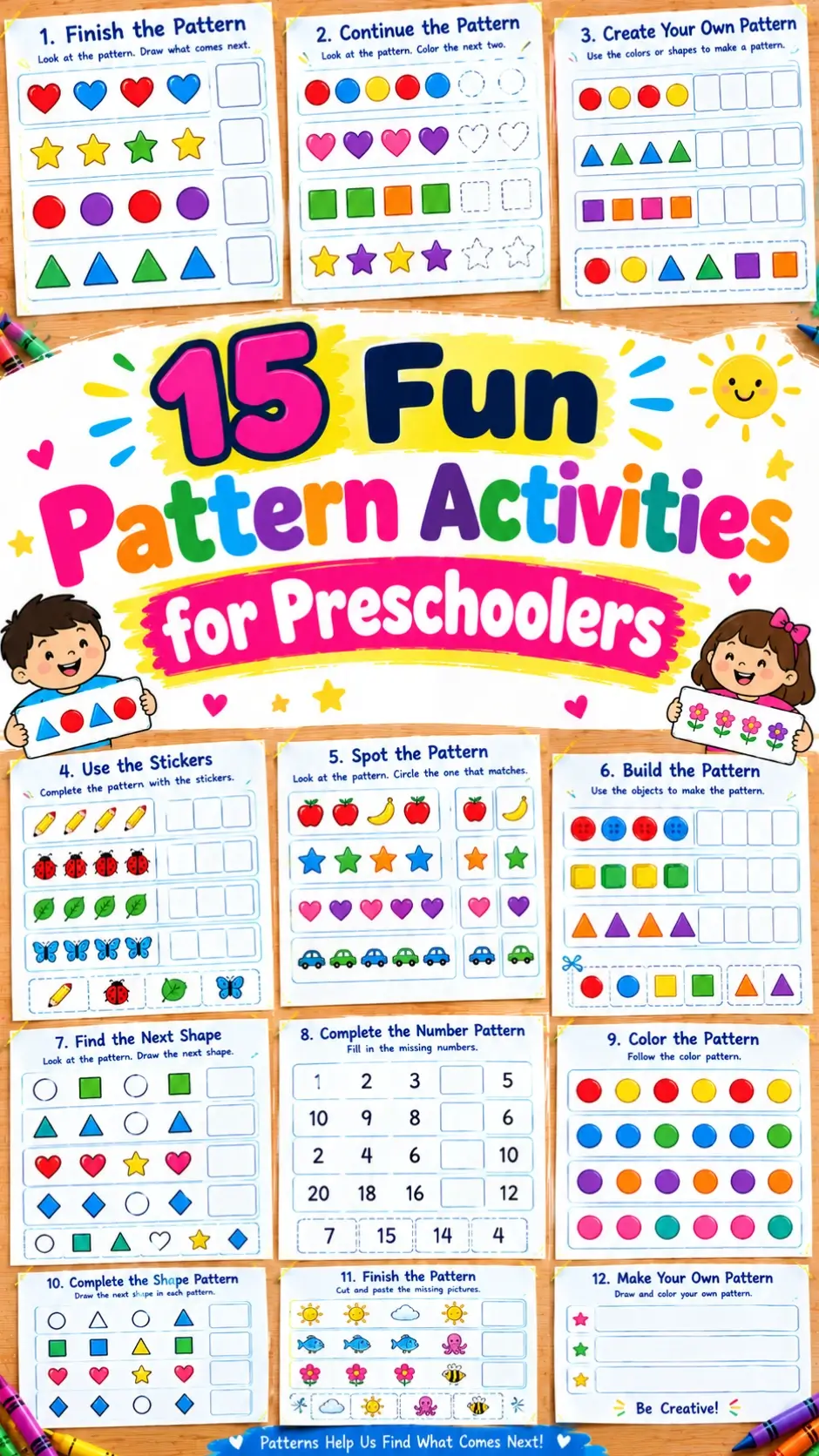
Patterns are everywhere once you start looking for them.
A child sees stripes on a shirt, tiles on the floor, beads on a bracelet, or the repeating colors on a toy. You can use those everyday moments to help your preschooler notice what comes next, copy a pattern, and eventually create one of their own.
These fun pattern activities for preschoolers use things you probably already have at home. You won’t need a special math kit.
And you don’t have to finish all 15. Pick one, sit beside your child, and see where it goes.
What is a pattern for preschoolers?
A pattern is something that repeats in a particular order.
For example:
Red, blue, red, blue, red, blue
Or:
Circle, square, circle, square
Your preschooler doesn’t need to learn complicated pattern names right away. Start with simple repeating patterns that they can see, touch, move, or hear.
Children can explore patterns through colors, shapes, sounds, movement, and everyday objects. These experiences help build early math thinking.
15 fun pattern activities for preschoolers
1. Button line patterns
Grab a handful of large buttons in 2 or 3 colors.
Start with a simple pattern such as:
Red, yellow, red, yellow.
Ask your child to continue the line.
Once they understand the idea, let them make a pattern for you to copy.
This little change matters. Your child gets to become the teacher.
2. Toy animal pattern train
Choose 2 or 3 small animal toys.
Make a line such as:
Bear, cow, bear, cow.
Then ask your child to continue the train.
Try a different rule with older preschoolers:
Bear, cow, duck, bear, cow, duck.
This gives your child a chance to notice that the repeating part can contain more than 2 items.
3. Sock matching patterns
Take clean socks from the laundry basket and make a floor pattern.
For example:
Striped sock, plain sock, striped sock, plain sock.
Let your child continue it.
You can change the pattern by size, color, or design. It’s a useful little activity when you’re already folding laundry, so it doesn’t feel like another lesson squeezed into the day.
4. Nature pattern strip
Go outside and collect a few safe natural items such as leaves, small sticks, and flowers that have already fallen.
Make a simple pattern:
Leaf, stick, leaf, stick.
Your child can copy it on the ground or on a piece of cardboard.
For younger children, use only 2 types of objects. Older preschoolers can try 3.
5. Sticker road
Draw a long road on a sheet of paper.
Give your child 2 kinds of stickers. They might be stars and circles.
Start:
Star, circle, star, circle.
Your child places stickers along the road and keeps the pattern going.
For a 4- or 5-year-old, leave one space empty in the middle and ask, “What belongs here?”
6. Pattern with clothespins
Take several clothespins in different colors.
Clip them along the edge of a cardboard strip.
Try:
Blue, yellow, blue, yellow.
Then let your child continue.
This also gives little fingers some extra work because opening and squeezing clothespins takes control. If your child is still developing fine-motor skills, use larger clips that are easy to handle.
7. Make a pattern with footsteps
Tape a few paper footprints to the floor.
Make a movement pattern:
Walk, jump, walk, jump.
Your child follows it.
Then try:
Clap, stomp, clap, stomp.
Once your child understands the game, let them make a movement pattern for you.
Movement is a natural way for young children to experience patterns because they can feel the repeated sequence with their whole body.
For more movement-based preschool ideas, you can also visit my collection of preschool learning activities for 3-year-olds.
8. Patterned paper strips
Cut strips of paper and give your child crayons or markers.
Draw:
Blue dot, red dot, blue dot, red dot.
Your child continues the pattern across the strip.
Then try a shape pattern:
Circle, triangle, circle, triangle.
This is a good activity for a child who enjoys drawing but isn’t ready to write much yet.
9. Snack pattern plate
Use small pieces of food your child can safely eat.
You might arrange:
Banana, strawberry, banana, strawberry.
Let your child copy the pattern onto their plate.
You can try crackers and fruit, or 2 different fruits.
Keep the pattern simple. The point is noticing the order, not turning snack time into a complicated math project.
If your child enjoys helping with food, you can find more age-appropriate ideas in my preschool cooking activities.
10. Pattern detective at home
Tell your child you’re looking for patterns.
Walk around the house together.
Look at:
- Curtains
- Rugs
- Clothes
- Pillows
- Tiles
- Blankets
- Wallpaper
- Books
When you find one, ask, “What repeats?”
You don’t even need to make your own pattern every time. Finding patterns that already exist helps children notice the idea in real life.
11. Cup pattern challenge
Put 2 colors of plastic cups on the floor.
Make a pattern such as:
Red, blue, red, blue.
Ask your child to build the same line beside yours.
Then change the order and let your child copy you again.
For older preschoolers, make a pattern and remove one cup. Ask them what is missing.
12. Pattern with household sounds
You don’t need musical instruments for this one.
Tap the table twice, then clap once.
Tap, tap, clap.
Repeat it.
Your child copies you.
Then let your child create a sound pattern that you have to copy.
Sound patterns are useful because your child can’t rely on color or shape. They have to listen carefully and remember the order. Preschool pattern activities can include sounds, movements, and call-and-response games.
If your child enjoys sound and word play, you can also add some ideas from my fun rhyming activities for preschoolers.
13. Missing pattern card
Draw a simple pattern on paper.
For example:
Circle, square, circle, ___, circle.
Ask your child what belongs in the empty space.
Start with very easy AB patterns.
Once your child gets comfortable, try:
Circle, triangle, square, circle, triangle, ___.
This activity is better for older preschoolers who already understand simple repeating patterns. By around age 5, many children can begin working out what comes next or what is missing.
14. Pattern sorting tray
Place several objects in a tray.
You might use:
- Large and small pom-poms
- Short and long craft sticks
- Big and small bottle caps
- Different colored blocks
First, let your child sort them by one quality.
Then use the sorted objects to make a pattern.
For example:
Big, small, big, small.
This helps your child see that patterns can be based on size as well as color. Preschool pattern work can use color, size, shape, and other attributes.
15. My child makes the pattern
This is the one I’d save for last.
Give your child a collection of safe objects and say:
“Can you make a pattern for me?”
Don’t give them the answer.
Let them decide what repeats.
Your child might make a color pattern. They might make a big-small pattern. They might even invent something that makes sense only to them.
Ask them to explain it.
“What comes next?”
“What part keeps repeating?”
Then copy their pattern.
For a preschooler, creating a pattern is a lovely step because they have to think about the rule rather than simply copy yours.
Pattern activities for 3-year-olds
A 3-year-old is still learning what a repeating sequence looks and feels like.
Start with AB patterns:
- Red, blue, red, blue
- Big, small, big, small
- Clap, stomp, clap, stomp
- Car, block, car, block
Use large objects that are easy to pick up.
At this age, copying your pattern is a perfectly good goal. PBS KIDS recommends very simple repeating patterns for young children, including patterns children can copy through movement and objects.
Don’t worry if your child changes the pattern halfway through. That’s part of learning.
Pattern activities for 4-year-olds
At 4, you can start asking your child to continue a pattern and tell you what comes next.
Try:
- Color patterns
- Size patterns
- Shape patterns
- Sound patterns
- Movement patterns
- Missing-item patterns
- 3-part repeating patterns
You can also ask your child to make a pattern for you.
That little role reversal tells you a lot about what they understand.
My preschool learning activities for 4-year-olds guide has more activities for this stage.
Pattern activities for 5-year-olds
A 5-year-old can usually handle longer and slightly more challenging patterns.
Try:
AAB: red, red, blue, red, red, blue
AB: red, blue, red, blue
ABB: red, blue, blue, red, blue, blue
ABC: circle, square, triangle, circle, square, triangle
You can leave out one item and ask your child to find it.
You can also show a pattern that has one mistake:
Red, blue, red, green, red, blue.
Ask, “Can you find the part that doesn’t match?”
By this age, children can begin representing patterns more abstractly and predicting missing parts.
For more activities at this stage, see my preschool learning activities for 5-year-olds.
How I practice patterns with Hafsa
With my little girl, Hafsa, I’d keep pattern practice very casual.
I might put 2 different colored objects on the floor and make a simple line. If she copies it, great. If she decides to make her own pattern with something completely different, I’d follow her idea for a while.
That’s usually where the fun starts.
You can do the same thing with socks, blocks, snack pieces, stickers, or whatever happens to be nearby. Preschoolers don’t need a special setup every time they practice math.
Why are patterns important for preschoolers?
Patterns help children notice order and repetition.
When your child looks at:
Red, yellow, red, yellow, ___
they’re thinking about what has already happened and using that information to predict what comes next.
That’s early mathematical reasoning.
Patterns also appear in sounds, movement, shapes, colors, and daily routines. Recognizing and creating them gives children practice noticing relationships between things.
Pattern activities can also support language. Ask your child to describe the rule:
“Blue keeps coming after yellow.”
“The big one comes after the little one.”
Those simple sentences make the math visible.
What pattern should preschoolers learn first?
Start with an AB pattern.
For example:
Apple, banana, apple, banana.
Or:
Circle, square, circle, square.
Once your child can copy and continue AB patterns, you can introduce AAB, ABB, and ABC patterns.
There’s no need to rush.
A child who can confidently recognize a simple repeating pattern is building a useful foundation for harder pattern work later.
What if my preschooler doesn’t understand patterns?
Make the pattern smaller.
Put 2 objects down.
Red, blue.
Then repeat:
Red, blue.
Then add another:
Red, blue, red.
Ask your child what should come next.
You can also use movement. Clap, stomp, clap, stomp is sometimes easier to understand than a row of colored objects because the child can hear and feel the repetition.
And if your child isn’t interested, leave it for another day. You can come back to patterns during snack time, getting dressed, cleaning up toys, or walking outside.
Can patterns be part of everyday learning?
Absolutely.
You might notice a pattern while folding clothes.
You might see one on the bathroom floor.
Your child’s shirt may have stripes.
The fence outside may repeat the same shapes.
A simple question like “What comes next?” can turn that moment into a quick math conversation.
You can also mix patterns with other preschool skills. For example, count the objects in a pattern, name the shapes, or ask which group has more. My math activities for preschoolers and counting activities for preschoolers have more ideas for those connections.
Pattern worksheets for preschoolers
Worksheets can be useful once your child has had enough hands-on practice.
A simple page might ask your child to:
- Color a repeating pattern
- Circle what comes next
- Draw the missing item
- Match two patterns
- Continue an AB pattern
- Find the pattern with a mistake
I’d introduce these after your child has played with real objects.
If you’re already using printable activities at home, you can also connect patterns with number tracing activities for preschoolers or alphabet activities for preschoolers without making every activity feel like a worksheet session.
How long should pattern practice last?
For a 3-year-old, 5 to 10 minutes can be enough.
A 4-year-old might stay interested for 10 to 15 minutes. A 5-year-old may spend 15 or 20 minutes building a more complicated pattern, especially when they get to create their own.
Watch your child rather than the clock.
If the pattern game turns into a tower-building game after 8 minutes, that’s fine. You’ve already had your math moment.
For more guidance on balancing focused learning with the rest of a preschooler’s day, see how many hours should a preschooler study?.
More preschool learning ideas
Pattern activities fit nicely into a larger preschool routine.
You can move from a pattern game into a story, a drawing activity, outdoor play, or a short worksheet. My best educational activities for preschoolers collection has ideas across different learning areas.
You can also connect patterns with animal themes. Try making an Arctic pattern with a polar bear, seal, polar bear, seal. Then move over to my Arctic animals activities for preschoolers for more animal-based learning.
For language practice, you can move into beginning sound activities for preschoolers or Who Am I preschool activities.
And if you’re working on early number concepts, number recognition activities for preschoolers, simple addition activities for preschoolers, and subtraction activities for preschoolers can follow naturally.
Frequently asked questions
What are the best pattern activities for preschoolers?
Start with simple hands-on activities such as button patterns, sticker patterns, movement patterns, household-object patterns, and missing-item games. Let your child copy your pattern before asking them to create their own.
What is the easiest pattern for a preschooler?
An AB pattern is usually the easiest place to begin. Try red-blue-red-blue or big-small-big-small.
What age can kids learn patterns?
Young children can begin exploring simple repeating patterns around the toddler and preschool years. At 3, focus on copying simple patterns. By 4, many children can continue patterns and predict what comes next. By 5, children can begin working with longer patterns and missing parts.
How do I teach patterns to a 3-year-old?
Use real objects and movement. Put 2 colors of blocks in an AB pattern, clap and stomp in a repeating sequence, or arrange 2 types of toys. Keep the pattern short and repeat it several times.
What comes after AB patterns?
You can try AAB, ABB, and ABC patterns. Move up when the simpler pattern feels comfortable.
Can pattern activities help with math?
Yes. Pattern work gives children practice with repetition, order, prediction, and relationships. These ideas are part of early mathematical thinking.
Should preschoolers use pattern worksheets?
They can, especially after hands-on practice. Real objects, movement, stickers, blocks, and household items give young children a chance to physically build the pattern before working with pictures on a page.
A simple pattern routine to try this week
If you want to start without preparing anything, try this:
Monday: Make a sock pattern.
Tuesday: Find 3 patterns around the house.
Wednesday: Make a clap-and-stomp pattern.
Thursday: Create a sticker pattern.
Friday: Let your child make a pattern for you.
Each activity can take just a few minutes.
And once your child starts spotting patterns on their own, you’ll probably find them everywhere too.
https://www.pinterest.com/brightstartacad/patterns-preschool/
https://funexpectedapps.com/en/blog-posts/top-7-pattern-activities-for-preschoolers
https://www.abcmouse.com/learn/activities/pattern-activities-for-preschoolers-and-kindergarteners/68688
https://www.prekinders.com/math-patterns/
https://www.pre-kpages.com/patterns/