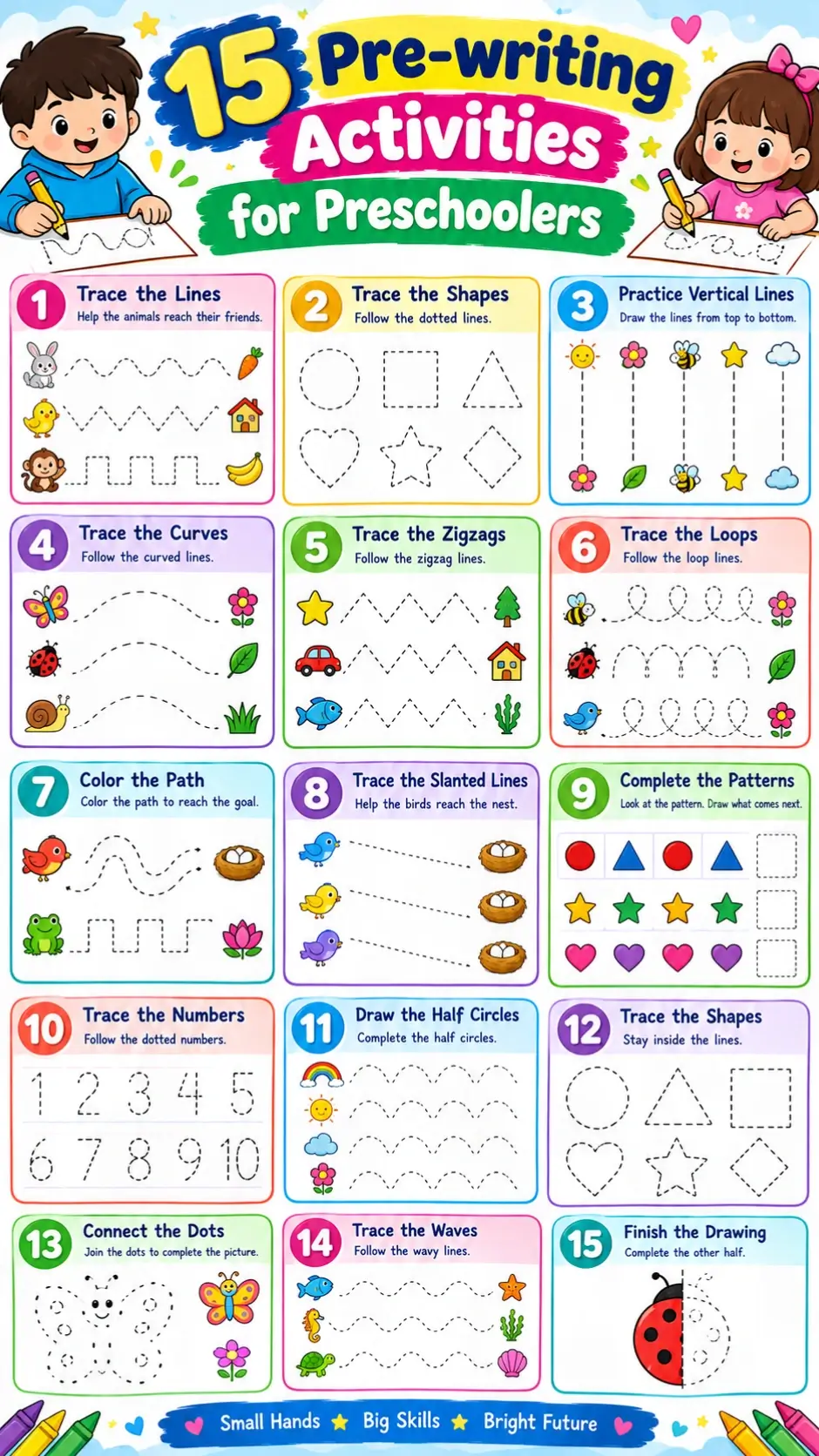
Before a preschooler writes a letter, their hands need plenty of practice making marks, changing direction, controlling a crayon, and copying simple shapes.
That’s where pre-writing activities come in.
A child can draw roads with chalk, make shapes with playdough, trace a path with a finger, or draw giant circles on a whiteboard. These activities look like play, but they’re giving little hands useful practice for later handwriting.
I prefer short sessions. Five to 10 minutes is enough for one activity, especially when your child gets to move, choose materials, and try again.
What are pre-writing skills?
Pre-writing skills are the movements and hand-control skills children develop before conventional handwriting.
They include things like making straight and curved lines, copying shapes, controlling a drawing tool, coordinating the eyes and hands, and developing a comfortable pencil grasp.
Children also need enough hand and arm control to keep a crayon moving where they want it to go.
The exact order varies from child to child. A common progression moves from simple vertical and horizontal lines toward circles, crosses, diagonal lines, squares, X shapes, and triangles.
So if your 3-year-old is still working on basic lines, that’s useful work.
Why are pre-writing activities important for preschoolers?
Writing asks a lot from a small body.
Your child has to sit comfortably, look at the page, hold a writing tool, control the hand, watch the mark being made, and remember the shape they’re trying to copy.
That’s a lot happening at once.
Pre-writing activities break that job into smaller pieces to practice. Drawing, playdough, large movements, and simple shape work can all help children develop control before formal handwriting begins. NHS occupational therapy guidance also recommends exploring pre-writing shapes through movement, playdough, blocks, and other hands-on activities rather than relying only on table work.
If you’re planning a broader preschool routine, you can also see these [best educational activities for preschoolers]Best educational activities for preschoolers.
15 pre-writing activities for preschoolers
You don’t need to do all 15.
Pick 1 or 2 that match what your child can already do, then repeat them on different days.
1. Draw giant lines on a wall
Tape a large sheet of paper to the wall.
Give your child a chunky crayon or washable marker and ask them to draw long lines from top to bottom.
Then try side-to-side lines.
The upright position gives the arm plenty of room to move, and your child practices controlling the direction of the mark.
You can say:
“Draw a line all the way down.”
Then:
“Now take it across.”
Keep your instructions simple.
2. Make roads for toy cars
Draw several large roads on a sheet of paper.
Some can be straight. Others can curve around a corner or go up and down.
Give your child a small toy car and let them drive along the roads first. Then give them a crayon and ask them to draw a road for the car.
This turns line practice into a little game.
For an older preschooler, leave the roads partly unfinished and ask them to connect the missing sections.
3. Playdough shape building
Give your child playdough and ask them to roll long pieces.
Use those pieces to make:
- A circle
- A square
- A cross
- A triangle
- A zigzag
You can make one shape first and let your child copy it.
This is especially useful when pencil work feels tiring. The child still gets to practice the movements involved in making shapes while using their hands in a different way.
4. Trace paths with a finger
Draw large paths on paper.
Make one path straight, one curved, one zigzag, and one with several turns.
Ask your child to follow each path with one finger.
Then let them trace the same paths with a crayon.
This two-step approach can make the transition from movement to pencil control feel easier.
5. Make a chalk sidewalk trail
Take sidewalk chalk outside.
Draw a large trail on the ground and ask your child to walk along it.
Make one straight trail first. Then try a curve, zigzag, or big loop.
After walking the trail, ask your child to draw a similar line with chalk.
Somerset NHS children’s therapy guidance recommends using large body movements to teach direction and shape concepts before expecting children to make small marks on paper.
6. Sticker path tracing
Draw a large curved path on paper.
Give your child small stickers and ask them to place the stickers along the path.
Once the path is filled, let them trace between the stickers with a crayon.
You can make a winding road, a big circle, or a simple zigzag.
This gives your child a clear visual route to follow.
7. Draw inside a giant shape
Draw one huge circle, square, or triangle on paper.
Ask your child to fill the inside with their own lines.
They can make loops, short strokes, dots, or scribbles.
The boundary gives them a simple way to practice controlling where their marks go.
Later, make the shape smaller.
8. Follow the flashlight
Darken a room slightly and use a flashlight to make a large path on the wall.
Move the light slowly in a straight line, curve, circle, or zigzag and ask your child to follow it with their finger.
Then switch roles.
Let your child move the flashlight while you follow.
You can finish by drawing the same movement on paper.
This is a nice choice for a child who loses interest quickly at the table.
9. Copy simple shape cards
Make cards showing one shape at a time.
Start with:
|
Then:
—
Then a circle.
Later, try a cross, square, X, and triangle.
Show the card and ask your child to copy it on a large sheet of paper.
Don’t worry if the first few attempts look uneven. Young children are still learning how much pressure and movement each shape requires. Occupational therapy guidance describes basic lines and shapes as important steps before children are expected to print letters and numbers.
10. Paint with water
Give your child a small paintbrush and a cup of water.
Take it outside and let them “paint” lines onto a wall, pavement, or other suitable outdoor surface.
Try vertical lines, horizontal lines, circles, and simple shapes.
The marks disappear as they dry, so your child can keep making new ones.
It’s a good option when you want writing practice without piles of paper.
11. Make shape pictures
Give your child paper and a few crayons.
Ask them to draw a picture using simple shapes.
For example, they could make a house from a square and triangle, or a robot from rectangles and circles.
You can name the shapes as they draw.
This activity gives children a reason to make controlled lines and shapes. It also leaves room for their own ideas.
For more shape-based preschool learning, see these Shape recognition activities for preschoolers.
12. Draw a treasure map
Draw a very simple map with a starting point and a treasure.
Add a straight path, a curve, a bridge, and a big circle around the treasure.
Let your child copy the map or create their own.
Then use a toy figure to follow the route.
This works well for preschoolers who enjoy stories and pretend play. The lines have a purpose, which can make practice feel much more interesting.
You can also use the same idea with your Where the Wild Things Are preschool activities.
13. Make letters with a finger
Once your child can comfortably copy some basic shapes, introduce large letter-like movements.
Write one familiar letter on a tray or large sheet.
Let your child trace it with a finger first.
For children learning English letters, you can connect this with your Alphabet activities for preschoolers.
For Bengali-speaking families, you can also connect pre-writing practice with Bengali alphabet learning activities for preschoolers.
Keep the letters large. Your child is learning the movement, not trying to produce tiny handwriting.
14. Make a name path
Write your child’s name in large letters.
Instead of asking them to copy the whole name immediately, choose one letter.
Let your child trace that letter with a finger. Then try it with a crayon.
You can add a simple road leading to the letter.
For example, the child follows the road, reaches the letter, and traces it.
As their control improves, you can introduce another letter from their name.
15. Create a pre-writing drawing tray
Use a shallow tray and cover the bottom with a thin layer of flour, cornmeal, or another age-appropriate dry material.
Your child can draw lines, circles, and simple shapes with one finger.
Smooth the surface and start again.
For younger preschoolers, make the movements large. Older children can try smaller shapes or simple letter strokes.
Supervise closely and choose a material that is safe for your child’s age.
Pre-writing strokes preschoolers can practice
You don’t have to teach every stroke in one week.
A simple progression can look like this:
- Vertical lines
- Horizontal lines
- Circles
- Crosses
- Diagonal lines
- Squares
- X shapes
- Triangles
- Simple letter-like forms
The progression is a guide, not a race.
Some children will make circles comfortably while still struggling with diagonal lines. That’s normal. A child may also be able to draw a shape in a large format but find it difficult when the shape gets smaller.
NHS guidance notes that children develop pencil grasp and pre-writing abilities gradually, with considerable variation between children.
Pre-writing activities by age
Age can help you choose an activity, but your child’s current skills matter more.
Pre-writing activities for 3-year-olds
Three-year-olds can spend plenty of time on large movements.
Try:
- Giant vertical lines
- Giant horizontal lines
- Finger tracing
- Chalk trails
- Playdough shapes
- Simple road drawing
- Large circles
- Free drawing
Keep the materials chunky and the marks large.
If you’re looking for other age-appropriate ideas, see these Preschool learning activities for 3-year-olds.
Pre-writing activities for 4-year-olds
Four-year-olds can usually handle more controlled drawing.
Try:
- Curved paths
- Shape copying
- Simple mazes
- Shape pictures
- Name-letter practice
- Drawing maps
- Crosses and diagonal lines
- Simple tracing pages
Give them chances to draw without a model, too.
Their own pictures are useful writing practice.
You can find more ideas in these Preschool learning activities for 4-year-olds.
Pre-writing activities for 5-year-olds
Five-year-olds may be ready for smaller and more controlled movements.
Try:
- Copying simple shapes
- Drawing simple patterns
- Tracing familiar letters
- Writing selected letters from their name
- Drawing paths with several turns
- Copying short lines of shapes
- Making their own picture and adding labels
You can also give them more opportunities to decide what they want to draw.
For a broader routine, see Preschool learning activities for 5-year-olds.
How to improve pencil control in preschoolers
Pencil control develops through repeated practice with different movements.
Give your child large crayons, short crayons, washable markers, chalk, paintbrushes, and other drawing tools.
You can also put drawing surfaces in different positions. A wall, easel, floor, and table each change how the arm moves.
And don’t turn every drawing session into handwriting practice.
Free drawing matters too.
Pre-writing and fine motor skills
Pre-writing and fine motor development are closely connected.
A child uses small hand and finger movements to control a crayon, but larger arm and shoulder movements matter too.
That’s why I like mixing tabletop drawing with play that uses the whole hand.
If you’re building a separate fine motor routine, you can use these Fine motor activities for preschoolers on different days.
Hand strength activities before writing
Your child can build hand strength during ordinary play.
Try:
- Squeezing a sponge during water play
- Kneading playdough
- Building with blocks
- Opening child-safe containers
- Using a spray bottle with water
- Pulling apart reusable construction pieces
- Carrying lightweight objects during play
You don’t need to turn these into exercises.
Let your child play.
The hands get practice while they’re busy doing something meaningful.
When should preschoolers start tracing?
Tracing can be introduced when your child is interested and has enough control to follow a simple path.
Start with large, simple paths.
A straight line is easier than a tight maze. A big circle is easier than a tiny shape.
If your child presses extremely hard, gets tired quickly, or loses interest after a few seconds, shorten the activity.
The goal is useful practice that your child can handle.
Should preschoolers practice letters every day?
They can, but they don’t have to.
A preschooler can build writing readiness through drawing and movement even when no letters appear on the page.
If you do formal practice, keep it short.
A few minutes of tracing after a playful hand activity can be enough.
You can also rotate language activities through the week, such as Beginning sound activities for preschoolers or Fun rhyming activities for preschoolers.
A simple 5-day pre-writing plan
You can repeat this routine every few weeks with new materials.
Day 1: Large lines
Draw vertical and horizontal lines on a large sheet.
Day 2: Curves
Make big circles and curved roads.
Day 3: Hands-on shapes
Build circles, squares, crosses, or triangles with playdough.
Day 4: Path practice
Use a finger first, then a crayon, to follow simple paths.
Day 5: Free drawing
Let your child make a picture using some of the lines and shapes from the week.
Keep each activity short.
If you want to plan the rest of your child’s structured learning time, see How many hours should a preschooler study.
Common pre-writing mistakes to avoid
Starting with tiny worksheets
Large movements are easier for young children. Give them room to move before expecting small, neat marks.
Correcting every line
A wobbly circle is still practice.
Give your child a chance to try before correcting anything.
Making every activity pencil-based
Switch between crayons, chalk, paint, playdough, fingers, and movement.
Comparing your child with another child
Children develop these skills at different speeds.
A 4-year-old who isn’t ready for a particular shape may simply need more practice with earlier movements.
Practicing for too long
When the hand gets tired, control usually gets worse.
Short sessions are easier to fit into family life.
Pre-writing activities and other preschool skills
Pre-writing can connect with almost any preschool topic.
You can draw animal paths after an animal story, make food pictures after a cooking activity, or draw shapes while working on early math.
For example, after Preschool cooking activities, your child could draw a plate and add circles for fruit.
After Where does food grow preschool activities, your child could draw a simple garden with straight stems and round vegetables.
You can also bring writing movements into math:
- Which has more preschool activities
- Number recognition activities for preschoolers
- Counting activities for preschoolers
- Math activities for preschoolers
- Simple addition activities for preschoolers
- Subtraction activities for preschoolers
For example, your child can draw 3 large circles beside the number 3. That’s early number writing practice without turning it into a handwriting lesson.
What about cutting and other hand skills?
Cutting, drawing, building, and manipulating materials all give children different ways to use their hands.
If you’re working on scissors separately, see these Cutting activities for preschoolers.
Your child can also practice hand control through Pattern activities for preschoolers and other art activities.
The key is variety.
Frequently asked questions
What are the best pre-writing activities for preschoolers?
Start with activities that match your child’s current ability. Large line drawing, playdough shapes, chalk trails, finger tracing, shape copying, simple paths, and free drawing are all useful choices.
What should a 3-year-old be able to draw?
Many 3-year-olds are working on basic lines, circles, and other simple marks. Development varies, so use your child’s current ability to decide what to practice next.
How can I prepare my preschooler for handwriting?
Give your child regular opportunities to draw, make shapes, use different writing tools, play with hands-on materials, and practice controlled movements. Keep the activities short and enjoyable.
Should I use pre-writing worksheets?
You can. Worksheets are useful for certain tracing and copying tasks, but they don’t need to be the main form of practice. Large movement and hands-on activities are useful too.
What are pre-writing strokes?
Pre-writing strokes are basic marks and shapes children practice before conventional handwriting. They include vertical and horizontal lines, circles, crosses, diagonal lines, squares, X shapes, and triangles.
How long should pre-writing activities last?
Start with about 5–10 minutes and adjust based on your child. Some activities may last only a few minutes, while a deeply interested child may continue longer.
Is playdough good for pre-writing skills?
Yes. Rolling, squeezing, pinching, flattening, and shaping playdough give children opportunities to use their hands and fingers while making shapes.
Does coloring help with pre-writing?
Coloring gives children practice controlling a drawing tool and moving it across a page. Large coloring areas are a good starting point for younger preschoolers.
Final thoughts
Pre-writing practice can happen almost anywhere.
A sidewalk, playdough mat, whiteboard, sheet of paper, or kitchen table can become a place for your child to practice lines and shapes.
Keep the movements big at first. Give your child different tools. Let them draw their own pictures.
And give those little hands time.
The goal is steady practice that feels like something your child wants to do again tomorrow.