Preschoolers learn a lot while they’re playing.
A good game gives your child something to think about, remember, say, move, or figure out. It can be as simple as guessing an object inside a bag or following a silly instruction around the room.
And you don’t need a shelf full of expensive games. A few household objects, some paper, and your imagination can keep a preschooler busy for quite a while.
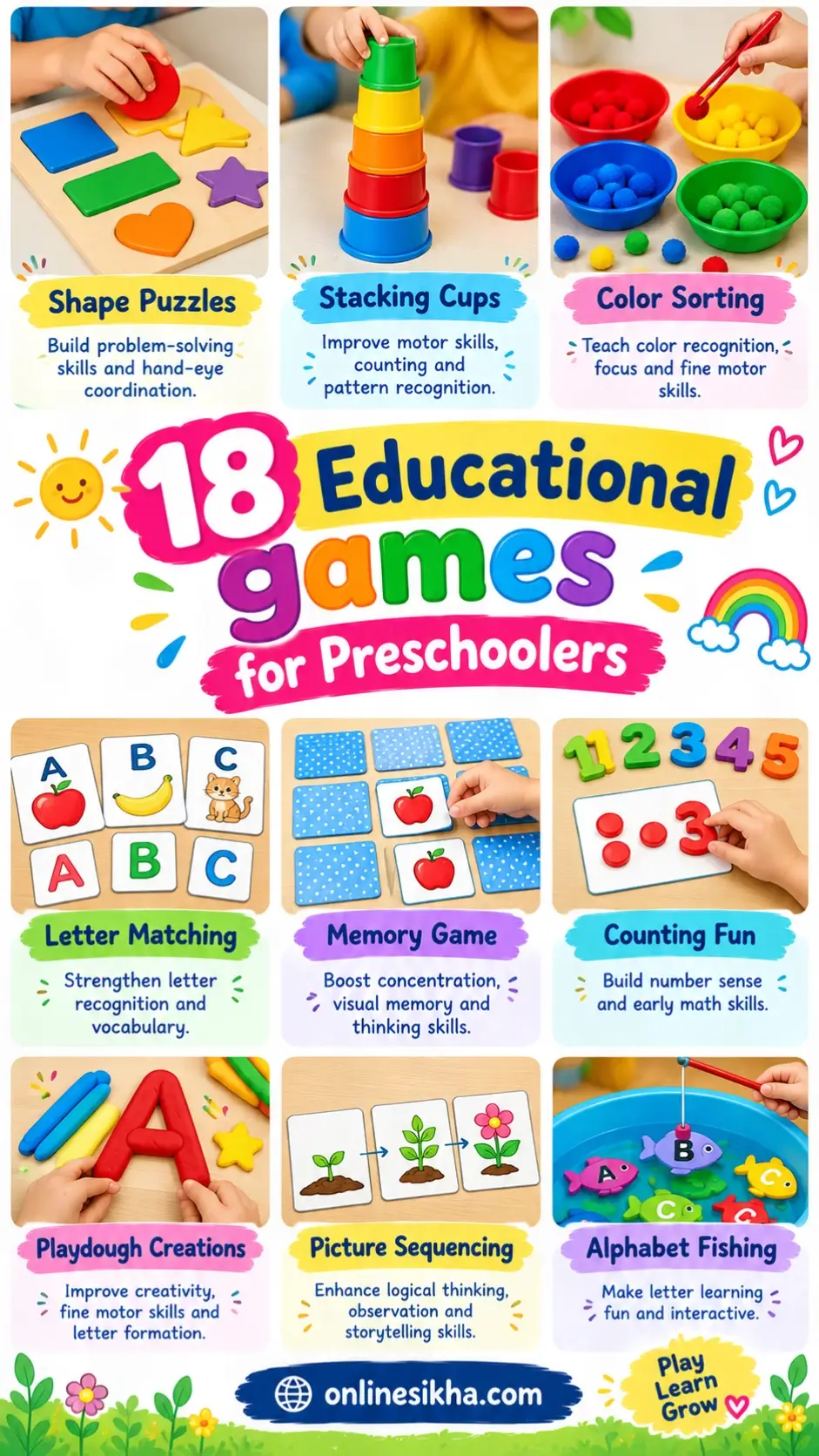
Here are 18 educational games for preschoolers that work well at home, in preschool, or during a short learning session.
What makes a game educational for preschoolers?
A preschool game usually works best when the rules are easy to understand, and the child gets plenty of chances to do something.
The game might ask your child to remember something, listen carefully, describe an object, follow a direction, make a choice, solve a small problem, or talk with another person.
Games can also support turn-taking and cooperation. Board and card games, for example, give young children practice with waiting, following rules, and handling the ups and downs of playing with someone else.
For online games, look for simple controls, clear instructions, and activities that match your child’s age. Preschool game collections commonly include early numbers, letters, colors, shapes, animals, and simple puzzles.
18 educational games for preschoolers
1. Mystery bag guessing game
Put 4 or 5 familiar objects inside a cloth bag.
Your child reaches inside without looking and feels one object. Ask, “What do you think it is?”
Let your child describe what they feel before taking it out.
“It’s round.”
“It’s hard.”
“I think it’s a ball!”
This game builds vocabulary, observation, memory, and reasoning.
For a younger preschooler, use very familiar objects. An older child can describe 2 or 3 clues before making a guess.
2. Which one doesn’t belong?
Place 4 objects together.
Three should have something in common, while one is different. For example, you might put a spoon, fork, plate, and toy car together.
Ask, “Which one doesn’t belong?”
There’s room for more than one answer. A child might say the car doesn’t belong because the others are used for eating. That’s a perfectly reasonable explanation.
Then change the group and let your child make the next one.
3. Sound detective
Sit somewhere quiet and make a sound behind your back.
You might shake keys, crumple paper, tap a spoon against a cup, zip a bag, or knock gently on a table.
Your child guesses what made the sound.
Then switch roles.
This simple game gives children practice listening carefully and connecting a sound with its source. Preschool science and language games often use observation and comparison in similar ways.
4. Simon Says with a learning twist
Play Simon Says, but add useful concepts to the instructions.
“Simon says touch your knees.”
“Simon says put your hand above your head.”
“Simon says take 2 steps forward.”
“Simon says turn around.”
Your child has to listen to the whole instruction before moving.
For younger children, keep the directions short. Older preschoolers can handle 2-part directions such as, “Simon says touch your ears and then sit down.”
5. I packed a picnic
Start with one item:
“I packed a picnic and brought an apple.”
Your child repeats it and adds another item.
“I packed an apple and a banana.”
You continue adding objects.
You don’t have to make the list long. Three or four items are enough for a younger preschooler.
This game gives memory and language a reason to work together.
6. Category corners
Choose 3 categories that your child knows.
For example:
- Animals
- Food
- Toys
Give your child a picture or object and ask which corner it belongs in.
A toy car goes to the toy corner. A banana goes to food.
As your child gets better at the game, use categories that require more thinking, such as things we wear, things that fly, or things we use in the kitchen.
7. Guess my object
Choose an object without showing your child.
Your child can ask questions that have a yes or no answer.
“Is it something we eat?”
“Is it bigger than my hand?”
“Is it in the kitchen?”
“Is it red?”
Keep the objects familiar so your child can use what they already know.
For a 5-year-old, you can let them choose the secret object while you ask the questions.
8. The rule switch game
Start by giving your child a simple sorting rule.
“Put all the toy animals on this side.”
After a few turns, change the rule.
“Now put animals that can fly on this side.”
Then change it again.
“Now put animals that live in water here.”
Your child has to listen for the new rule and change their thinking.
This is a good game for older preschoolers because the rule keeps changing. It also gives you a chance to talk about why an object belongs in one group.
9. Puppet problem-solving
Use a stuffed animal or puppet as the character.
Give the puppet a small problem.
“My teddy lost his shoe. What should he do?”
Or:
“The rabbit wants to give her friend a present, but she doesn’t know what to choose.”
Let your child suggest a solution.
Then ask, “What could she try next?”
There doesn’t have to be one correct answer. The goal is to get your child talking through a problem.
10. Question ball
Sit across from your child and gently roll a ball back and forth.
Whoever catches it answers a question.
Start with easy questions:
“What fruit do you like?”
“What animal makes a loud sound?”
“What did you play with today?”
For older preschoolers, ask questions that require a little more thought:
“What would you take to the beach?”
“What could you build with 3 boxes?”
“What would you do if your friend felt sad?”
This works well with 2 or more children too.
11. Action word game
Choose an action word such as jump, clap, crawl, stretch, or march.
Say the word and let your child act it out.
Then make it a guessing game. Act without speaking while your child guesses the action.
You can add vocabulary as your child gets comfortable: stomp, tiptoe, spin, wave, reach, bend, and balance.
This type of movement game gives children practice connecting spoken words with physical actions. Active preschool games are also commonly used for balance, coordination, listening, and social interaction.
12. Animal clue game
Think of an animal and give your child clues one at a time.
“I have 4 legs.”
“I have a long tail.”
“I like to climb trees.”
Your child guesses the animal.
Then let your child give the clues.
You can connect this game with your where do animals live preschool activities by adding a habitat clue: “I live in a very cold place.”
For more animal learning, try these Arctic animals activities for preschoolers.
13. Story character guessing game
Choose a familiar story your child knows.
Think of one character and give clues without saying the name.
“I am small.”
“I live with my grandmother.”
“I meet a wolf.”
Your child guesses the character.
You can use books your child already enjoys, including stories you’ve used for Where the Wild Things Are preschool activities.
This game builds listening and story recall without asking your child to retell the entire book.
14. What would you choose?
Give your child 2 simple choices and ask them to explain their decision.
“Would you rather have a pet cat or a pet rabbit?”
“Would you rather build a tower or a house?”
“Would you rather eat an apple or a banana?”
Then ask, “Why?”
The explanation is the interesting part.
Your child’s answer might be funny, unexpected, or very practical. Let them talk.
15. Secret instruction game
Give your child a small task using one instruction.
“Put the teddy on the chair.”
Then make it a little harder.
“Put the teddy under the chair.”
Then:
“Put the teddy beside the box.”
Your child has to listen carefully and understand words such as under, beside, behind, and inside.
For children ready for more, give 2 instructions in one turn.
This works nicely alongside other preschool learning activities for 4-year-olds.
16. Number detective
Write a few numbers on separate cards.
Hide them around the room.
Call out one number and let your child find it.
For example, “Can you find number 5?”
When your child finds it, ask them to bring it back.
Keep the number range appropriate for your child’s age. If your child is still learning the basic numerals, use 1 to 5 first.
For more focused practice, see these number recognition activities for preschoolers.
You can later turn the game into a counting challenge with these counting activities for preschoolers.
17. Letter sound detective
Choose a familiar letter sound.
Say, “I’m looking for something that starts with /b/.”
Your child searches the room for a ball, book, bottle, or another familiar object that begins with that sound.
Keep the focus on hearing the beginning sound rather than asking your child to read a word.
Once your child enjoys this game, you can try more beginning sound activities for preschoolers.
For children learning Bangla letters, you can adapt the same idea with Bengali alphabet learning activities for preschoolers.
18. The yes-or-no challenge
Think of an object, animal, food, or place.
Your child gets 5 questions to figure out what you’re thinking about.
For example:
“Is it an animal?”
“No.”
“Can we eat it?”
“Yes.”
“Is it a fruit?”
“Yes.”
“Is it yellow?”
“Yes.”
“Is it a banana?”
“Yes!”
Start with 5 questions. Older preschoolers can try 10.
This game is simple, but children have to remember the answers, change their guesses, and choose useful questions.
Preschool Educational games for 3-year-olds
Three-year-olds usually do best with short games and simple rules.
Good choices include:
- Mystery bag
- Sound detective
- Simon Says
- Category corners
- Animal clue game
- Action word game
- Number detective with 1 to 5
- Simple yes-or-no guessing
Keep the game moving.
If your child loses interest after 5 minutes, that’s useful information. Pick it up another day rather than stretching the game until it feels like work.
You can also mix games with the other preschool learning activities for 3-year-olds you’re already using.
Preschool Educational games for 4-year-olds
Four-year-olds can usually handle a little more memory, language, and rule-following.
Try:
- I packed a picnic
- Which one doesn’t belong?
- The rule switch game
- Puppet problem-solving
- Secret instructions
- Story character guessing
- Animal clue game
- Question ball
You can also add simple literacy games such as alphabet activities for preschoolers.
For children who enjoy word sounds, fun rhyming activities for preschoolers give you another way to turn language practice into play.
Preschool Educational games for 5-year-olds
By 5, many children are ready for games with several steps or changing rules.
Try:
- The rule switch game
- I packed a picnic
- Guess my object
- Secret instruction game
- Yes-or-no challenge
- Story character guessing
- Question ball
- Number detective
You can also bring in early math. A game can lead naturally into simple addition activities for preschoolers or subtraction activities for preschoolers.
If your child enjoys number games, math activities for preschoolers gives you more ideas to rotate through.
How I play educational games with Hafsa
With Hafsa, I’d keep the game short and let her take the lead sometimes.
If we’re playing the mystery bag game, I’ll let her choose the objects. If we’re doing animal clues, I’ll let her make up the clues, even when they’re hilariously easy.
That’s part of the fun.
I also don’t correct every little mistake immediately. If she guesses the wrong animal, I’ll give another clue and let her think again.
And when she’s clearly finished, we’re finished.
Educational games don’t have to involve screens
There are plenty of good online preschool games. Sheppard Software, for example, has preschool games covering areas such as numbers, colors, shapes, alphabet, and animals.
Education.com also has a large collection of preschool games covering early math, language, science, and other areas.
Still, screen-free games are easy to fit into normal family life.
A mystery bag, guessing game, movement game, or question ball can happen in the kitchen, living room, classroom, or even while waiting somewhere.
And your child gets to talk to you while playing.
Educational games using everyday objects
Your home is already full of game materials.
Try:
Socks: Make a guessing game where your child feels a sock inside a bag and describes it.
Kitchen tools: Play “What am I?” using safe utensils.
Toy animals: Play animal clues and habitat guessing.
Books: Guess the character from clues.
Boxes: Make category houses or pretend delivery stations.
Cups: Hide an object under one cup and let your child guess where it is.
You can also turn everyday learning into a wider routine with these best educational activities for preschoolers.
Games that build fine motor skills
Some educational games naturally involve small hand movements.
Picking up cards, turning pages, moving game pieces, rolling dice, opening containers, and handling small objects all give children chances to use their hands.
For more ideas, see these fine motor activities for preschoolers.
If you’re working toward drawing and writing, pre-writing activities for preschoolers and pencil grip activities for preschoolers can fit into the same overall routine.
And when your child is ready for scissors, you can add these cutting activities for preschoolers.
Games for learning colors, shapes, and patterns
You can build separate games around visual concepts too.
For color practice, try these color matching activities for preschoolers.
For shapes, use these shape recognition activities for preschoolers.
And when your child starts noticing what comes next in a sequence, try pattern activities for preschoolers.
The key is to change the game as your child’s skills grow. A 3-year-old might simply identify a shape. A 5-year-old might have to remember it, find it, and explain why it belongs.
A simple weekly educational game plan
You don’t need a different game every hour.
Try one game each day:
Monday: Mystery bag guessing
Tuesday: Simon Says
Wednesday: Which one doesn’t belong?
Thursday: Animal clue game
Friday: Yes-or-no challenge
Each game can take 5 to 15 minutes.
You can repeat a game your child loves the following week with different objects or questions.
And if you’re planning a structured preschool routine, keep game time reasonable alongside play, movement, meals, rest, and other activities. This guide on how many hours a preschooler should study can help you think about the balance.
More educational games and activities to try
Once your child gets comfortable with these games, you can branch into different learning areas.
For social and language play, try Who Am I preschool activities.
For food and everyday science, see where does food grow preschool activities and preschool cooking activities.
For comparison skills, try which has more preschool activities.
And when you’re looking for a broader age-specific collection, you can browse preschool learning activities for 5-year-olds.
Frequently asked questions
What are educational games for preschoolers?
Educational games are playful activities that give preschoolers practice with skills such as language, memory, early math, observation, problem-solving, listening, movement, and social interaction.
The game can be screen-free or digital.
What are the best educational games for a 3-year-old?
Start with games that have one or two simple rules.
Mystery bags, sound guessing, Simon Says, animal clues, simple category games, and movement games are good choices.
How long should a preschool game last?
Start with about 5 to 15 minutes.
Some children will want to keep playing, while others will move on quickly. Follow your child’s attention rather than forcing a fixed length.
Are board games good for preschoolers?
Yes, when the game matches the child’s age and attention span.
Board games can give children practice with taking turns, following rules, counting, matching, observation, and playing cooperatively.
Are online educational games good for preschoolers?
They can be useful when the game is age-appropriate and your child is actively interacting with it.
Choose games with simple instructions and controls your child can manage. Preschool online collections commonly include early literacy, math, color, shape, animal, and puzzle games.
Final thoughts
Educational games don’t have to look like schoolwork.
A bag with 5 objects can become a vocabulary game. A stuffed animal can become a problem-solving character. A ball can become a question game.
And when your child asks to play the same game again tomorrow, that’s a pretty good sign you’ve found one that works.