
A child holding a pencil with the whole hand is completely normal in the early years. As the hand gets stronger and finger control improves, the way they hold crayons, markers, and pencils gradually changes.
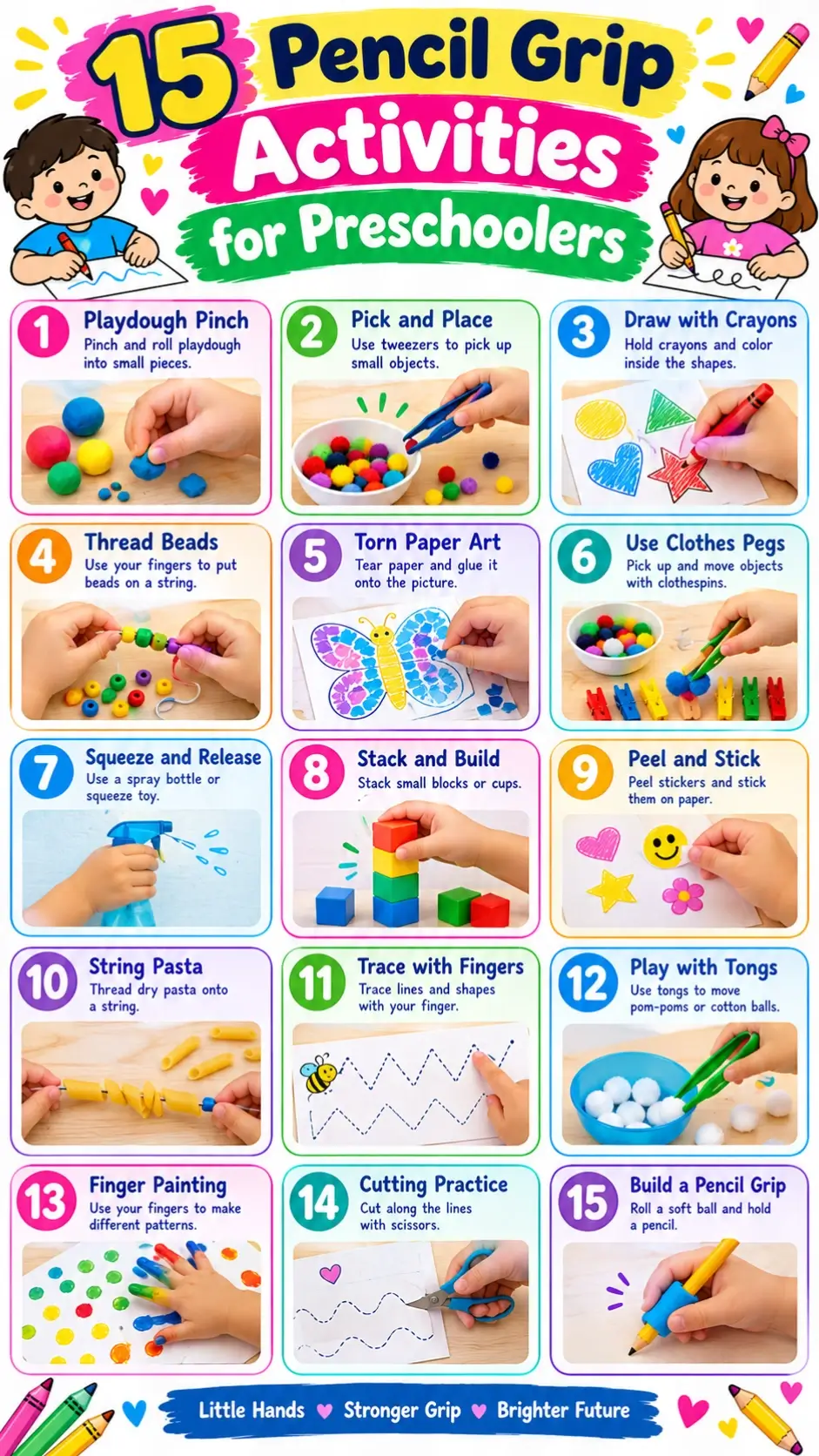
You can help that process through play with pencil grip activities for Preschoolers.
A few minutes of squeezing, pinching, picking up small objects, drawing on a vertical surface, or making tiny marks with a short crayon can give little hands useful practice without turning the activity into handwriting homework.
I see this as especially useful during the preschool years. With Hafsa, I’d rather set up a quick hand activity and let her play for a few minutes than keep asking her to “hold the pencil correctly” over and over.
What are pencil grip activities for Preschoolers?
Pencil grip means the way a child holds a pencil or another writing tool.
You may also hear the term pencil grasp. Occupational therapists commonly use “grasp” when talking about how a child holds and moves a writing tool.
Young children move through different grasp patterns as their hands develop. A younger child may use the whole hand, while an older preschooler may start using the thumb, index finger, and middle finger more precisely.
The movement matters too.
In a more mature dynamic grasp, the fingers make small movements to control the pencil while the wrist and forearm provide stability.
Why do pencil grip activities matter?
Drawing and writing ask a lot from a child’s hands.
Your child needs enough finger strength to hold the tool, enough control to move it, and enough coordination to watch what the hand is doing on the page.
That’s why pencil grip activities for young children often don’t involve pencils at all.
Tongs, playdough, small objects, short crayons, peg games, and other hand activities can work on the smaller skills that children later use for drawing and writing.
If you’re building a wider preschool routine, you can also mix these activities with the ideas in best educational activities for preschoolers.
Pencil grasp development by age
Children don’t all develop their pencil grasp at the same age, so think of these as general stages.
| Around 2–3 years | Around 3–4 years | Around 4–5 years | Around 5–6 years |
|---|---|---|---|
| A child may use a digital-pronate grasp, with several fingers on the writing tool and movement coming mainly from the forearm or whole arm. Large scribbles, simple drawings, and short coloring sessions are appropriate here. | Some children begin using a static tripod or quadrupod grasp. The thumb, index finger, and middle finger become more involved, although the hand may still move as a unit. This is a good age for playful hand-strength and finger-control activities. You can find more ideas for this age in preschool learning activities for 3-year-olds. | Children gradually gain more control over their fingers. Some begin using a more mature dynamic tripod or quadrupod grasp. They may still change their grip during drawing or writing. That’s okay. | A mature grasp may become more consistent, with small finger movements controlling the pencil. Development still varies from child to child. You can also see what other skills are appropriate for this stage in preschool learning activities for 4-year-olds and preschool learning activities for 5-year-olds. |
15 pencil grip activities for young children
These activities focus on different parts of pencil control, including finger strength, pinch strength, hand separation, wrist stability, visual-motor control, and small finger movements.
You don’t need to do all 15.
Pick 2 or 3 that your child enjoys and rotate them during the week.
1. Tiny crayon drawing
Break regular crayons into small pieces, around 1–2 inches long.
Give your child a few pieces and invite them to draw simple pictures.
The short crayons give the hand less room to wrap around the tool, which can encourage more finger-based holding. Short writing tools are commonly suggested for preschoolers who are developing a more refined grasp.
Try circles, dots, little flowers, faces, or anything your child wants to draw.
2. Sticker dot roads
Draw several simple roads on paper.
Give your child small round stickers and ask them to place the stickers along each road.
Peeling a small sticker requires a pinch between the fingers, while placing it accurately adds a little visual-motor practice.
You can make one road straight, one curved, and one shaped like a simple loop.
3. Coin slot game
Take a clean container with a narrow slot in the lid.
Give your child large play coins or safe-sized tokens and ask them to push them through the slot one at a time.
The thumb and fingers work together to pick up and position each piece.
Make it a simple counting game if your child enjoys numbers. For more number ideas, see number recognition activities for preschoolers.
4. Mini tongs rescue
Put large pom-poms or soft craft pieces in a bowl.
Give your child child-sized tongs and another empty bowl.
The job is simple: pick up one piece and move it across.
Tongs ask the fingers to open and close with control, and they give children a different way to practice the pinch needed for many fine motor tasks.
You can make it an animal rescue game. “The little bears are stuck. Can you move them home?”
5. Clothespin color match
Put colored paper circles around a plate or piece of cardboard.
Give your child matching clothespins.
Ask them to clip the red clothespin onto the red circle, blue onto blue, and so on.
Opening a clothespin takes hand strength and finger coordination. Your child also has to look carefully at the color before placing it.
6. Draw on a vertical surface
Tape a large sheet of paper to a wall or easel.
Give your child crayons or washable markers and let them draw while standing.
A vertical surface changes the position of the wrist and arm and can give children a different experience with shoulder and hand stability. Occupational-therapy resources commonly use vertical or slanted surfaces as one way to support pencil control.
Try drawing big circles, roads, rain, clouds, or simple houses.
7. Fingerprint paths
Draw a few simple paths on paper.
Instead of giving your child a pencil, let them follow the path with the tip of one finger using washable paint.
Make a road, spiral, wave, or simple loop.
This is a nice activity for younger children who aren’t ready for much pencil work yet.
8. Pick-and-drop pom-pom game
Put a group of large pom-poms in one bowl.
Place an empty ice cube tray beside it.
Your child picks up one pom-pom at a time and drops it into a compartment.
For older preschoolers, give them a color pattern to follow.
This also connects nicely with your pattern activities for preschoolers.
9. Hole-punch picture
Draw a simple outline of a cloud, leaf, balloon, or animal.
With an age-appropriate child-safe hole punch and close adult supervision, let your child punch holes around the outline.
The repeated squeezing motion works the hand.
For younger preschoolers, use a punch designed for small hands and keep the activity brief.
10. Chalkboard mini marks
Give your child a small piece of sidewalk chalk and a chalkboard or other suitable writing surface.
Ask them to make tiny dots, short lines, circles, and little X shapes.
Then erase the board and start again.
Chalk gives a different amount of resistance from paper, which can make simple mark-making feel interesting.
You can later use the same idea with letters from your alphabet activities for preschoolers.
11. Threading card shapes
Make a simple cardboard shape with large holes around the edge.
Give your child a thick shoelace or piece of yarn with a secured end.
Let them thread from hole to hole.
The hand that holds the card has a job too. It keeps the card steady while the other hand works.
That two-hand cooperation is useful for later paper and writing tasks.
12. Mini eraser transfer
Put several large, soft erasers in a small bowl.
Give your child a pair of child-sized tweezers.
Ask them to transfer each eraser into an ice cube tray.
For a younger child, use larger pieces and an easier tool. For an older preschooler, use smaller objects if they’re safe and appropriate.
The goal is controlled finger movement, not speed.
13. Playdough finger pinches
Roll a long piece of playdough.
Ask your child to pinch little sections between the thumb and index finger.
Make a pretend caterpillar with lots of tiny bumps.
Then try making small balls by rolling pieces between the fingertips.
Playdough activities are commonly used in occupational-therapy resources because rolling, pinching, and manipulating the material give the hands plenty of resistance and movement.
14. Pencil-control parking spaces
Draw 6–8 small parking spaces on paper.
Give your child a short crayon or pencil and ask them to draw a tiny car inside each space.
Then draw a short road from the edge of the page to each parking spot.
This gives the child a reason to make smaller controlled marks.
If your child already enjoys number work, you can number the spaces and connect it with counting activities for preschoolers.
15. Draw a tiny garden
Give your child a small piece of paper.
Ask them to draw a garden using tiny marks:
- Small circles for flowers
- Short lines for grass
- Little dots for seeds
- Small leaves
- Tiny insects
The paper can be only half an A4 sheet.
A smaller drawing area naturally asks the child to control the pencil more carefully than a huge sheet of paper.
How to teach a child to hold a pencil
Start by giving your child a comfortable writing tool.
For younger preschoolers, short crayons, broken crayons, or small pencils can be easier to manage than a long full-sized pencil.
Then show the basic position without turning it into a constant correction.
For a tripod grasp, the pencil rests against the middle finger while the thumb and index finger help hold it.
You can use a simple phrase such as:
“Pinch with these two fingers, then let the pencil rest.”
Show it once.
Let your child try.
If the grip changes after a few seconds, that’s expected during development.
Does my preschooler need a tripod grip?
The tripod grasp is a common mature grasp, but it isn’t the only functional grasp.
Children can develop other mature patterns, including quadrupod variations, that can work well for drawing and handwriting. Research and occupational therapy sources caution against judging a grasp only by whether it looks exactly like a textbook tripod.
Look at how your child uses the pencil.
Can they draw and write comfortably?
Can they control the pencil?
Do they tire quickly?
Does their hand hurt?
If the grasp is making writing difficult, an occupational therapist can look at the child’s specific needs rather than simply trying to force the fingers into one position.
Pencil control activities for 3-year-olds
Three-year-olds usually need plenty of large, playful movement.
Good choices include:
- Tiny crayon drawing
- Vertical-surface drawing
- Fingerprint paths
- Playdough pinching
- Clothespin matching
- Large-object tong games
Keep pencil tasks short.
At this age, scribbling, drawing circles, making lines, and exploring different writing tools are useful parts of early writing development.
You can also mix in beginning sound activities for preschoolers when your child starts making marks for letters and sounds.
Pencil control activities for 4-year-olds
Four-year-olds can usually handle a little more precision.
Try:
- Pencil-control parking spaces
- Chalkboard mini marks
- Small sticker paths
- Coin slot games
- Threading cards
- Simple drawing prompts
You can also introduce short tracing tasks if your child enjoys them.
If you’re planning other learning areas for this age, shape recognition activities for preschoolers can fit nicely alongside drawing and pencil-control work.
Pencil control activities for 5-year-olds
Five-year-olds can usually spend more time on controlled drawing and early handwriting.
Try small mazes, simple pictures, letter formation, copying short words, and drawing within small spaces.
Give your child opportunities to write for a real reason.
They could label a pretend shop, write a name on a drawing, make a shopping list, or create a little sign.
For math-related pencil practice, you can connect drawing and writing with math activities for preschoolers, simple addition activities for preschoolers, or subtraction activities for preschoolers.
How I practice pencil skills with Hafsa
With Hafsa, I’d keep pencil practice connected to something she already wants to do.
For example, I might draw 5 little houses and ask her to give each house a door. Then we could make tiny flowers around the houses with a short crayon.
Another day, I’d put a sheet of paper on the wall and let her draw while standing.
I don’t need every picture to look perfect. I’m more interested in giving her hands plenty of chances to move, pinch, press, draw, and control a small tool.
And sometimes the best pencil activity is 5 minutes long because that’s all the attention available that day.
How long should pencil activities last?
For preschoolers, short sessions are usually enough.
Try 5–10 minutes for a focused pencil activity, especially when your child is still developing hand endurance.
You can stop earlier if your child is tired or frustrated.
There is plenty of learning happening outside pencil time too. A preschool day can include movement, stories, pretend play, building, drawing, and hands-on tasks.
If you’re working on a daily schedule, see how many hours should a preschooler study? for a broader look at structured learning time.
Pencil grip and everyday activities
You can work on hand control during ordinary activities.
Ask your child to help peel a banana. Let them pick up small pieces of food with their fingers. Give them a chance to stir batter, turn pages, open simple containers, or sort small objects.
You don’t have to label every activity as a pencil-grip exercise.
For example, preschool cooking activities can give children plenty of opportunities to use both hands and control utensils.
And if your child enjoys practical play, activities such as where does food grow preschool activities can add drawing, labeling, sorting, and simple hands-on tasks around the same theme.
Pencil grip and hand-eye coordination
Pencil control also depends on seeing where the pencil is going and adjusting the hand.
Simple drawing games can help.
Draw a road and ask your child to keep the pencil between the lines. Draw a circle and ask them to make dots around it. Give them a picture with a few missing parts and let them complete it.
You can later connect these skills with number tracing activities for preschoolers when your child is ready for more structured tracing.
A simple 5-day pencil grip routine
You can use this little routine at home.
Monday:
Play the clothespin color-match game for 5 minutes.
Tuesday:
Do 5 minutes of playdough pinching, then draw with a short crayon.
Wednesday:
Try the coin-slot game, followed by a tiny drawing.
Thursday:
Draw on a vertical surface for 5–10 minutes.
Friday:
Use pencil-control parking spaces or draw a tiny garden.
That’s plenty for one week.
You can repeat the routine with different themes rather than constantly searching for new activities.
When should I be concerned about my child’s pencil grip?
Every child develops at a different pace, and an unusual-looking grip doesn’t automatically mean there’s a problem.
Pay closer attention when the grip comes with other difficulties.
For example, your child may:
- Complain that their hand hurts
- Tire very quickly during drawing
- Avoid all pencil or crayon activities
- Have significant trouble controlling the tool
- Struggle with basic drawing tasks compared with their usual abilities
- Become very frustrated whenever they need to write or draw
If you’re seeing several of these signs, an occupational therapist can assess the child’s hand skills and handwriting needs.
Frequently asked questions
What is the best pencil grip for a preschooler?
There isn’t one grip that every preschooler must use. A dynamic tripod grasp is a common mature pattern, while other mature grasps such as quadrupod variations can also be functional.
How can I improve my child’s pencil grip?
Give your child plenty of hand and finger activities, then provide short opportunities to draw and write. Tongs, clothespins, playdough, short crayons, threading, and small-object games can all support the skills used for pencil control.
Should a 3-year-old use a tripod grip?
A 3-year-old may be developing a static tripod or quadrupod grasp, but children vary. At this age, playful fine motor work and drawing are more appropriate than repeatedly forcing a particular finger position.
Are broken crayons good for pencil grip?
Short crayons can encourage children to use their fingers instead of wrapping the whole hand around a long writing tool. They can be a useful option for preschool drawing.
Does handwriting practice improve pencil grip?
Some handwriting practice helps children use and refine their grasp, but pencil control also depends on the hand, wrist, arm, visual-motor skills, and overall coordination. That’s why pencil-free hand activities are useful too.
How long should a preschooler practice pencil grip?
Start with short sessions of around 5–10 minutes and adjust based on your child’s age, interest, and endurance. You can spread practice across the week instead of doing one long session.
What if my child holds the pencil differently from other children?
A different-looking grasp can still work well. Look at comfort, control, speed, legibility, and fatigue rather than comparing your child’s fingers with another child’s grip. If the grasp is causing functional problems, an occupational therapist can take a closer look.
More preschool activities to try
Pencil control fits nicely into a wider preschool routine.
You can rotate it with language, math, movement, stories, and practical activities throughout the week. A child who spends 5 minutes drawing after a story may get more from that session than they would from a long worksheet block.
Here are a few related ideas from OnlineSikha:
- Which has more preschool activities? for early comparison and thinking activities.
- Fun rhyming activities for preschoolers for language play.
- Who Am I preschool activities for simple language and self-awareness activities.
- Where do animals live preschool activities for an animal-themed learning session.
- Cutting activities for preschoolers for another hand-skill activity.
- Preschool learning activities for 3-year-olds for more ideas suited to younger preschoolers.
Final thoughts
Pencil control develops through many small experiences.
Let your child pinch playdough, clip clothespins, move tiny objects, draw on a wall-mounted sheet, make marks with a short crayon, and scribble pictures that only make sense to them.
Then give them a pencil and let them try.
With Hafsa, I’d keep the whole thing relaxed. A few minutes of enjoyable hand play today can be enough.