
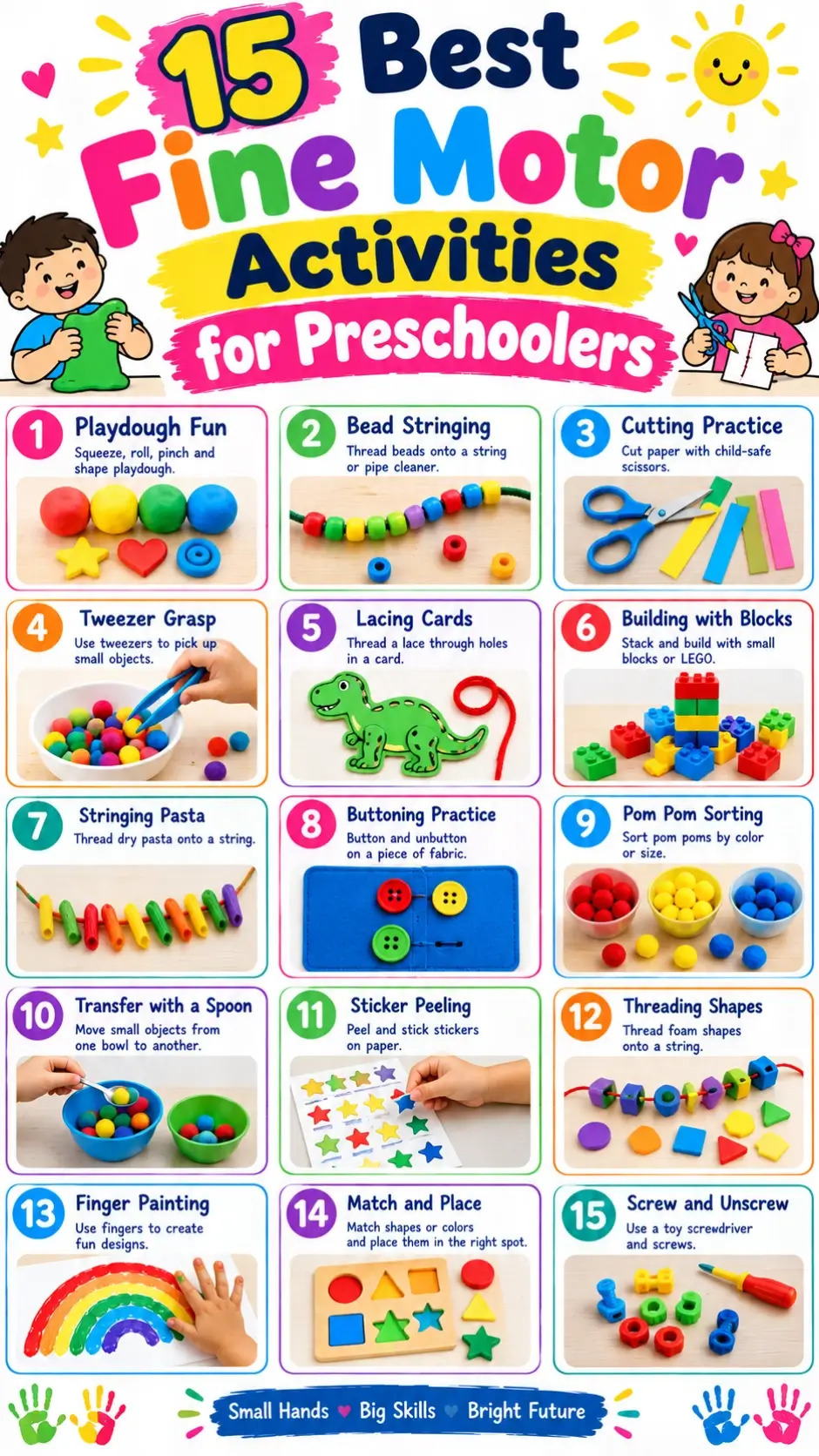
Fine motor skills help preschoolers control the small muscles in their fingers, hands, and wrists. Children use these skills when they hold a crayon, open a zipper, turn a lid, use scissors, button clothes, or pick up tiny objects.
And preschoolers learn these skills through doing things.
You can give your child a short activity at the kitchen table, add a hand-strengthening task to pretend play, or turn an everyday job into practice. It doesn’t have to become a big lesson.
I see this with my little girl, Hafsa. Give her something she can pinch, twist, peel, squeeze, or move from one place to another, and she gets a chance to work those little hand muscles while she plays.
What are fine motor skills?
Fine motor skills are the small, controlled movements children make with their hands and fingers.
A preschooler uses fine motor control to:
- Hold and control a pencil or crayon
- Pick up small objects with the thumb and fingers
- Turn lids and knobs
- Use a spoon
- Button and zip clothing
- Tear and fold paper
- Use scissors
- Build with small pieces
- Draw simple lines and shapes
- Manipulate play materials
Fine motor control also works together with visual and hand-eye coordination. These skills become useful during drawing, early writing, self-care, crafts, and many everyday tasks. Occupational therapy resources also connect pre-writing with finger strength, grasp strength, wrist stability, manual dexterity, and visual-motor skills.
If you’re working on early writing too, you can pair these activities with simple alphabet activities for preschoolers and number tracing activities for preschoolers.
15 best fine motor activities for preschoolers
Here are simple activities you can do at home with things you probably already have.
1. Sticker peel and place
Give your child a sheet of small stickers and a piece of paper.
Ask them to peel each sticker and place it inside a drawn circle, along a line, or on a simple picture. Peeling the sticker takes a small pinch between the thumb and finger, while placing it carefully works on hand-eye control.
For a little extra learning, draw letters or numbers on the paper.
You could make an A page for alphabet practice or numbers 1 to 5 for early number recognition.
2. Twist-and-match containers
Collect a few clean containers with different screw-on lids.
Mix the lids and let your preschooler figure out which lid belongs to each container. Then have them twist each lid open and closed.
This gives their fingers plenty of turning practice, and the matching part adds a little thinking to the activity.
Choose containers with large lids that are easy for small hands to handle.
3. Sponge squeeze station
Put 2 small bowls on a tray. Fill one with a little water and leave the other empty.
Give your child a clean sponge. They squeeze the sponge over the empty bowl, dip it back into the water, and repeat.
The squeezing action makes this a nice hand-strength activity. It can also become a simple water-transfer game on a warm afternoon.
4. Make a paper snowball
Give your child pieces of scrap paper or old magazine pages.
Ask them to crumple each piece into a tight little ball using both hands.
Then place a bowl a short distance away and let your child toss the paper balls into it.
The squeezing is the main part here. You can make the game silly by pretending the paper balls are snowballs.
5. Clothespin rescue
Draw several simple shapes on a piece of cardboard. Write a color or letter inside each shape.
Give your child clothespins and ask them to clip one onto each shape.
Squeezing the clothespin works the fingers, while placing it in the right spot adds hand-eye control.
For younger preschoolers, start with 3 or 4 clothespins. Older preschoolers can work through a larger set.
6. Open and close a zipper bag
Put a few soft toys, crayons, or large craft items inside a reusable zipper bag.
Let your child open the zipper, take everything out, put it back, and close the bag.
You can turn it into pretend play too. Maybe the bag is a travel bag for a teddy bear going on a trip.
Small zipper movements require careful finger control. Household tasks like opening bags, twisting containers, and handling closures are also common ways to work fine motor skills at home.
7. Dropper painting
Put a small amount of colored water into several cups.
Give your preschooler a child-safe dropper and a sheet of thick paper. Let them squeeze the dropper to pick up the colored water and release drops onto the paper.
This takes more control than simply pouring water.
You can make dots, mix 2 colors, or create a simple picture from the drops. PreKinders includes eyedropper activities among its preschool fine motor ideas because children have to control their fingers while releasing small amounts of liquid.
8. Make a button board
Take a piece of sturdy fabric and attach a few large buttons securely. You can also use an old shirt with large buttons.
Show your child how to push the button through the hole and pull it back out.
Start with 1 or 2 buttons. Once your child understands the movement, add a few more.
This is useful because buttoning is a real self-care skill. Preschoolers get to practice the same hand movement during play that they’ll eventually use while getting dressed.
9. Nuts and bolts
Use large child-safe nuts and bolts that are easy to grip.
Ask your child to twist the nut onto the bolt and then remove it.
They’ll need both hands for the task, with one hand holding the bolt while the other turns the nut.
PreKinders includes nuts and bolts as a fine motor activity because the twisting motion requires the fingers, hands, and wrists to work together.
Supervise this activity closely and choose pieces that are large enough for your child’s age.
10. Hole-punch pictures
Draw a simple outline of a star, heart, circle, or animal on paper.
Give your preschooler a child-safe paper punch and let them punch holes along the outside of the shape.
They’ll need to squeeze the punch, release it, move the paper, and repeat.
Older preschoolers may enjoy making a picture from several punched shapes. Paper punchers are also used in preschool fine motor work to practice hand control and dexterity.
11. Wash-and-scrub station
Give your child a small bowl of water, a toothbrush that isn’t being used for brushing teeth, and a few washable plastic toys.
Let them scrub the toys and rinse them.
A tiny toy car, plastic animal, or building piece can become the “dirty” item that needs cleaning.
The repeated brushing movement gives the hand and fingers a useful workout. It also turns an ordinary household task into play.
You can connect this with animal play by using figures from your where do animals live preschool activities activity set.
12. Rubber band stretch
Take a sturdy plastic cup or small container and a few wide rubber bands.
Show your child how to stretch a rubber band around the outside of the container.
They’ll need to open their fingers against the band’s resistance and carefully place it around the container.
Keep the bands large and supervise closely. Rubber bands can snap, so this is a hands-on activity that needs an adult nearby.
13. Peel and tear a paper collage
Give your child strips of thin colored paper.
Let them tear the paper into small pieces using both hands. Then they can glue the pieces onto a larger sheet to make a simple collage.
You could make a tree, a house, a rainbow, or even an animal.
Paper tearing requires the hands to work together in different directions. OT Perspective also recommends paper tearing and crumpling as simple preschool hand activities using everyday materials.
14. Mini brush painting
Give your child a small sheet of paper and a thin paintbrush.
Instead of covering a large page, ask them to paint tiny dots, short lines, little flowers, or small shapes.
The smaller working area encourages more controlled movements.
This is a good activity for a preschooler who already enjoys painting and is ready to work with a little more precision. PreKinders also recommends small-brush painting as a later fine motor activity after children have had plenty of experience with larger painting movements.
15. Finger treasure hunt in dough
Hide a few large objects inside soft play dough.
Your child presses, pinches, pulls, and digs through the dough to find each item.
You can hide large buttons, chunky plastic shapes, toy animals, or other age-appropriate objects.
Once they find something, ask them to place it in a bowl.
This gives the fingers resistance from the dough while adding a little excitement to the activity. NAPA Center also recommends hiding objects in putty or play dough as a way to work on hand strength and using both hands together.
Fine motor activities by age
Preschoolers develop at different speeds, so age ranges are useful guides rather than strict deadlines.
Fine motor activities for 3-year-olds
At 3, keep the movements simple and give your child plenty of time to figure things out.
Good choices include:
- Sticker peeling
- Sponge squeezing
- Paper crumpling
- Large button practice
- Opening and closing containers
- Simple clothespin activities
- Large-piece dough treasure hunts
You can also mix fine motor play into your child’s regular learning time. My preschool learning activities for 3-year-olds include other hands-on ideas that fit naturally into this age.
Fine motor activities for 4-year-olds
Four-year-olds can usually handle activities that require a little more control.
Try:
- Hole punching
- Dropper painting
- Nuts and bolts
- More detailed sticker activities
- Small brush painting
- Zipper practice
- Paper collage work
You can combine these with early literacy, shapes, or numbers. For example, let your child place stickers on a letter or punch around a simple shape.
My guide to preschool learning activities for 4-year-olds has more activities for this stage.
Fine motor activities for 5-year-olds
By 5, many children are ready for activities that need more precision and longer attention.
Try:
- Detailed paper collages
- Small brush painting
- Buttoning several buttons
- More complex hole-punch pictures
- Building with smaller construction pieces
- Drawing small shapes and pictures
- Fine motor tasks connected to early writing
This is also a good age to connect hand skills with literacy and math. You can add beginning sound activities for preschoolers or number work to a fine motor station.
For more ideas, see preschool learning activities for 5-year-olds.
Why are fine motor skills important for preschoolers?
Your child uses fine motor skills all day.
Think about getting dressed. A child has to pull a zipper, push a button, hold clothing, and sometimes manage shoelaces.
Then there’s drawing, coloring, eating with utensils, turning pages, opening containers, and eventually writing.
PreKinders describes fine motor development as part of the preschool foundation for holding and controlling writing tools, while NAPA Center connects handwriting preparation with finger strength, grasp, wrist stability, manual dexterity, and visual-motor skills.
These skills also show up during the everyday learning activities you already do at home.
For example, a child can practice hand control while doing number recognition activities for preschoolers, handling pieces during counting activities for preschoolers, or manipulating materials during shape recognition activities for preschoolers.
Fine motor skills and early writing
A preschooler needs several skills before writing becomes comfortable.
They need to hold a writing tool, control their fingers, move their wrist, coordinate their eyes and hands, and keep their movements fairly steady.
That’s why fine motor play and early writing can work nicely together.
You might spend 5 minutes squeezing a sponge, then 5 minutes drawing lines. Another day, you could do sticker work before a short alphabet activity.
Keep the writing portion short, especially for younger preschoolers. My guide on how many hours a preschooler should study explains why short learning sessions work better for this age.
How I would use these activities with Hafsa
I wouldn’t put 5 fine motor activities on the table at once.
I’d choose one.
For example, I might give Hafsa a few stickers and a simple picture to decorate. Another day, we could wash some plastic animals with a small brush. On a different afternoon, she could squeeze a sponge into a bowl of water.
That’s enough.
If she enjoys one activity, let her repeat it. Repetition is useful because her hands get more practice with the same movement.
You can also connect fine motor work to her other interests. If she’s playing with animals, use animal figures. If she’s interested in food, give her a safe kitchen task. If she likes drawing, add stickers, hole punches, or small brushes.
For more hands-on preschool ideas, you can also browse the best educational activities for preschoolers.
Fine motor activities using everyday learning
You don’t have to separate every skill into its own lesson.
Fine motor practice fits into many preschool activities.
While working on which has more preschool activities, your child can move objects with their fingers.
During simple addition activities for preschoolers, they can pick up and move counters.
The same idea works with subtraction activities for preschoolers. Let your child physically move the objects instead of only looking at numbers on paper.
And math activities for preschoolers can include plenty of hands-on materials.
You can also bring fine motor play into pretend themes. Try animal figures during Arctic animals activities for preschoolers, or use small kitchen tools during preschool cooking activities.
Simple weekly fine motor routine
Here’s a simple way to spread the activities across a week:
| Day | Activity |
|---|---|
| Monday | Sticker peel and place |
| Tuesday | Sponge squeeze station |
| Wednesday | Clothespin rescue |
| Thursday | Dropper painting |
| Friday | Paper collage |
| Saturday | Button practice |
| Sunday | Finger treasure hunt |
You can swap activities based on what your child enjoys.
There’s no reason to finish the whole list.
When should you be concerned about fine motor skills?
Children develop at different rates, and preschool skills don’t appear on exactly the same day for every child.
Look at the bigger picture. Can your child use their hands during play? Can they pick up and manipulate objects? Are they gradually becoming more comfortable with everyday tasks?
If your child consistently struggles with hand movements, avoids many age-appropriate hand tasks, or has lost a skill they previously had, talk with your child’s pediatrician or an occupational therapist.
An occupational therapist can look at specific hand, coordination, and visual-motor skills and suggest activities that fit your child’s needs.
More preschool activities to try
Fine motor play works well alongside other preschool learning.
For language and social learning, try fun rhyming activities for preschoolers.
For themed learning, you can try Where the Wild Things Are preschool activities and Where Does Food Grow preschool activities.
These activities give you plenty of chances to add small hand movements naturally without turning every play session into a worksheet.
Frequently asked questions
What are the best fine motor activities for preschoolers?
The best activities are ones that make your child use their fingers and hands with some control. Sticker peeling, buttoning, squeezing sponges, twisting lids, clothespins, hole punching, dropper painting, paper tearing, and dough play are good choices.
How can I improve my preschooler’s fine motor skills at home?
Give your child regular chances to use their hands during play and everyday tasks. Let them open containers, peel stickers, squeeze sponges, manipulate dough, button clothing, paint with small brushes, or move objects with their fingers.
Short sessions are enough.
What fine motor skills should a 3-year-old have?
A 3-year-old is usually working on skills such as grasping small objects, using simple tools, manipulating play materials, turning pages, drawing basic marks, and managing some simple dressing tasks. Children develop at different rates, so look for gradual progress rather than a strict checklist.
Do fine motor activities help with handwriting?
They can help children build some of the hand and visual-motor skills used during early writing. Fine motor activities can work on finger strength, grasp, wrist stability, and manual control, which are part of the larger group of skills involved in handwriting.
How long should a fine motor activity last?
Start with around 5 to 10 minutes and see how your child responds. Some children will stay with an activity longer when they’re interested, while others will be ready to move on quickly.
Are worksheets good for fine motor development?
Worksheets can give children practice with drawing, tracing, coloring, and other pencil tasks. They work best as one part of a wider mix of hands-on play, everyday tasks, and activities that use the fingers and hands in different ways.
Final thought
Fine motor practice can happen almost anywhere.
A zipper, sticker sheet, sponge, button, piece of paper, or small paintbrush can give your preschooler a chance to use those little fingers with purpose.
Pick one activity today. Keep it simple, stay nearby when small materials are involved, and let your child have a little fun with it.
https://napacenter.org/fine-motor-activities/
https://www.pinterest.com/bernluvsbooks/fine-motor-fun/
https://www.prekinders.com/fine-motor-skills/
https://library.sheffieldchildrens.nhs.uk/fine-motor-skills-in-pre-school-and-younger-children/
https://www.pinterest.com/clipartteacher/fine-motor-activities-for-preschoolers/