
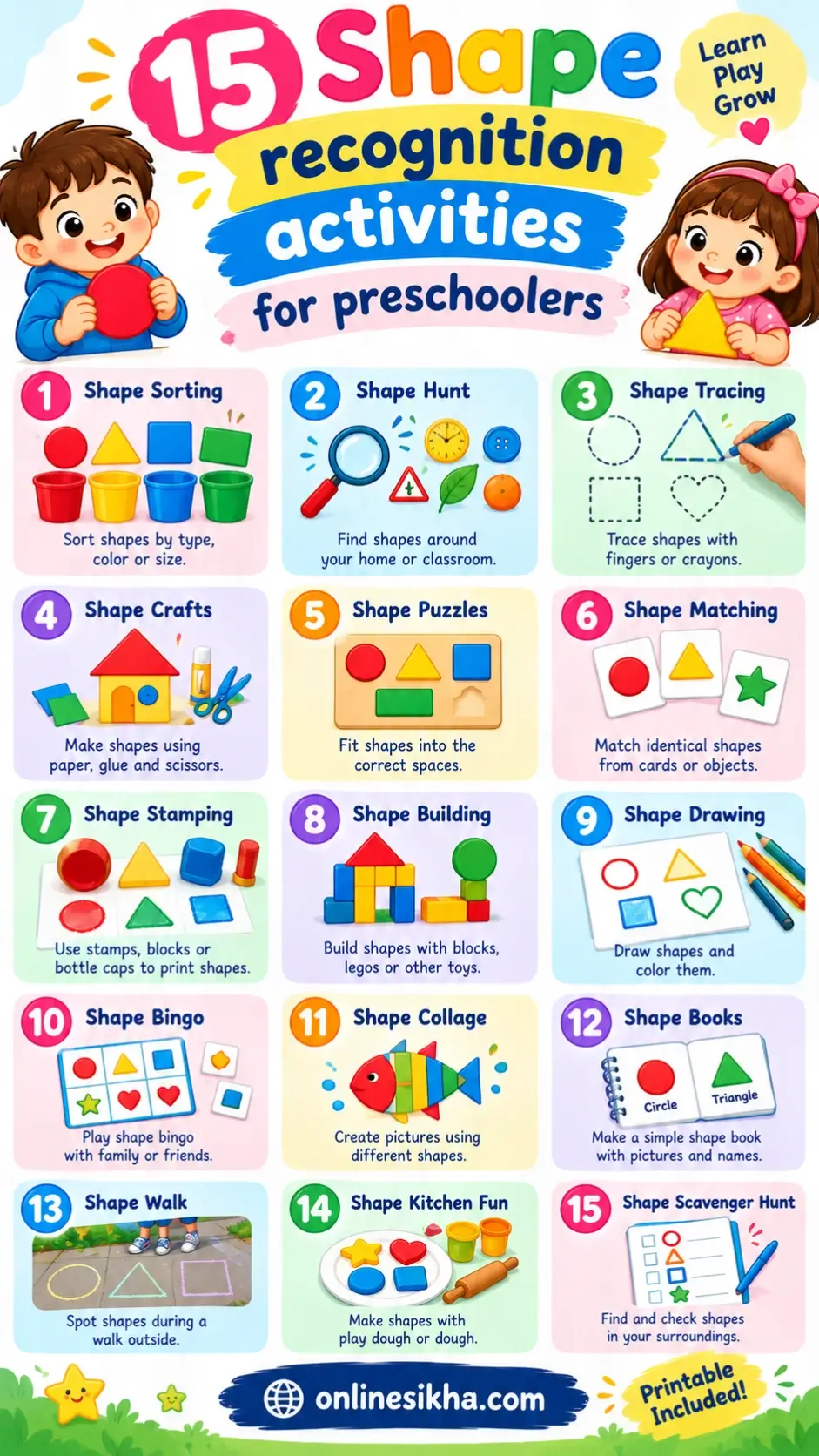
Learning shapes starts with something very simple: noticing.
A child sees a round plate, a square window, a triangle on a sign, or a rectangle on a book cover. When you give those everyday shapes a name, your child starts connecting what they see with words like circle, square, triangle, and rectangle.
These shape recognition activities for preschoolers make that learning feel natural. Most need only paper, household objects, or toys you already have.
And you don’t need to teach 10 shapes at once. Start with a few familiar ones and give your child plenty of chances to see them again.
Why shape recognition matters for preschoolers
Shape recognition is an early math skill. Children gradually learn to tell shapes apart, name them, notice their characteristics, and find them in everyday objects. Hands-on practice gives them more chances to make those connections.
As your child learns, use simple shape language.
Say, “This is a triangle. It has 3 sides and 3 corners.”
Then let your child find another triangle.
That little conversation is doing more than teaching a shape name. Your child is learning to look closely and explain what they see.
15 shape recognition activities for preschoolers
1. Shape basket sort
Collect small household objects, kitchen cooking items, or toys with different shapes.
Put a circle, square, triangle, and rectangle on separate pieces of paper. Ask your child to place each object beside the shape it matches.
A round lid might go beside the circle. A small box might go beside the rectangle.
Start with only 2 or 3 shapes if your child is new to the activity.
2. Shape detective around the house
Give your child one shape to find.
Say, “Can you find something shaped like a circle?”
Walk around the room together and look for one. A plate, clock, bowl, or lid might work.
Then choose another shape.
I like this one because you don’t need to prepare anything. Your home becomes the activity.
3. Shape match with real objects
Place a few real objects on a table.
Next to them, put simple paper shapes. Your child matches the paper shape to an object with a similar shape.
Try a plate with a circle, a book with a rectangle, and a coaster with a square.
The objects don’t have to be perfect geometric examples. That’s part of the learning. Children need to see that shapes can look different in size, color, and context.
4. Shape mystery bag
Cut several large shapes from cardboard and place them in a cloth bag.
Your child reaches inside without looking and feels one shape.
Ask, “What do you think it is?”
Let your child pull it out and check the answer. For younger preschoolers, start with shapes that feel very different, such as a circle and triangle.
You can talk about sides and corners as your child becomes more comfortable.
5. Find the shape that doesn’t belong
Put 4 shape cards in a row.
For example:
Circle, circle, square, circle.
Ask your child which one is different.
Then change the arrangement:
Triangle, square, triangle, triangle.
This helps your child look carefully at shape differences instead of simply memorizing names.
6. Shape parking spaces
Draw several large shapes on the floor with painter’s tape.
Give your child toy cars, animals, or other small toys.
Call out a shape and let your child move a toy into that space.
“Park the car in the triangle.”
“Now park it in the circle.”
This gives shape recognition a little movement, which can be useful for children who don’t want to sit at a table for long.
7. Shape sorting by size
Prepare several circles, squares, triangles, and rectangles in different sizes.
Ask your child to put the same shapes together.
Then ask, “Which circle is bigger?”
Keep the first round simple. You’re checking whether your child can recognize the shape even when its size changes.
8. Shape flip game
Cut out a few shapes from paper.
Place one shape in front of your child. Turn it around, rotate it, or move it to a different position.
Ask, “Is it still a triangle?”
Yes.
This is a useful little lesson because a triangle is still a triangle when it points a different way. Preschoolers sometimes rely too much on the exact position they’ve seen before.
Hands-on shape work can include matching, flipping, and turning shapes, which helps children notice that a shape stays the same when its position changes.
9. Shape picture cards
Draw simple pictures using only basic shapes.
For example, make a house with a square and triangle. Make a flower with circles. Make a robot using rectangles and squares.
Point to each part and ask, “What shape is this?”
Then let your child find the same shape from a small group of shape cards.
You can make new pictures together when your child is ready.
10. Shape sorting with buttons
If you have large buttons in different shapes, put them into a bowl.
Ask your child to sort them by shape.
If your buttons don’t have different shapes, use other safe household items instead. Always supervise young children around small objects.
You can also ask your child to explain the groups: “These are circles. These have 4 sides.”
11. Shape listening game
Give your child 3 shape cards.
Say the name of one shape without showing it.
“Touch the square.”
Then try:
“Touch the triangle.”
“Touch the circle.”
Once your child gets comfortable, make it slightly harder by placing more shapes on the table.
This simple game checks whether your child connects the spoken word with the visual shape.
12. Shape hunt in a picture book
Choose a picture book with lots of objects.
Before reading, pick one shape.
“Let’s look for circles.”
As you turn the pages, stop whenever your child spots one.
You might find a circle in a wheel, a sun, a plate, or a character’s eyes.
This works especially well when your child already enjoys looking through books.
13. Shape memory pairs
Make pairs of simple shape cards.
You might have 2 circles, 2 squares, 2 triangles, and 2 rectangles.
Place them face down. Your child turns over 2 cards at a time and tries to find a matching pair.
Keep the number of pairs small at first.
The game asks your child to remember where a shape was while also paying attention to its form.
14. Which shape fits?
Cut a simple opening in a piece of cardboard, such as a circle, square, or triangle.
Give your child matching shapes.
Ask your child to place each shape through the correct opening.
You can make this from an old cereal box, so there isn’t much preparation involved.
As your child plays, use the shape names aloud.
“Where does the triangle go?”
“Can you find the square?”
15. Shape talk during everyday routines
You don’t always need a separate activity.
Talk about shapes while you’re doing normal things.
“Your plate is a circle.”
“That book is a rectangle.”
“Look at the square window.”
“When we cut the sandwich, can you find a triangle?”
These tiny conversations add up. Your child starts hearing shape names in real situations instead of only during a lesson.
Which shapes should preschoolers learn first?
Start with common 2D shapes:
- Circle
- Square
- Triangle
- Rectangle
- Oval
You can add shapes such as a star, heart, diamond, hexagon, and pentagon as your child becomes more comfortable.
The exact order isn’t a race. If your 3-year-old knows circle and square but mixes up triangle and rectangle, that’s perfectly fine.
Give those shapes more practice.
Shape recognition activities for 3-year-olds
At 3, keep shape activities short and physical.
Start with 2 or 3 familiar shapes. Let your child touch them, hold them, match them to objects, and find them around the house.
A 3-year-old might recognize a circle but still call an oval a circle. That’s normal. The goal is repeated exposure and simple conversations.
If you’re building a broader learning routine for this age, you can also see my guide to preschool learning activities for 3-year-olds.
Shape recognition activities for 4-year-olds
At 4, many children are ready to compare shapes more closely.
Ask questions such as:
“How are these 2 shapes alike?”
“Which shape has 3 corners?”
“Can you find a rectangle that looks different from this one?”
You can also introduce less familiar shapes once the basic ones are comfortable.
My preschool learning activities for 4-year-olds has more ideas for building early learning skills through play.
Shape recognition activities for 5-year-olds
By 5, you can ask children to describe shapes using simple properties.
“How many sides does it have?”
“How many corners?”
“Can you find 2 shapes that have something in common?”
You can also begin talking about simple 3D shapes using familiar objects, such as a ball for a sphere or a box for a rectangular prism.
Keep the language simple. Your child doesn’t need a geometry lesson.
How I practice shapes with Hafsa
With my little girl, Hafsa, I’d rather turn shape learning into something she can do with her hands.
If we’re eating, I can point to her plate and ask about its shape. If we’re playing with toys, I can pick up a block and ask her to find another one with the same shape.
Those little moments are easier to repeat than sitting down for a long lesson.
And if she’s tired, I leave it there. A few minutes of good attention is enough for a preschooler.
What if my child keeps mixing up shapes?
Slow down and reduce the number of choices.
If your child mixes up square and rectangle, work with only those 2 for a while. Put them side by side and talk about what you can see.
You can say, “This one has 4 sides. This one also has 4 sides. Look at how the sides are different.”
Let your child touch the shapes and turn them around. Children often need repeated hands-on experiences before a shape name sticks.
Should preschoolers learn shape names or shape properties first?
Do both, but keep the language simple.
Start with the name: “This is a triangle.”
Then add one small detail: “A triangle has 3 sides.”
Later, you can ask your child to identify a triangle from several shapes without giving the name first.
Shape learning gradually moves from simply seeing a shape to comparing its sides, corners, size, and position.
Can worksheets help with shape recognition?
Yes. Worksheets can give children another way to practice identifying, matching, coloring, and tracing shapes.
I just wouldn’t make worksheets the whole activity.
Try a real-object shape hunt first, then give your child a short worksheet. That way, the picture on the page has a connection to something your child has already seen and touched.
You can also pair shape work with your number recognition activities for preschoolers when you’re planning a broader preschool math routine.
For children who enjoy pencil work, my number tracing activities for preschoolers can also fit into the same learning routine.
Shape recognition and early math
Shapes are part of early math, so you can naturally connect them with other math ideas.
Ask your child to sort shapes, compare sizes, count the sides of a triangle, or find 2 objects with the same shape.
You don’t need to turn every activity into a math lesson. A simple question while your child is playing can be enough.
For more ideas, see my collection of math activities for preschoolers.
How long should shape practice last?
Keep it short enough that your child still wants to continue.
A 3-year-old might spend 5 minutes matching shapes. A 4- or 5-year-old may stay with a game longer, especially if there’s movement, sorting, or a challenge involved.
You can also spread shape practice across the day instead of doing one long session. My guide to how many hours a preschooler should study explains why short, age-appropriate learning periods make sense for young children.
Frequently asked questions
What is the easiest shape for a preschooler to recognize?
A circle is usually a good starting point because children see many circular objects in everyday life, such as plates, wheels, and balls. Square, triangle, and rectangle are good next choices.
How do I teach my preschooler to recognize shapes?
Show your child a few shapes at a time and use the shape names often. Then let your child match shapes, find them around the house, sort objects, and compare shapes that look similar.
What are the basic shapes for preschoolers?
The common starting shapes are circle, square, triangle, rectangle, and oval. You can introduce star, heart, diamond, pentagon, and hexagon later.
Should I teach 2D and 3D shapes at the same time?
For most preschoolers, start with familiar 2D shapes. Once your child is comfortable, introduce 3D shapes through real objects such as balls, cans, boxes, and blocks.
Are shape recognition activities good for preschool math?
Yes. Shape recognition supports early geometry and visual discrimination. Children also practice comparing, sorting, describing, and noticing differences between shapes.
More preschool learning ideas
Shape learning fits nicely into a wider preschool routine.
For literacy, you can try alphabet activities for preschoolers and beginning sound activities for preschoolers.
For language and social learning, see Who Am I preschool activities and fun rhyming activities for preschoolers.
For more math practice, you can also visit counting activities for preschoolers, simple addition activities for preschoolers, and subtraction activities for preschoolers.
If you’re planning learning activities around themes, you might also enjoy Where the Wild Things Are preschool activities, Where Does Food Grow preschool activities, and Where Do Animals Live preschool activities.
Final thought
Shape recognition grows through repetition.
Point out a circle at breakfast. Find rectangles in a book. Sort a few shapes after lunch. Ask your child to spot a triangle while you’re outside.
Those small moments give preschoolers plenty of chances to see a shape, say its name, and recognize it in a new place.
https://www.pinterest.com/personalizednamebooks/shapes-activities-for-preschoolers/
https://www.abcmouse.com/learn/activities/shape-activities-for-preschoolers-and-kindergarteners/16061
https://teaching2and3yearolds.com/how-to-teach-shape-recognition-to-preschoolers/
https://littlebinsforlittlehands.com/shape-activities/
https://www.pre-kpages.com/shapes-activities-preschoolers/
https://misskindergarten.com/shape-activities-for-preschool/