
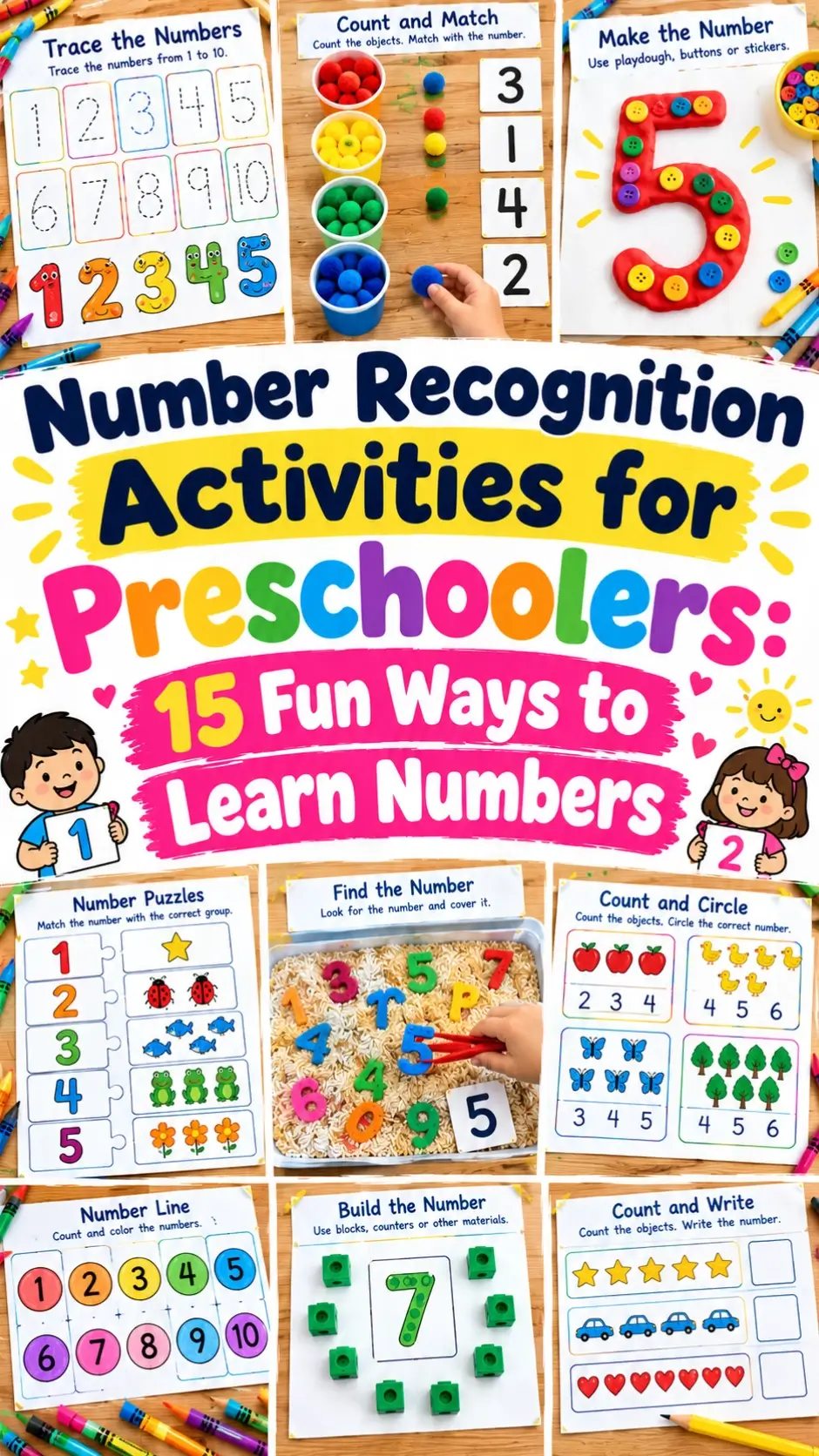
Learning to recognize numbers takes time. A preschooler might happily count from 1 to 10 and still pause when you point to the number 7.
That’s normal.
Number recognition means being able to look at a numeral and know what it is. Children also need to connect that numeral with its spoken name and, gradually, with the amount it represents.
I see this kind of learning with my little girl, Hafsa. A number card can feel boring after a few minutes, while the same number becomes much more interesting when she’s looking for it, moving around, or using it in a game.
So I’ve put together 15 number recognition activities for preschoolers that you can do at home or in a classroom. Most need only paper, cards, toys, or things you already have around the house.
When should preschoolers learn number recognition?
There’s no single age when every child suddenly knows all the numbers.
Some children recognize a few numerals around age 3. Others need more time and repeated practice. Start with a small group of numbers your child can handle, such as 1 to 5, then add more as those become familiar.
You can also separate number recognition from counting practice. A child may know how to say “1, 2, 3, 4, 5” without recognizing the written numeral 5.
That’s why short, repeated games work so well.
15 number recognition activities for preschoolers
1. Number parking lot
Draw several parking spaces on a large sheet of paper. Write one numeral in each space.
Make small paper cars and write matching numbers on them.
Your child chooses a car, says the number, and parks it in the matching space.
Start with 1 to 5. Add 6 to 10 later.
You can make this more fun with toy cars if you have them. The game suddenly becomes a parking problem instead of a number drill.
2. Feed the number monster
Draw a funny monster on a piece of cardboard and cut a small opening for its mouth.
Make small number cards from 1 to 10.
Call out a number and ask your child to find it and feed it to the monster.
For example:
“Can you find number 4?”
Your child searches through the cards, picks 4, and pushes it into the monster’s mouth.
You can also let the child choose a card and tell you which number they found.
3. Number clothesline
Write numbers on small pieces of paper.
Attach a string between 2 chairs or along a wall. Give your child clothespins and the number cards.
Ask them to hang the numbers in order.
If your child is still learning 1 to 5, use only those numbers.
Once they know more, mix up 1 to 10 and let them put the cards back in sequence.
This gives number recognition a little movement without turning it into a running game.
4. Find the number in a book
Pick a picture book with large, easy-to-see numbers.
Choose one number before you start reading. If you’re looking for 3, ask your child to spot every 3 they see.
You can also point out numbers on page numbers, clocks, signs, or pictures inside the book.
Keep it casual. You don’t need to stop the story every time.
5. Number sticker parking
Draw 10 large circles on paper and write one numeral inside each circle.
Give your child stickers.
Call out a number and let them place a sticker on the matching numeral.
For younger preschoolers, use numbers 1 to 5. Older preschoolers can work with 1 to 10.
This one works well when your child likes stickers and needs a quiet table activity.
6. Number mail
Make a few paper envelopes and write a numeral on each one.
Then make small “letters” with numbers written on them.
Your child becomes the mail carrier.
They pick up a number card, identify it, and deliver it to the envelope with the same number.
You can make the envelopes different colors if that helps your child keep track of them.
7. Number puzzle strips
Cut strips of paper into 2 or 3 large pieces.
On one piece, write a numeral. On the matching piece, draw the same number of simple dots or pictures.
For example:
5 | ● ● ● ● ●
Cut between the numeral and the dots.
Your child puts the pieces together.
As your child gets better at the game, make the pieces smaller or use numbers up to 10.
8. Number window game
Write numbers on sticky notes and place them around a room.
Ask your child to open or check one “window” at a time by lifting the sticky note.
When they find a number, they say it aloud.
You can give a simple challenge:
“Can you find number 6?”
Or:
“Find a number bigger than 3.”
For a younger child, stick with identifying one number at a time.
9. Number parking ticket
Make pretend parking tickets with numbers 1 to 10.
Give your child toy cars or paper cars.
Call out a number and hand your child the matching ticket. They need to find the car with that number.
You can reverse the game too. Your child picks a ticket and tells you what number it shows.
Pretend play gives you lots of chances to repeat the same numbers without making the activity feel repetitive.
10. Mystery number bag
Put several number cards into a small bag.
Your child reaches in and pulls out one card without looking.
Ask:
“What number did you get?”
If they don’t know it, tell them and have them repeat the number.
Then put the card back and try again.
For a younger preschooler, use only 3 or 4 familiar numbers. Add new numbers gradually.
11. Number detective
Write numbers on small cards and hide them around one room.
Give your child a “detective mission.”
“Find number 2.”
Once they find it, ask them to bring it back.
Then choose another number.
You can also give your child a small paper checklist with 1 to 5 and let them mark each number after finding it.
Number hunts are already used in preschool settings as a way to practice numeral identification.
12. Match the number to its shadow
Make pairs of cards.
One card has a large numeral. The matching card has the same numeral drawn as a simple outline or “shadow.”
Mix the cards.
Your child picks a card and looks for its matching pair.
This is especially useful for numbers that look confusing to your child. Give extra practice to those numbers instead of constantly adding new ones.
13. Number stepping stones
Place paper numbers on the floor.
Call out a number and ask your child to step on it.
“Find 5!”
Once they can identify several numbers, call them in a sequence:
“Step on 2, then 4, then 1.”
Keep the numbers far enough apart for safe movement.
You can also make the game slower by asking your child to point to the number instead of stepping on it.
14. Number stamp match
Draw large numbers on a sheet of paper.
Give your child a number stamp or washable marker.
Call out a number and let them stamp or mark the matching numeral.
If you don’t have number stamps, stickers work just as well.
15. Make a number book
Give your child several sheets of paper and make a small number book together.
Put one numeral on each page.
For number 1, your child might draw 1 sun. For number 2, they can draw 2 flowers. Keep going as far as your child is ready.
The point is to connect the written numeral with an actual quantity.
How to teach number recognition without worksheets
Worksheets can be useful, especially for short practice sessions. But preschoolers also need to see numbers outside a worksheet.
Look for numbers during normal routines.
You might point to the number on a house, a clock, a calendar, a food package, or a page in a book.
You can also say:
“That’s number 8.”
Then move on.
Your child doesn’t need to answer every time. Repeated exposure matters.
If you’re looking for more hands-on preschool learning ideas, my guide to the best educational activities for preschoolers has activities across several early-learning areas.
Number recognition activities for different ages
For 3-year-olds
Start small.
Use numbers 1 to 5 and give your child plenty of chances to see the same numerals again.
Good choices include:
- Feed the number monster
- Number parking lot
- Number sticker parking
- Mystery number bag
- Number stepping stones
Your child doesn’t need to master 1 to 10 right away.
You can also mix number games into the activities in my preschool learning activities for 3-year-olds.
For 4-year-olds
Many 4-year-olds can work with numbers 1 to 10, although their skills will vary.
Try:
- Number clothesline
- Number mail
- Number detective
- Number puzzle strips
- Number stamp match
You can also ask your child to identify a numeral and then tell you what comes before or after it.
For more ideas at this age, see preschool learning activities for 4-year-olds.
For 5-year-olds
Five-year-olds can often handle more numbers and slightly longer games.
Try mixing recognition with sequencing:
“Find 7. Now find 8.”
Or show 3 cards and ask your child to put them in order.
You can also introduce simple number games with 1 to 20 if your child is ready.
My preschool learning activities for 5-year-olds have more ideas for children who are ready for slightly harder preschool work.
Number recognition vs. counting
These skills are connected, but they’re different.
A child might count:
“1, 2, 3, 4, 5.”
Then you show the numeral 5, and they don’t know what it is.
That’s why it’s useful to practice both.
Give your child a number card and ask them to identify it. Then ask them to build that number using objects, such as 5 blocks or 5 toy animals.
PreKinders uses activities that connect numerals with quantities, while also separating numeral identification as its own skill.
Your which has more preschool activities article can also come later when your child is ready to compare groups and talk about more and less.
What if my child keeps mixing up numbers?
Slow down.
Some numerals look confusing to young children. Give your child more practice with the numbers they’re mixing up instead of adding 5 new ones at once.
You can also change the activity.
If your child doesn’t recognize 6 on a worksheet, try finding 6 on a number card, feeding 6 to the number monster, or spotting 6 in a book.
The numeral stays the same. The experience changes.
How long should a number activity last?
For preschoolers, short sessions usually work better.
You might spend 5 to 10 minutes on one number game, then move to something else.
If your child is still interested, keep going.
If they’re looking around the room, getting silly, or walking away, you’re probably done for the moment.
I’ve found this matters with Hafsa too. A short game that ends while she’s still enjoying it can make the next round much easier.
If you’re planning a daily routine, my guide on how many hours a preschooler should study explains how to balance planned learning with play, movement, and rest.
A simple 5-day number recognition plan
You don’t need to teach every number every day.
Monday: Practice numbers 1, 2, and 3 with the number monster.
Tuesday: Use the number parking lot with 1 to 5.
Wednesday: Play number detective.
Thursday: Make a small number book.
Friday: Play number stepping stones and review the numbers your child knows.
If your child is still unsure about a number, keep it in the next week’s activities.
That’s perfectly fine.
Common mistakes to avoid
Teaching too many numbers at once
Start with a small set.
A child who confidently recognizes 1 to 5 is making progress. You can add 6 later.
Asking for recognition every few seconds
Your child doesn’t need to answer every number you see.
Sometimes simply pointing out a numeral is enough.
Making every activity a test
Turn the number into something your child can use.
Park it. Find it. Feed it. Hang it. Step on it.
That gives your child a reason to look closely at the numeral.
Moving ahead before the basics are comfortable
If 1 to 5 still feels shaky, stay there for a while.
There’s no prize for reaching 10 quickly.
Frequently asked questions
What are the best number recognition activities for preschoolers?
Good activities include number parking, number puzzles, number hunts, number mail, number books, stepping-stone games, matching games, and pretend-play activities. Choose games that let children see, say, and use the numeral.
How do I teach my preschooler to recognize numbers?
Start with a small group of numerals, such as 1 to 5. Show the numbers regularly through games, books, cards, movement, and everyday objects. Once those numbers become familiar, add new ones.
Should preschoolers recognize numbers before counting?
Children can develop counting and numeral recognition at the same time. A child may learn to say numbers in order before recognizing the written numerals, so it’s useful to practice both skills separately and together.
Are number recognition worksheets useful for preschoolers?
Yes, short worksheet sessions can give children extra practice. Hands-on games, movement, books, and everyday number spotting offer more ways to practice the same skill.
More preschool activities from OnlineSikha
Once you’re building a preschool learning routine, you can mix number work with language, stories, science, and creative activities.
Try these next:
- Alphabet activities for preschoolers
- Beginning sound activities for preschoolers
- Fun rhyming activities for preschoolers
- Who Am I preschool activities
- Where the Wild Things Are preschool activities
- Where does food grow preschool activities
- Where do animals live preschool activities
- Preschool cooking activities
Final thoughts
Number recognition gets easier when children see the same numerals in different places.
A number can be a parking spot in the morning, a hidden card after lunch, and a stepping stone later in the day.
Keep the practice short. Repeat the numbers your child needs. And give them plenty of chances to play with numbers instead of only looking at them on a worksheet.