
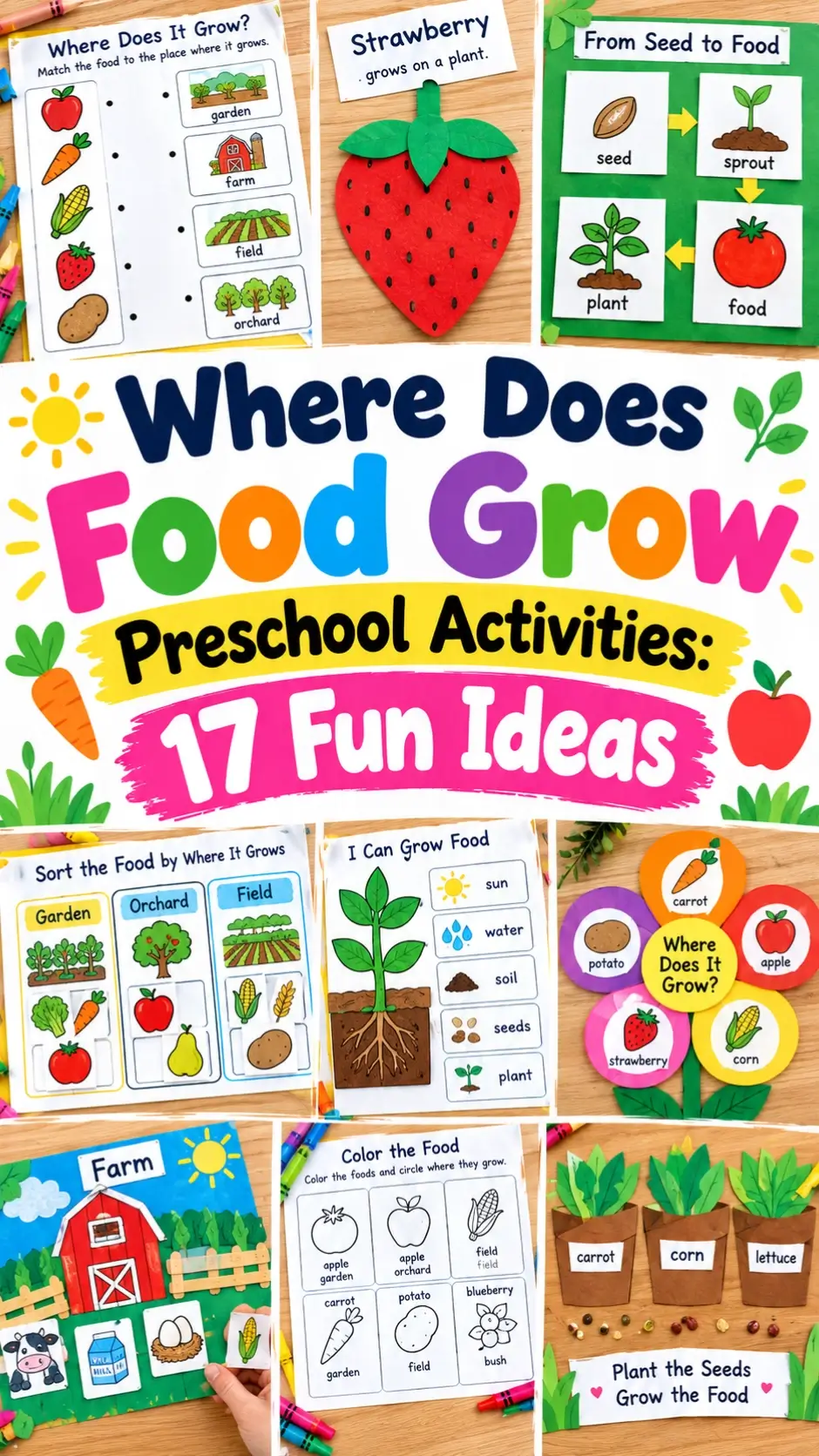
Where does a carrot grow? What about an apple, potato, rice, or strawberry?
Preschoolers see food every day, but many young children mainly see it after it has already reached the kitchen or grocery store. A simple ” Where Does Food Grow? “ preschool activities theme helps connect the food on their plate with plants, farms, gardens, trees, and animals.
You don’t need a big garden or complicated lesson plan. A few real foods, some pictures, a handful of seeds, and plenty of questions can turn an ordinary snack or play session into a learning opportunity.
I like these kinds of learning activities because children can actually see the connection. My little girl, Hafsa, is much more interested when I can put a real fruit, vegetable, or seed in front of her and ask, “Where do you think this came from?”
For preschoolers, the goal is simple: help them begin to understand that food has a source. Food comes from plants or animals, and plant foods can grow in different places, including underground, on vines, on bushes, on trees, or above the soil.
What do preschoolers learn from where food grows activities?
A food-growing theme can support several areas of preschool development at the same time.
Children can learn:
- Where common foods come from
- The difference between plant and animal foods
- That some foods grow underground
- That some foods grow on trees, vines, bushes, or stems
- Basic plant vocabulary
- How seeds become plants
- How farmers and gardeners grow food
- Where food goes after it is harvested
- How food gets from a farm or garden to a kitchen
- How to observe, compare, describe, and ask questions
The activities below keep those ideas concrete and playful.
🔥 Related: How Many Hours Should a Preschooler Study? A Simple Daily Guide
1. Where did my food come from?
Start with foods your child already knows.
Put a few foods on the table, such as an apple, carrot, potato, tomato, banana, egg, or milk carton.
Pick one at a time and ask:
“Where do you think this comes from?”
Let your child answer before you explain.
Then tell them the simple answer. For example:
Apple → apple tree
Carrot → carrot plant
Potato → potato plant, underground
Egg → chicken
Milk → cow or other milk-producing animal
This simple conversation is a good starting point because children first need to understand that food has a source. A 3–5-year-old food-origins activity from Food A Fact of Life similarly introduces children to identifying food and its plant or animal source.
2. Underground or above ground?
Some vegetables grow beneath the soil while others grow where children can see them above the ground.
Use real vegetables if you have them.
Place a potato, carrot, onion, tomato, cucumber, or similar foods on a table. Ask your child to guess whether each one grows:
Under the soil
or
Above the soil
You can then show a picture of the plant or briefly explain where it grows.
For younger preschoolers, don’t worry about getting every answer right. The guessing is part of the activity.
🔥 Related: 10 Beginning Sound Activities for Preschoolers
3. Tree, vine, bush, or ground?
Take the idea one step further.
Show pictures of foods such as:
- Apples
- Grapes
- Strawberries
- Pumpkins
- Tomatoes
- Bananas
- Watermelon
Ask your child where they think each food grows.
Then introduce four simple categories:
Tree
Vine
Bush/plant
Ground
You can use pictures rather than expecting children to understand every botanical difference. The main idea is that foods grow in different places.
Activities that ask preschoolers to investigate how fruits and vegetables grow are commonly used to help children connect produce with its source.
4. Open a fruit and look for seeds
Choose a fruit that contains visible seeds.
Cut it open yourself and let your child look closely at the inside.
Ask:
“Can you find the seeds?”
“What color are they?”
“Are there lots of seeds or just a few?”
“What do you think happens to a seed when it gets the right conditions?”
You can use an apple, papaya, watermelon, cucumber, tomato, or another suitable food.
Give your child a magnifying glass if you have one. They can examine the seeds without needing to touch them.
A seed investigation is also used in preschool fruit-and-vegetable learning because it gives children a chance to examine the inside of familiar foods.
5. Grow a sweet potato in water
This is an easy way to let children watch plant growth over time.
Place a sweet potato so that part of it sits in water. Use toothpicks or another safe support method to keep it from dropping completely into the container.
Put it somewhere suitable and check it regularly.
Ask your child to look for:
- Roots
- New shoots
- Leaves
- Changes in size
You can take a quick photo every few days and compare the pictures.
The point is to let your preschooler see that food plants are living things that grow and change.
6. Start a tiny food garden
You don’t need a backyard.
Use a small pot, grow bag, recycled container, or sunny windowsill where appropriate. Choose something suitable for your local growing conditions.
Let your child help put soil into the container and plant a seed or seedling.
Then give them a simple job such as checking the plant or helping with watering.
Children can learn a lot from watching a food plant change from a small seed or seedling into something that produces leaves, flowers, or edible parts. Home gardens and containers are also recommended as practical ways to introduce children to where food comes from.
7. Make a food journey
Choose one food and tell its simple journey.
For example:
Seed → plant → food → harvest → kitchen → plate
Draw each stage on a separate piece of paper.
You can use a tomato as your example:
Tomato seed → tomato plant → tomato fruit → farmer harvests it → tomato reaches the kitchen
Let your child act out each step.
For preschoolers, this works better as a short story than as a complicated explanation of agriculture or transportation.
8. Become a food detective
Choose one food from your refrigerator or kitchen.
Tell your child they are a “food detective.”
Give them clues:
“It grows from a plant.”
“It grows underground.”
“It is orange.”
“We often eat it cooked.”
The answer might be a carrot.
Then switch roles and let your child give you clues.
This encourages children to describe foods using color, shape, location, and other simple characteristics.
9. Match the food to its plant
Find pictures of familiar foods and pictures of the plants they grow on.
For example:
Apple → apple tree
Banana → banana plant
Tomato → tomato plant
Coconut → coconut palm
Pumpkin → pumpkin vine
Place the pictures face up and let your child connect each food with its plant.
You don’t need dozens of examples. Five or six pairs are plenty for one preschool session.
10. What part of the plant do we eat?
This is a fun step once your child understands that vegetables come from plants.
Introduce a few familiar examples:
Carrot → root
Potato → tuber
Spinach → leaves
Broccoli → flower buds
Peas → seeds
Don’t worry about teaching botanical terminology perfectly. Use the everyday words your child can understand first, then introduce the plant part when it fits naturally.
You can also show the real food while talking about it.
11. Visit a grocery store like a farmer
Turn your next grocery trip into a small learning game.
Before leaving home, choose three foods to investigate.
At the store, ask:
“Where do you think this food grew?”
“Would it grow underground?”
“Could it grow on a tree?”
“Do you think a farmer grew it?”
You can also look for foods that have pictures of farms, plants, or growing information on their packaging.
The grocery store can help children make the connection between food production and the food they see at home. Farmers’ markets can offer an even more direct opportunity because children may see fresh produce and meet the people who grow or sell it.
12. Make a pretend farm stand
Set up a small pretend farm stand with toy food, real empty food containers, baskets, or homemade paper foods.
Give your child the role of farmer.
You can say:
“Which foods did you grow today?”
“Where did the carrots come from?”
“What are you selling?”
“Which food grows on a tree?”
Let your child create the rules of the game.
This also introduces useful vocabulary such as farmer, garden, harvest, seed, plant, soil, basket, farm, and fresh.
13. Follow one food from farm to plate
Pick one familiar food and make a simple picture path.
For example:
Rice plant → rice is harvested → rice is processed → rice is cooked → rice goes on your plate
Or:
Milk-producing animal → milk is collected → milk is processed → milk reaches the store → milk comes home
Food is often grown, raised, caught, processed, and then sold before reaching the consumer, so this activity helps children see that there can be several steps between a source and the kitchen.
Keep the explanation short for preschoolers. You’re introducing the idea of a journey, not teaching the entire food industry.
14. Taste something from a plant
Choose two or three safe foods that come from plants.
For example, you might offer:
- Cucumber
- Banana
- Tomato
- Carrot
- Apple
Before tasting, ask your child where each one grows.
After tasting, ask:
“Is it crunchy?”
“Is it soft?”
“Is it sweet?”
“Is it juicy?”
“What did you notice?”
This connects the abstract idea of food growing with something children can see, smell, touch, and taste.
Always consider allergies, choking risks, and your child’s individual eating needs when offering food.
15. Plant a seed and make a growth diary
Give your child a few sheets of paper folded into a small booklet.
Call it My Little Plant Diary.
Each time you check the plant, let your child draw what they see.
The first page might show a seed.
Later pages might show a tiny root, a stem, leaves, and eventually a larger plant.
Your child doesn’t need to write sentences. A drawing, date, and one word such as “seed,” “root,” or “leaf” are enough for preschool.
16. Food source charades
Write or draw a few food sources on cards.
Examples:
- Tree
- Garden
- Farm
- Chicken
- Cow
- Underground
Let your child pick one and act it out without saying the answer.
If they choose “tree,” they might stretch their arms like branches.
If they choose “chicken,” they can flap their arms.
Then connect the action to food:
“Which foods can come from a tree?”
“What food can come from a chicken?”
This makes a simple food-origin lesson more active.
17. Cook something that grew from a plant
Choose a very simple recipe that your child can help prepare safely.
For preschoolers, useful jobs can include washing produce, tearing leafy greens, pouring pre-measured ingredients, mashing soft foods, stirring, or spreading ingredients with an appropriate child-safe tool. Adult supervision is needed around kitchen tools, heat, and food preparation.
While preparing the food, keep asking:
“Where did this ingredient grow?”
“What part of the plant are we eating?”
“Did we eat a seed, root, fruit, or leaf?”
Now your child can see the full connection from plant to meal.
Simple weekly plan for this theme
You can turn these ideas into a five-day preschool theme without making every day feel like a lesson.
Day 1: Where does food come from?
Try “Where did my food come from?” and the food detective game.
Day 2: Where does food grow?
Explore underground, above-ground, tree, vine, and plant foods.
Day 3: Seeds and plants
Open a fruit to find seeds and start a small plant or growth diary.
Day 4: Farm to plate
Create a food journey and play farmer’s market.
Day 5: Food and cooking
Prepare a simple food together and talk about where each ingredient came from.
You can stretch the theme over another week if your child becomes especially interested in gardening.
Books to pair with a where food grows theme
A few picture books can give your activities a natural starting point.
Look for books about:
- Growing vegetables
- Seeds and plants
- Farms
- Gardens
- Fruits and vegetables
- Farmers
- How food reaches the table
Pre-K Printable Fun specifically recommends books such as Anywhere Farm, My Garden, The Fruits We Eat, The Vegetables We Eat, Soup Day, Eating the Alphabet, and The Carrot Seed for a growing-fruits-and-vegetables theme.
Tips for teaching preschoolers where food grows
Start with foods your child already eats
A familiar banana or potato is much easier to understand than an unusual crop.
Use real food whenever possible
A real carrot gives children something to look at, touch, smell, and discuss. Real fruits and vegetables can make the lesson much more concrete.
Don’t correct every wrong guess immediately
If your child says an apple grows underground, ask, “What makes you think that?”
Then show them where apples grow.
That little conversation is often more useful than simply saying, “No, that’s wrong.”
Keep the science simple
Preschoolers don’t need a detailed lesson about photosynthesis or agricultural systems.
“Seeds grow into plants, and plants can give us food” is a perfectly useful starting point.
Follow your child’s questions
If your child suddenly wants to know where chocolate comes from, follow that question. If they’re fascinated by seeds, spend another day looking at seeds.
Food-growing activities can naturally lead into plants, insects, weather, soil, cooking, farms, and nature.
Frequently asked questions
What are some Where Does Food Grow Preschool Activities?
Start with real foods. Ask children where foods come from, investigate seeds inside fruit, explore which foods grow underground or above ground, grow a small plant, or create a pretend farm stand.
How do you teach preschoolers where food comes from?
Use foods children already know and connect each one with its source. For example, show an apple and explain that it grows on an apple tree. Then let children investigate real plants, seeds, gardens, farms, or markets.
What foods grow underground?
Some familiar foods that grow underground include carrots, potatoes, onions, radishes, and beets. You can introduce this idea through real vegetables and simple pictures.
What foods grow on trees?
Apples, oranges, mangoes, coconuts, and many other foods grow on trees or tree-like plants. The exact growing structure varies by plant, so preschoolers can simply focus on the basic idea that some foods grow above the ground on trees.
How can I teach farm to table to preschoolers?
Choose one familiar food and tell its journey from its source to the plate. Use pictures, pretend play, a grocery-store visit, gardening, or simple cooking to make each step easier to understand.
Can preschoolers grow their own food?
Yes. With adult help, preschoolers can participate in age-appropriate gardening tasks such as planting larger seeds, watering plants, observing growth, and eventually helping with harvesting. Gardening tasks can be adjusted to the child’s age and abilities.
Final thoughts
Children don’t have to visit a large farm to learn where food grows.
A potato from the kitchen, a few seeds from a fruit, a small pot of soil, or a trip to the grocery store can start the conversation.
The biggest goal is helping preschoolers make a simple connection: food comes from somewhere before it reaches our plate.
Once children start asking, “Where did this come from?” you’ve already opened the door to a lot of meaningful learning.