
Preschool children learn with their whole bodies. I see this with my little girl, Hafsa. She touches, moves, talks, builds, sorts, draws, pretends, asks questions, and tries the same thing again when her first attempt doesn’t quite work.
That’s why the best educational activities for preschoolers usually feel like play.
A 3-year-old can learn counting while putting blocks into a basket. A 4-year-old can practice language while pretending to run a grocery store. A simple walk outside can turn into a science activity when a child starts collecting leaves and comparing their shapes.
You don’t need a classroom full of expensive supplies, either. A few household objects, some paper, crayons, blocks, play dough, and a little time can create plenty of learning opportunities.
Here are 25 educational activities you can try at home or in a preschool classroom.
Related Posts:
👉 How Many Hours Should a Preschooler Study?
👉 20 Best Preschool Learning Activities for 5-Year-Olds
👉 25 Best Preschool Learning Activities for 4-Year-Olds
👉 30 Best Preschool Learning Activities for 3-Year-Olds
What makes an educational activity good for preschoolers?
A good preschool activity gives children something to do, think about, or talk about.
It should match their age and attention span. It should leave room for movement and curiosity. And whenever possible, children should get to touch the materials and make choices themselves.
Play-based learning is a major part of the activities recommended by UNICEF for young children. Their preschool examples include shape games, sorting by color and size, number activities, storytelling, emotion recognition, color mixing, and everyday learning through family activities.
1. Alphabet scavenger hunt
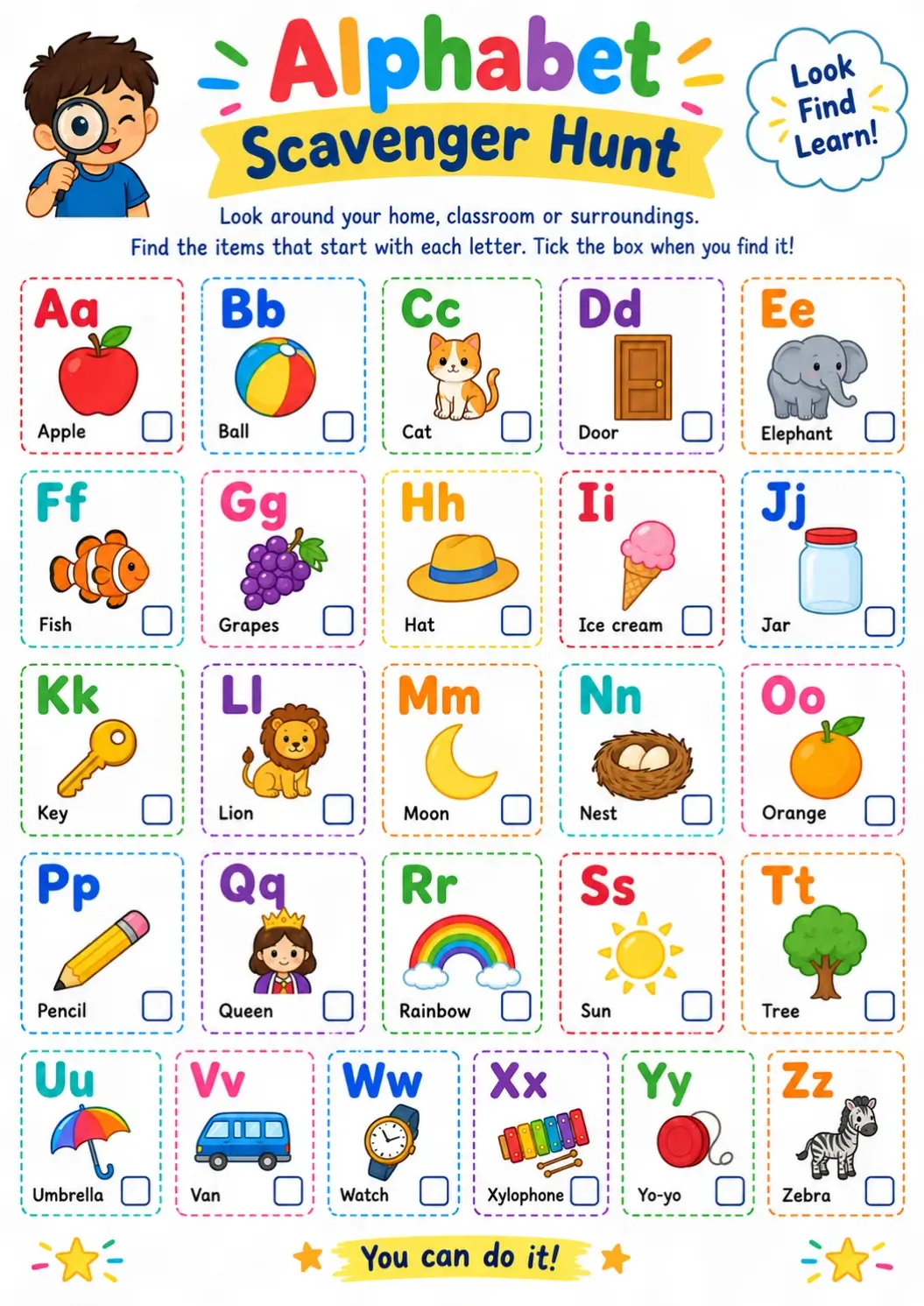
Write a few large letters on pieces of paper and place them around the room.
Call out one letter and ask your child to find it. Once they find the letter, ask them to name a word that starts with that sound.
For younger preschoolers, start with 3 or 4 familiar letters. Older children can search for uppercase and lowercase pairs.
Skills practiced: letter recognition, early phonics, listening, movement, and vocabulary.
2. Name puzzle
Write your child’s name on a strip of paper. Then write each letter on a separate card and mix the cards up.
Ask your child to put the letters back in the correct order.
You can make the puzzle harder by removing the finished name and asking your child to remember the order.
This simple activity gives children a reason to look closely at letters. It also helps them understand that letters have a particular order when we write a name.
Skills practiced: name recognition, alphabet knowledge, visual memory, and early writing.
3. Count everyday objects
You don’t need special counting toys.
Ask your child to count spoons while setting the table, socks while doing laundry, toy cars in a basket, or pieces of fruit during snack time.
Touch each object once as you count it. This helps children connect a spoken number with one object.
You can also ask questions such as, “Can you give me 5 blocks?” or “How many apples do we have?”
Skills practiced: counting, one-to-one correspondence, number recognition, and quantity.
4. Sort toys by color
Put a collection of toys on the floor and ask your child to make groups.
Red toys go together. Blue toys go together. Yellow toys get their own group.
Once your child understands the basic idea, change the rule. Sort the same toys by size, shape, or type.
Sorting activities are simple, but they give preschoolers plenty to think about. UNICEF’s preschool activities include sorting by shape, color, and size.
Skills practiced: classification, observation, color recognition, comparison, and early math.
5. Build a block tower
Give your child a pile of blocks and ask them to build the tallest tower they can.
Then count the blocks. Try building a shorter tower. Compare the two.
You can introduce simple questions: “Which tower is taller?” “Which one has more blocks?” “What happens if we put the biggest block at the bottom?”
Children are learning about balance, size, quantity, and cause and effect while their hands stay busy.
Skills practiced: problem-solving, early math, spatial awareness, coordination, and persistence.
6. Shape hunt around the house
Choose a shape such as a circle.
Walk around the house and look for circular objects. A plate, clock, lid, or bowl might qualify.
Then choose a square, rectangle, or triangle.
For older preschoolers, ask them to describe the shapes. “How many sides does the rectangle have?” “Which shape has no corners?”
Shape recognition is easier when children can connect a shape on paper with something they see in real life.
Skills practiced: shape recognition, vocabulary, observation, and early geometry.
7. Play dough letters and numbers
Give your child some play dough and ask them to make a letter or number.
Start with simple shapes. You can roll long pieces of dough and bend them into letters.
For a math variation, make the number 5 and then place 5 small dough balls beside it.
Supervise closely if your child still puts small materials in their mouth.
Skills practiced: fine motor control, letter formation, number recognition, hand strength, and visual learning.
8. Letter tracing with sensory materials
Fill a shallow tray with flour, cornmeal, or another age-appropriate sensory material.
Write a large letter with your finger and ask your child to copy it.
You can also practice simple lines, circles, and shapes before moving into letters.
This works especially well for children who aren’t ready to spend much time holding a pencil.
Skills practiced: pre-writing, fine motor control, hand-eye coordination, and letter recognition.
9. Sink or float experiment
Fill a small container with water and gather several safe household objects.
Before putting each item in the water, ask your child to predict what will happen.
“Do you think the spoon will sink?”
Test the prediction. Then talk about what happened.
This activity appears in preschool learning resources because it gives children a simple way to make a prediction, test an idea, and observe the result.
Skills practiced: prediction, observation, early science, vocabulary, and reasoning.
10. Color mixing
Give your child 2 or 3 washable paint colors and let them mix small amounts together.
Ask what they think will happen when yellow and blue meet.
Then let them test it.
You can also use colored water in clear cups for a less messy version. UNICEF includes color mixing among its play-based activities for children ages 4 to 6.
Skills practiced: color recognition, observation, prediction, creativity, and early science.
11. Nature collection walk
Take a short walk outside with a small basket or bag.
Ask your child to find things such as a small leaf, a smooth stone, a large leaf, or something yellow.
When you return, place the objects on a table and sort them.
Talk about texture, size, color, shape, and where each item came from.
A nature walk can turn into several activities at once. Children move, observe, collect, compare, and talk.
Skills practiced: observation, classification, vocabulary, movement, and science awareness.
12. Make a nature collage
Use leaves, grass, fallen flowers, small twigs, or other safe natural materials collected during a walk.
Give your child paper and glue and let them create a picture.
They might make a tree, an animal, a person, or an abstract pattern.
Don’t worry about making the picture look a certain way. Let the child decide where the pieces belong.
Skills practiced: fine motor control, creativity, planning, vocabulary, and hand-eye coordination.
13. Pretend grocery store
Turn a small part of your home or classroom into a pretend grocery store.
Use empty food containers, toy food, paper bags, and pretend money.
Take turns being the customer and cashier.
Ask your child to count 3 apples, find something red, or put 2 items in a bag.
Dramatic grocery-store play can combine early math, language, social interaction, and everyday vocabulary in one activity.
Skills practiced: counting, language, social skills, memory, and pretend play.
14. Storytelling with puppets
You can make simple puppets from paper bags, socks, or paper cutouts.
Read a short story and then let your child retell it with the puppets.
You can also start a story with one sentence and let your child decide what happens next.
Try questions such as, “Where did the rabbit go?” or “What happened after that?”
The goal is conversation and storytelling. There doesn’t need to be a perfect ending.
Skills practiced: vocabulary, listening, memory, sequencing, imagination, and communication.
15. Picture sorting game
Collect pictures from old magazines, printed images, or homemade cards.
Ask your child to sort them into groups.
Animals go in one group. Foods go in another. Vehicles go somewhere else.
Then ask your child to explain why each picture belongs where it is.
This adds a language component to a simple sorting game.
Skills practiced: classification, vocabulary, speaking, observation, and reasoning.
16. Counting with snacks
Snack time can become a quick math lesson.
Put a small number of crackers, fruit pieces, or other age-appropriate food items on a plate.
Ask your child to count them.
You can then ask, “What happens if we add one more?” or “Can you give me 3?”
Keep the activity playful and follow normal food and choking-safety guidance for your child’s age.
Skills practiced: counting, quantity, comparison, and simple addition.
17. Button or pom-pom sorting
Use larger age-appropriate objects in several colors and place them in a mixed pile.
Ask your child to sort them into containers.
Start with 2 groups. Once that becomes easy, introduce more colors or another sorting rule.
Fine motor practice happens naturally as children pick up and move each object.
Skills practiced: sorting, color recognition, fine motor control, concentration, and early math.
18. Make an alphabet book
Give your child several sheets of paper and create a small alphabet book together.
Choose one letter per page.
Your child can draw an object that starts with the letter. For example, A could have an apple, B could have a ball, and C could have a cat.
Older preschoolers can help write the letters or trace them.
Education.com includes alphabet books, letter people, alphabet hunts, and name puzzles among its preschool resources.
Skills practiced: alphabet knowledge, vocabulary, drawing, pre-writing, and memory.
19. Build a bridge
Give your child blocks, cardboard pieces, paper cups, craft sticks, or other safe building materials.
Ask them to make a bridge for a toy car.
Test it.
Does the car cross? Does the bridge fall? What could they change?
You don’t need to explain engineering terms. Let the child build, test, change, and try again.
Preschool engineering activities from Education.com include building challenges such as boats, bridges, towers, and other structures.
Skills practiced: problem-solving, spatial thinking, construction, fine motor control, and early engineering concepts.
20. Water pouring station
Place a shallow basin outside or somewhere easy to clean.
Give your child cups, spoons, funnels, and containers in different sizes.
Let them pour water from one container to another.
Ask which cup holds more. Ask what happens when the cup is full.
Water play can become a quiet learning activity that works on coordination and early measurement ideas.
Skills practiced: hand-eye coordination, measurement, comparison, concentration, and sensory exploration.
21. Emotion matching game
Draw or print simple faces showing emotions such as happy, sad, angry, surprised, and tired.
Ask your child to match the face with the emotion.
Then make one of the faces yourself and ask your child to guess how you feel.
You can also ask, “When do you feel happy?” or “What can you do when you’re upset?”
UNICEF includes emotion-recognition activities for preschool children using facial expressions.
Skills practiced: emotional vocabulary, recognition of facial expressions, communication, and social-emotional learning.
22. Sound and movement game
Play a sound effect and give your child a movement to follow.
Jump when the sound gets louder. Freeze when it stops. Clap 3 times. Turn around. Walk slowly.
You can let your child become the leader and choose the next movement.
Movement games are especially useful when a child has been sitting for a while.
Skills practiced: listening, body control, following directions, memory, rhythm, and gross motor skills.
23. Treasure hunt
Hide a toy somewhere safe and create a few simple clues.
For younger children, use visual clues or simple directions such as “Look under the chair.”
Older preschoolers can follow 2-step directions or a basic homemade map.
You can add early math by asking them to take 5 steps forward or look for a shape along the way.
Education.com includes treasure hunts as a preschool activity that can introduce children to maps and imaginative play.
Skills practiced: listening, memory, spatial awareness, vocabulary, movement, and problem-solving.
24. Cooking together
Give your child a small, safe job while you prepare food.
They might wash vegetables, stir ingredients, count spoonfuls, pour pre-measured ingredients, or arrange fruit on a plate.
Talk about quantities and sequence.
“First we wash the fruit. Then we cut it. After that, we put it on the plate.”
Cooking gives children a real reason to use numbers, language, observation, and following directions.
Skills practiced: sequencing, counting, vocabulary, fine motor skills, and independence.
Always handle knives, hot surfaces, raw ingredients, and other kitchen hazards yourself.
25. Preschool worksheet station
Worksheets can fit into preschool learning when they’re short, age-appropriate, and connected to what the child is already learning.
Try a simple tracing page after practicing lines with play dough. Use a counting worksheet after counting blocks. Try a shape worksheet after a shape hunt around the house.
Keep the session short.
A child who finishes 1 page with interest may get more from it than a child pushed through 5 pages while losing focus.
You can rotate tracing, coloring, matching, counting, alphabet, shapes, and simple puzzles throughout the week.
Skills practiced: pencil control, visual discrimination, early literacy, early math, and following directions.
How to choose the right activity for your child
You don’t need to do all 25 activities in one week.
Pick activities based on what your child is ready to practice.
| For a 3-year-old | For a 4-year-old | For a 5-year-old |
|---|---|---|
| Focus on simple activities such as: – Sorting 2 colors – Counting objects from 1 to 5 – Shape hunts – Play dough – Water pouring – Picture matching – Simple movement games – Storytelling with pictures Keep instructions short. Give your child plenty of time to touch and explore the materials. | You can make many activities a little harder. Try: – Counting larger groups – Alphabet hunts – Name puzzles – Simple patterns – Nature classification – Sink-or-float predictions – Story retelling – Pretend grocery stores – Basic building challenges Ask more questions, too. “Why do you think that happened?” can turn a quick activity into a longer conversation. | Older preschoolers may enjoy these steps. – Creating an alphabet book – Building bridges – Making simple maps – Creating patterns – Sorting objects by 2 properties – Cooking with measured ingredients – Making up stories – Simple science experiments Let your child explain their thinking. Their explanation can tell you more than whether they got the “right” answer. |
How long should preschool learning activities last?
There isn’t one perfect number of minutes for every preschooler.
Some children will happily spend 15 minutes building a tower. Another child may move on after 5 minutes and come back later.
Short activities usually work well because preschoolers have limited attention spans. You can spread learning across the day instead of expecting one long sitting.
For example:
Morning: 10 minutes of alphabet or counting.
Afternoon: 15 minutes of outdoor or sensory play.
Evening: 10 minutes of reading and storytelling.
Those small moments add up.
How to make educational activities more effective
Start with one clear skill.
If you’re practicing counting, count. If you’re practicing colors, sort colors. You can add other skills naturally, but don’t turn a simple game into a complicated lesson.
Use things your child already likes. A child who loves dinosaurs might count toy dinosaurs. A child who loves cars can practice colors, sizes, letters, and numbers with toy vehicles.
Let your child make choices, too.
“Do you want to sort by color or size?” is a small question, but it gives the child ownership of the activity.
And repeat activities.
Preschoolers don’t need a brand-new activity every day. Repeating a familiar game with a small change gives them another chance to understand the idea.
A simple weekly preschool activity plan
Here’s an easy starting point for parents and teachers.
| Day | Main activity | Skill |
| Monday | Alphabet scavenger hunt | Letters and sounds |
| Tuesday | Counting toys | Early math |
| Wednesday | Sink or float | Science |
| Thursday | Nature collage | Creativity and fine motor |
| Friday | Pretend grocery store | Math and language |
| Saturday | Shape hunt | Geometry |
| Sunday | Storytelling with puppets | Language |
You can switch activities based on your child’s interests.
If your child is fascinated by water this week, do more water experiments. If they’re suddenly interested in letters, play more alphabet games.
The plan should fit the child.
Common mistakes to avoid
Parents sometimes make preschool learning harder than it needs to be.
1. Making every activity a test
A child doesn’t need to answer every question correctly.
Give them time to think. Sometimes watching what they do tells you more than asking another question.
2. Using too many materials
A kitchen spoon, 5 blocks, and a sheet of paper can be enough.
More supplies don’t automatically create better learning.
3. Expecting long periods of sitting
Preschoolers need movement.
Mix table activities with jumping, walking, dancing, building, outdoor play, and sensory activities.
4. Correcting every little mistake
If your child draws a circle that looks more like an oval, that’s part of learning.
You can model the skill again without turning the activity into a correction session.
5. Choosing activities based only on appearance
A beautiful craft may look great in a photo, but your child needs time to do something meaningful with it.
The best test is simple: Did your child get to think, talk, move, create, or solve something?
Frequently asked questions
What are the best educational activities for preschoolers?
Some of the best choices include alphabet hunts, counting games, sorting, shape hunts, play dough, nature walks, storytelling, pretend play, simple science experiments, building activities, art, and water play. Choose activities that match your child’s age and current interests.
What educational activities can preschoolers do at home?
You can use everyday household objects for many preschool activities. Try counting spoons, sorting socks, building block towers, searching for shapes, making a pretend grocery store, cooking together, or creating a simple treasure hunt.
How can I teach my preschooler without making learning feel like school?
Count during snack time. Talk about shapes as you walk around the house. Tell stories with toys. Sort laundry by color. Build towers and compare their heights. Children can practice real skills during ordinary moments.
What should a 3-year-old learn through activities?
A 3-year-old can practice early language, counting, colors, shapes, simple problem-solving, fine motor control, movement, social interaction, and emotional vocabulary. The exact pace varies from child to child.
Are worksheets good for preschoolers?
Worksheets can be useful when they’re short and age-appropriate. They work best alongside hands-on activities, conversation, movement, reading, art, and play.
For example, practice counting real objects first, then use a simple counting worksheet.
What are good hands-on activities for preschoolers?
Building blocks, play dough, sorting games, nature walks, water play, cooking, collages, science experiments, puzzles, gardening, and pretend play are all hands-on options.
You can also include ideas such as paper plate crafts, alphabet scavenger hunts, counting puzzles, stacking blocks, puppet storytelling, gardening, color mixing, obstacle courses, shadow play, water play, and cooking.
How can I keep my preschooler interested in learning activities?
If your child loves animals, use animal pictures for counting and sorting. If they love vehicles, use toy cars for color and number games. You can also let your child choose between 2 activities.
Do preschool activities need to be expensive?
No.
Many activities use paper, crayons, blocks, household objects, recycled containers, play dough, water, leaves, or toys you already have.
A simple activity that your child actually enjoys can be more useful than a shelf full of unused supplies.
Final thoughts
The best educational activities for preschoolers are the ones children can actually participate in.
Give them something to touch. Give them a question to think about. Let them make a mess occasionally (within reason), change their plan, ask why, and try again.
A block tower can become a math lesson. A walk can become a science lesson. A grocery game can become a language lesson.
And sometimes the learning happens in a place you didn’t plan for at all.
Keep a few simple activities ready, follow your child’s interests, and let learning grow out of play.
Resources
https://www.pinterest.com/sarahmomof4boys/activities-for-preschoolers/ https://www.reddit.com/r/preschool/comments/1rjitle/what_learning_activities_actually_work_for_your/
https://www.unicef.org/northmacedonia/play-based-learning-activities-children-aged-3-10
https://www.education.com/resources/grade-pk/activities/