Learning beginning sounds is an important step in early literacy. Before preschoolers can confidently read simple words, they need opportunities to listen carefully to spoken words and notice that different words can start with different sounds.
The good news is that beginning sound activities for preschoolers do not need to feel like formal phonics lessons. Children can practice while talking, moving, playing games, looking at pictures, and exploring familiar words.
For example, when you say “sun” and stretch the first sound—**/ssss/—**your child can learn to notice what comes first in the word. Later, that sound can be connected to the letter S.
What Are Beginning Sounds?
A beginning sound is the first sound we hear in a spoken word.
For example:
- Ball begins with /b/
- Moon begins with /m/
- Sun begins with /s/
- Fish begins with /f/
- Dog begins with /d/
Beginning-sound practice helps children pay attention to the individual sounds within words. This is part of phonemic awareness, an early literacy skill that can be developed through playful listening and speaking activities.
At first, children do not necessarily need to see the alphabet. They can simply listen and answer:
“What sound do you hear at the beginning of moon?”
Once they are comfortable hearing the sound, you can introduce the matching letter.
Why Are Beginning Sound Activities Important?
Beginning sounds help children become more aware of how spoken words are made.
Regular, playful practice can help preschoolers:
- Listen carefully to spoken words
- Identify the first sound in familiar words
- Notice when two words begin with the same sound
- Tell different beginning sounds apart
- Connect common sounds with letters
- Build vocabulary
- Develop early phonics skills
- Prepare for reading and spelling
It is helpful to remember that hearing a beginning sound and recognizing its written letter are related but different skills. A child can learn to hear that moon starts with /m/ before being able to recognize the letter M.
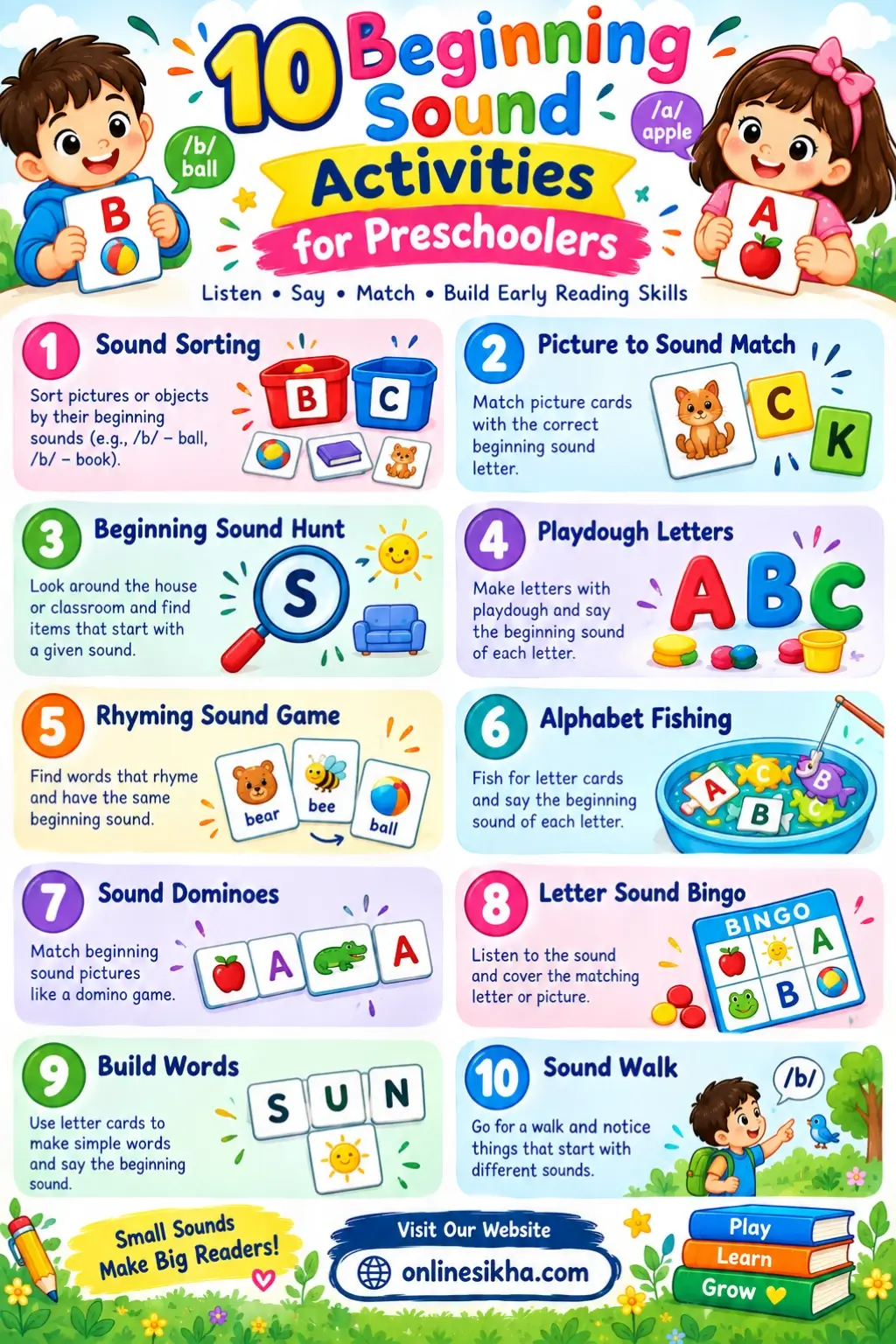
10 Beginning Sound Activities for Preschoolers
1. Stretch the First Sound
Choose a familiar word and say it slowly, emphasizing the first sound.
For example:
Mmmmoon
Ask:
“What sound did you hear first?”
Try simple words with clear beginning sounds:
- moon
- sun
- fish
- map
- dog
- ball
Once your child understands the idea, say the word normally and let them identify the first sound.
Make it playful: Use a long voice for continuous sounds such as /m/, /s/, or /f/.
Skills practiced: Listening, phoneme isolation, beginning-sound awareness.
2. Same Sound or Different Sound?
Say two familiar words aloud.
For example:
“Moon and mouse. Do they start with the same sound?”
Then try:
“Moon and sun. Same or different?”
Use pairs that are easy to hear at first:
- cat – car
- fish – fan
- moon – milk
- sun – sock
- dog – ball
This activity does not require letter cards. The child simply listens and compares.
Skills practiced: Sound discrimination, listening, phonemic awareness.
3. Beginning Sound Puppet
Use a hand puppet, stuffed animal, or even a homemade paper character.
Give the puppet a silly problem:
“My puppet wants to eat something that starts with /b/. What could he eat?”
Your child might suggest:
- banana
- bread
- biscuit
- berries
You can change the sound for each round.
The puppet can deliberately make mistakes too:
“I want something that starts with /m/. Is a banana a good choice?”
Let your child correct the puppet.
Skills practiced: Beginning-sound identification, vocabulary, listening, speaking.
4. What Doesn’t Belong?
Say three words. Two should begin with the same sound, while one begins differently.
For example:
sun – sock – moon
Ask:
“Which word doesn’t belong?”
More examples:
- cat – cup – dog
- fish – fan – ball
- moon – milk – sun
- pig – pizza – car
Keep the words familiar so your child can concentrate on the sounds rather than struggling to understand the vocabulary.
Skills practiced: Sound comparison, auditory discrimination, reasoning.
5. Name Sound Game
Children are often very interested in people’s names, making names a useful way to introduce beginning sounds.
Say family members’ or familiar people’s names slowly:
“Mmmaria.”
Then ask:
“What sound does Maria start with?”
You can also compare names:
“Mina and Maya start with the same sound. Can you hear it?”
For a classroom, children can listen to the names of their classmates.
Skills practiced: Beginning-sound awareness, listening, vocabulary, personal connection.
6. Sound Hop
Write a few large letters on separate pieces of paper and place them on the floor.
Choose one sound and say a word.
For example:
“Ssssun!”
The child jumps onto S.
Then say another word:
“Mmmmoon!”
The child jumps onto M.
Start with only two or three letters and use words with very clear beginning sounds.
Skills practiced: Letter-sound association, gross-motor movement, listening.
7. Feed the Sound Monster
Make a simple paper “monster” with a large open mouth and prepare several picture cards.
Choose one target sound, such as /t/.
Show a picture and say its name together:
“Tiger. T-t-tiger.”
If it starts with /t/, the child feeds it to the monster.
If it does not, the child puts it aside.
You can make the monster hungry for a different sound during the next round.
Skills practiced: Beginning-sound identification, vocabulary, decision-making, fine-motor coordination.
8. Beginning Sound Telephone
Pretend to make a telephone call to a friend, toy, or stuffed animal.
Say:
“Hello! Can you tell me a word that starts with /b/?”
The child answers with a word such as ball or banana.
For younger preschoolers, give choices:
“Does /b/ start ball or sun?”
As children become more confident, let them think of their own words.
Skills practiced: Sound production, vocabulary, expressive language, phonemic awareness.
9. Sound Train
Create a small paper train with several carriages.
Put one target letter on the engine, such as M.
Now ask your child to name words that begin with that sound. Each correct word gets a paper “passenger” or picture placed into a carriage.
For example:
M train: moon → mouse → milk → monkey
The goal is not to produce a huge list. Three or four words are enough for a preschooler.
Skills practiced: Beginning sounds, vocabulary, letter-sound connection, memory.
10. Silly Sound Sentences
Choose one beginning sound and create a funny sentence using several words that begin with it.
For example, for /b/:
“Ben has a big blue ball.”
For /s/:
“Silly Sam saw a small snake.”
You can deliberately make the sentence silly:
“A monkey made muffins for a mouse!”
Ask your child to listen for the repeated beginning sound.
Older preschoolers can help you invent their own silly sentences.
Skills practiced: Listening, beginning-sound awareness, vocabulary, oral language.
Start With Easy Beginning Sounds
Some sounds are easier for young children to hear and stretch than others.
For early practice, you might begin with familiar words containing sounds such as:
/m/ – moon, milk, mouse
/s/ – sun, sock, snake
/f/ – fish, fan, fox
/n/ – nose, net, nest
/b/ – ball, baby, bus
/t/ – top, toy, tiger
/d/ – dog, door, duck
Choose words your child already knows. Familiar vocabulary makes it easier to focus on the sound itself.
You do not need to introduce every letter sound at once. Short practice with a small group of sounds gives children more opportunities to listen carefully and succeed.
How to Make Beginning Sound Practice Easier
If your child finds these educational activities difficult, simplify them.
Give two choices
Instead of asking:
“What sound does dog start with?”
say:
“Does dog start with /d/ or /m/?”
Use familiar words
Choose words your child can easily name. If they don’t know what an object is called, the activity becomes a vocabulary lesson instead of a sound lesson.
Emphasize the first sound
Stretch the beginning when appropriate:
mmmmilk
ssssun
ffffish
This can make the first sound easier to notice.
Start with two sounds
You don’t need five or six choices. Start with two clearly different sounds and gradually increase the challenge.
Keep sessions short
Five minutes of happy practice can be more useful than a long activity that leaves your child frustrated. Early literacy learning can be incorporated into everyday conversations and play.
A Simple Beginning Sound Routine
You can practice beginning sounds without setting aside a formal lesson every day.
Try this simple routine:
| Days | Activities |
|---|---|
| Monday | Play “Same Sound or Different Sound?” |
| Tuesday | Practice stretching the first sound in familiar words. |
| Wednesday | Play the puppet or sound monster game. |
| Thursday | Practice jumping onto beginning-sound letters. |
| Friday | Make a silly sound sentence together. |
Keep reviewing sounds your child already knows while gradually introducing new ones.
When Should Preschoolers Learn Beginning Sounds?
There is no single age when every child should master beginning sounds.
You can introduce beginning sounds when your child is interested in words, enjoys listening games, and can participate in simple conversations about sounds.
The goal is not to rush children into reading. Instead, give them repeated opportunities to listen, talk, compare sounds, and connect sounds with meaningful words.
Final Thoughts
The best beginning sound activities for preschoolers are simple enough to fit naturally into everyday play.
You can stretch the first sound of a word, compare two names, play with a puppet, jump to a letter, feed a sound monster, or invent a silly sentence. These little games help children become more attentive to the sounds they hear in spoken language.
Remember that beginning-sound learning does not have to be perfect. If your preschooler gets an answer wrong, simply repeat the word slowly and model the sound.
With short, positive practice and plenty of repetition, children can gradually develop the listening skills they need for future phonics, reading, and writing.
Frequently Asked Questions
What are beginning sounds for preschoolers?
Beginning sounds are the first sounds children hear when a word is spoken. For example, ball begins with /b/ and sun begins with /s/. Preschoolers can practice identifying these sounds through simple listening and speaking games.
How do I teach beginning sounds to my preschooler?
Start with familiar words and clear sounds. Say a word slowly, emphasize its first sound, and ask your child what they hear. Once the child becomes comfortable, connect the sound with its corresponding letter.
How long should beginning sound activities last?
For preschoolers, short activities of around five to ten minutes are usually sufficient. You can also practice naturally during conversations, play, books, and daily routines rather than relying on one long lesson.
🔥 Related: How Many Hours Should a Preschooler Study? A Simple Daily Guide