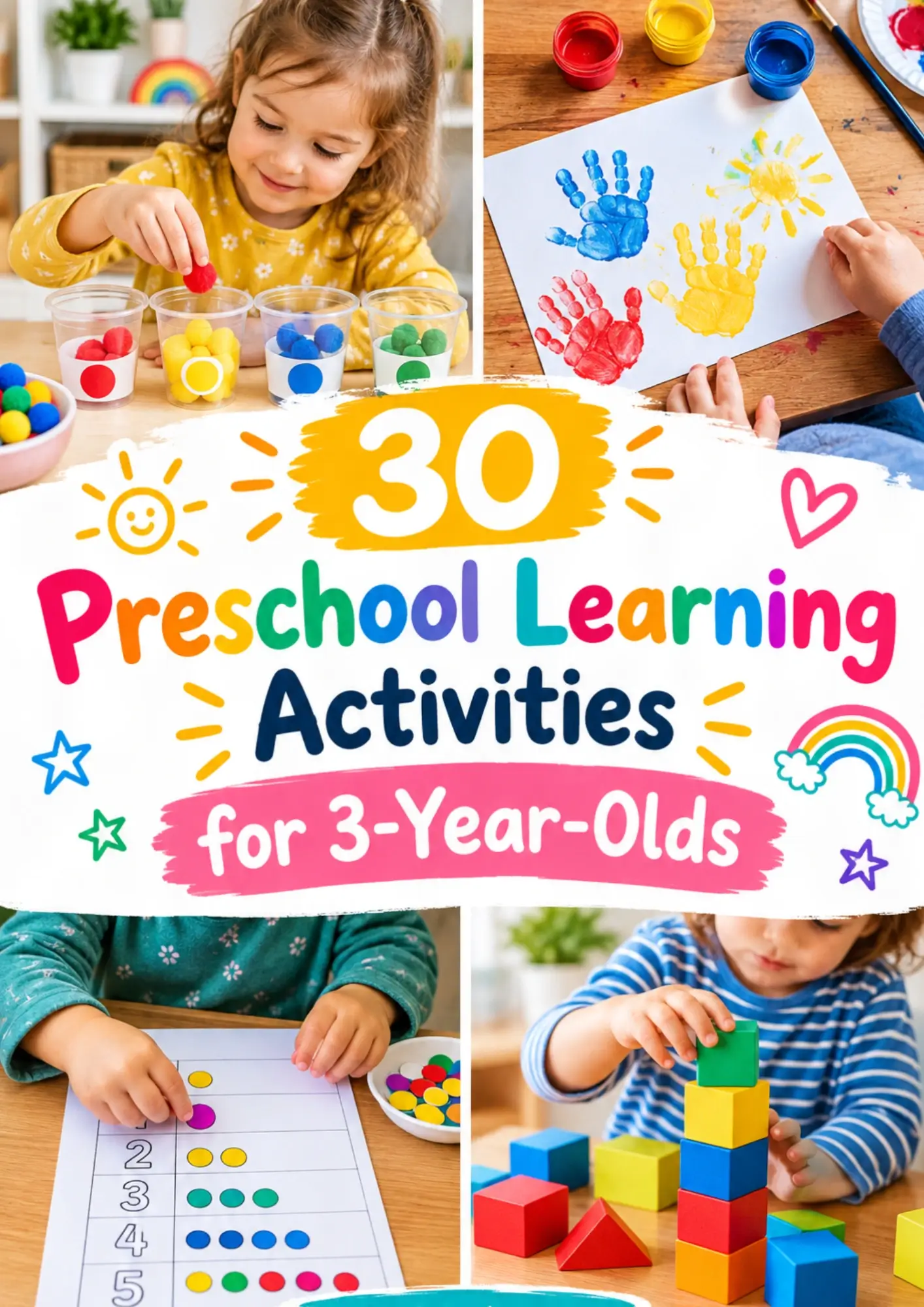
Three-year-olds are busy little people.
They want to touch everything, ask “why?” about everything, carry 7 toys at once, and sometimes spend 20 minutes doing something you thought would take 2 minutes. That’s part of the fun.
I see this with my little girl, Hafsa. Give her something she can touch, move, sort, build, or draw, and learning happens naturally. She doesn’t need a long lesson. She needs something interesting to do and an adult who talks with her while she does it.
That’s why the best preschool learning activities for 3-year-olds are simple, playful, and hands-on.
A 3-year-old can practice counting with blocks, learn colors by sorting toys, develop hand control with play dough, build vocabulary through picture cards, and learn about nature during a short walk outside.
You don’t need a special classroom, either. A few blocks, paper, crayons, play dough, household objects, and some imagination can keep a 3-year-old learning for hours across the week.
What should a 3-year-old learn through play?
At age 3, children are building many early skills at the same time.
They are learning to communicate more clearly, recognize familiar objects and colors, count small groups, notice shapes and patterns, use their hands with more control, follow simple directions, and solve small problems.
Their educational activity collection also includes everyday topics such as animals, vehicles, food, clothing, household objects, and personal routines. Play is a natural way to practice these skills.
UNICEF’s play-based learning resources for children ages 3 to 10 include activities built around creative expression, problem-solving, curiosity, persistence, and time spent playing with adults.
So you can keep things simple.
Your child doesn’t need to know that an activity is “educational.” You can simply say, “Let’s see how many blocks we have.”
Related Posts:
👉 25 Best Educational Activities for Preschoolers
👉 How Many Hours Should a Preschooler Study?
👉 20 Best Preschool Learning Activities for 5-Year-Olds
👉 25 Best Preschool Learning Activities for 4-Year-Olds
1. Count the blocks
Grab a small pile of blocks and sit on the floor with your child.
Ask your 3-year-old to put the blocks into a basket one at a time while you count together.
“1, 2, 3, 4…”
Then let your child try.
Once counting becomes familiar, change the game. Ask your child to give you 3 blocks. Then ask for 5.
You can also make small towers and count how many blocks are in each one.
Wunderkiddy specifically recommends counting everyday objects such as fingers, trees, cars, and flowers as a way to practice early number skills.
Skills practiced: counting, number sense, one-to-one correspondence, listening, and hand-eye coordination.
2. Sort toys by color
Put several toys on the floor.
Choose 2 or 3 colors and place a container beside each group.
Ask your child to put the red toys together, the blue toys together, and the yellow toys together.
Hafsa might start by putting something in the wrong basket. That’s fine. I can simply pick up another toy and say, “Look, this one is red. Where should it go?”
Once your child understands color sorting, try sorting by size or type.
Skills practiced: color recognition, classification, observation, vocabulary, and early math.
3. Go on a shape hunt
Choose one shape.
Start with a circle.
Walk around the house and look for objects that have a similar shape. A plate, clock, lid, bowl, or ball might lead to a conversation about circles.
Then look for squares and rectangles.
You can keep the questions simple:
“Can you find a circle?”
“Which one is bigger?”
“Does this have corners?”
A real object gives children something concrete to connect with the shape they’re learning.
Wunderkiddy’s 3- to 4-year-old collection includes shape matching and real-life object sorting activities, reflecting this kind of learning through familiar things.
Skills practiced: shape recognition, observation, comparison, and vocabulary.
4. Make letters with play dough
Give your child a small amount of play dough.
Start with letters that have simple shapes. You can roll the dough into long pieces and bend them to form letters.
Your child’s name is a great place to start.
Make the first letter yourself and ask your child to copy it.
At 3, the goal can simply be becoming familiar with letters and controlling the dough. There’s no need to expect perfect letter formation.
Play dough also gives little fingers plenty of work to do.
Skills practiced: fine motor control, hand strength, letter recognition, creativity, and pre-writing.
5. Practice lines before letters
Take a sheet of paper and draw simple lines. You can use pre-writing tracing worksheets instead.
Make straight lines, curves, zigzags, loops, and circles.
Ask your child to trace them with a crayon.
You can turn it into a little story. Draw a road and ask your child to help a toy car travel from one side of the paper to the other.
This gives the child a reason to move the crayon across the page.
Hands-on activities for 2- to 3-year-olds commonly use tracing, dot painting, and themed pre-writing activities to practice fine motor control and hand-eye coordination.
Skills practiced: pencil control, hand-eye coordination, pre-writing, and concentration.
6. Make a simple color-matching game
Take pieces of colored paper and a few objects that match those colors.
Put the colored papers on the floor.
Ask your child to place each object on the matching color.
You can use toy cars, blocks, socks, bottle caps, or other safe household objects.
Keep the number of colors small at first.
When your child gets comfortable, add another color.
Skills practiced: color recognition, matching, visual discrimination, and fine motor skills.
7. Build a Lego tower from a picture
Build a small tower using blocks or large building pieces.
Take a picture of it or draw a simple version on paper.
Ask your child to make another tower that looks the same.
For a younger 3-year-old, use just 2 or 3 colors.
Then increase the number of pieces.
A similar activity from Oh Hey Let’s Play has children match block towers to picture cards while practicing color identification, following directions, hand-eye coordination, and problem-solving.
Skills practiced: visual matching, colors, spatial awareness, fine motor control, and problem-solving.
8. Make a sensory tray
Fill a shallow tray with an age-appropriate sensory material.
You could use dry rice, large pasta pieces, or another material suitable for your child’s age and abilities.
Hide a few large toy objects in the tray.
Ask your child to find them.
You can add a learning goal:
“Can you find the red car?”
“Can you find the animal?”
“Can you find 3 objects?”
Always supervise sensory play and choose materials that are safe for your particular child.
Skills practiced: sensory exploration, vocabulary, counting, searching, and fine motor control.
9. Paint with cotton swabs
Put a little washable paint on a plate.
Give your child cotton swabs and paper.
Draw a large letter, shape, or simple line on the paper.
Ask your child to make dots along the line.
You can also let your child create a picture using dots.
Oh Hey Let’s Play uses cotton-swab painting as a way to combine pre-writing with fine motor practice, including tracing lines, shapes, letters, and numbers.
Skills practiced: fine motor control, hand-eye coordination, color recognition, and pre-writing.
10. Go on a nature walk
You don’t need to go somewhere special.
Walk around your yard, neighborhood, garden, or another safe outdoor area.
Ask your child to find a leaf, a flower, a small stone, something green, or something bigger than their hand.
Talk about what you see.
“What color is that leaf?”
“Is this leaf big or small?”
“Is the stone smooth or rough?”
A short walk can become a science lesson without feeling like one.
Skills practiced: observation, vocabulary, classification, movement, and early science.
11. Sort leaves by size
Bring a few fallen leaves home from your walk, where appropriate and safe.
Place them on a table or floor.
Ask your child to make a group of big leaves and a group of small leaves.
You can also sort them by color.
Then count how many are in each group.
This takes one simple collection and turns it into several small learning games.
Skills practiced: comparison, sorting, counting, observation, and vocabulary.
12. Play a sink-or-float game
Fill a container with water.
Collect several safe objects.
Before placing each object in the water, ask your child to guess what will happen.
“Will it sink or float?”
Then test it.
You don’t need a scientific explanation at this age. Let your child watch what happens and talk about it.
Ask, “Were you right?”
Simple prediction-and-test activities give young children a chance to explore cause and effect.
Skills practiced: prediction, observation, vocabulary, and early science thinking.
13. Play with water and cups
Set up a small water station with cups and containers.
Let your child pour water from one container into another.
Use containers of different sizes.
Ask:
“Which cup has more?”
“Can you fill this one?”
“Which one is empty?”
This is especially nice on a warm day when a little spilled water isn’t a disaster.
Water pouring also gives small hands practice with controlled movements.
Skills practiced: coordination, comparison, early measurement, concentration, and sensory learning.
14. Make a pretend grocery store
Turn a small table into a pretend shop.
Use toy food or empty food packages that are safe and clean.
Give your child a small basket.
Ask them to buy 2 apples, 1 banana, or 3 boxes.
Then switch roles.
Your child can become the shopkeeper while you become the customer.
Pretend grocery play brings numbers and language together in a situation children recognize from everyday life.
Skills practiced: counting, vocabulary, memory, social interaction, and pretend play.
15. Read a picture book and ask questions
Choose a picture book with large, clear illustrations.
Read slowly.
You don’t need to finish the entire book every time.
Point to a picture and ask, “What’s this?”
Ask your child to find an object.
“Where’s the dog?”
“What color is the car?”
“What do you think happens next?”
At age 3, these conversations can be just as useful as reading every word on every page.
Skills practiced: vocabulary, listening, memory, comprehension, and communication.
16. Let your child retell a story
After reading a familiar story, close the book.
Ask your child what happened.
If they remember only one part, start there.
“Yes, the bear went into the forest. What happened next?”
You can also use toys as characters.
A stuffed animal can become the bear. A block can become the house.
Wunderkiddy lists speaking, reading, and everyday topics among areas that can be practiced with 3- to 4-year-olds through play-based activities.
Skills practiced: memory, sequencing, vocabulary, imagination, and communication.
17. Make an animal matching game
Draw or print pictures of familiar animals.
Make another set showing the same animals.
Mix them up.
Ask your child to find the matching pairs.
You can make the game more interesting by making animal sounds.
“Which animal says moo?”
“Can you find the cow?”
Once your child knows the animals, talk about where they live or what they eat.
Skills practiced: memory, matching, vocabulary, listening, and observation.
18. Create simple patterns
Place objects in a basic pattern.
Red block, blue block, red block, blue block.
Ask your child what comes next.
You can use blocks, toy cars, colored paper, or even pieces of fruit during snack time.
Start with very simple patterns.
Once your child understands the idea, try more complicated combinations.
Pattern activities are included throughout 3- to 4-year-old learning resources, including color and object sequences.
Skills practiced: observation, memory, prediction, early math, and logical thinking.
19. Thread large objects
Use large, age-appropriate threading materials.
You can thread large beads onto a suitable cord, for example.
Ask your child to make a color pattern.
“Red, blue, red, blue.”
Then let them try.
Oh Hey Let’s Play includes threading activities that combine color matching and counting with fine motor practice.
Choose materials carefully because small pieces can be choking hazards for young children.
Skills practiced: fine motor control, hand-eye coordination, patterns, counting, and following directions.
20. Make a simple puzzle
Start with a puzzle your child can handle.
You can also make a homemade puzzle by cutting a familiar picture into a few large pieces.
Mix the pieces.
Ask your child to put them back together.
Don’t immediately show them where every piece goes. Let them turn pieces around and test different possibilities.
That’s where the problem-solving happens.
Skills practiced: spatial awareness, visual matching, concentration, and problem-solving.
21. Play “find something”
Choose a characteristic.
“Find something red.”
“Find something round.”
“Find something soft.”
“Find something bigger than your hand.”
Your child walks around looking for an object that matches.
You can play this indoors or outside.
It takes almost no preparation, which is handy when your child suddenly announces that they’re bored 4 minutes after breakfast.
Skills practiced: vocabulary, observation, classification, movement, and listening.
22. Help with simple household jobs
Learning doesn’t have to happen at a little table with a worksheet.
Give your 3-year-old small jobs around the house.
They can put socks into a basket, match pairs, put toys away, help place napkins on the table, or sort safe household items.
Talk while you’re doing it.
“These socks are the same color.”
“Can you find the other spoon?”
“How many plates do we need?”
Wunderkiddy specifically includes cooking and everyday household activities among suitable learning opportunities for children around ages 3 to 4.
Skills practiced: sorting, counting, vocabulary, following directions, coordination, and independence.
23. Make a simple feelings game
Draw a few faces showing happy, sad, angry, surprised, and tired.
Point to each one.
Ask your child how the person might be feeling.
Then make the same expression yourself.
“Can you make a happy face?”
“Can you make a surprised face?”
UNICEF includes emotion-recognition activities using facial expressions among its play-based learning resources.
Keep the conversation simple and connected to your child’s daily experiences.
Skills practiced: emotional vocabulary, facial-expression recognition, communication, and social-emotional learning.
24. Sing counting songs
Songs are an easy way to repeat numbers.
Count your fingers.
Count steps.
Count jumps.
Sing songs that involve numbers and actions.
Then pause before the final number and let your child say it.
Movement makes this even more fun.
Skills practiced: number sequence, memory, listening, rhythm, and movement.
25. Make a simple obstacle course
Use pillows, cushions, tape lines, boxes, or other safe household items.
Ask your child to walk around one object, step over another, crawl through a safe space, and finish by jumping on a marked spot.
Keep the course simple.
You can add directions such as “go forward,” “turn around,” “stop,” and “jump.”
Skills practiced: gross motor control, balance, listening, spatial awareness, and following directions.
26. Practice cutting with paper
Once your child is ready and under close adult supervision, give them child-safe scissors and strips of paper.
Start with simple snips.
Then move to straight lines and simple shapes.
Don’t worry if the first cuts look like they were made during a tiny paper earthquake.
The hand is learning.
Cutting activities are commonly included in 3- to 4-year-old printable activity collections alongside pre-writing and fine motor work.
Skills practiced: hand strength, bilateral coordination, fine motor control, and visual tracking.
27. Match socks
After laundry day, put several clean socks in a pile.
Ask your child to find matching pairs.
Start with obvious colors and patterns.
Then count the pairs.
This is one of those activities that takes almost no preparation because the materials are already sitting in your house.
Skills practiced: visual discrimination, matching, sorting, counting, and everyday independence.
28. Make a simple nature collage
Collect a few safe leaves, flowers, or other fallen natural materials during an outdoor walk.
Give your child paper and glue.
Let them arrange the materials however they like.
You can talk about the colors and shapes while they work.
Don’t worry about making a picture that looks like the example you saw online. Let your child make their own version.
Skills practiced: fine motor control, creativity, observation, vocabulary, and planning.
29. Play with shadows
On a sunny day, go outside and look at your shadows.
Move your hands.
Jump.
Turn around.
Ask your child what happens to the shadow.
You can also place a toy on the ground and look at its shadow.
It’s a tiny science experiment that takes almost no preparation.
Skills practiced: observation, movement, language, and early science concepts.
30. Make a preschool worksheet station
Worksheets can be useful for a 3-year-old when they’re short, simple, and connected to hands-on learning.
For example, count real blocks first and then try a simple counting worksheet.
Find circles around the house and then practice tracing circles on paper.
Sort toys by color and then try a color-matching page.
At this age, I’d keep worksheet sessions short. A 3-year-old doesn’t need to sit through a stack of pages.
The point is to give your child another way to practice a skill they’ve already encountered through play.
Wunderkiddy has separate 3- to 4-year-old resources for counting, matching, sorting, pre-writing, shapes, logic, and other early skills.
Skills practiced: pencil control, visual discrimination, matching, counting, tracing, and following directions.
How long should learning activities last for a 3-year-old?
There isn’t a magic number of minutes.
One activity might hold your child’s attention for 15 minutes. Another might last 3 minutes before they run away to find a toy truck.
That’s normal.
At 3, it’s usually better to follow the child’s interest and stop before frustration takes over.
If Hafsa wants to keep building her block tower, I’d let her keep building. If she loses interest after 5 minutes, we can try something else later.
You can also break learning into small moments throughout the day.
Try 10 minutes of reading in the morning, a counting game before lunch, outdoor exploration in the afternoon, and a short drawing or tracing activity later.
Learning doesn’t have to happen in one long sitting.
A simple weekly learning plan for a 3-year-old
If you’re unsure where to begin, use a simple rotation.
| Day | Activity | Main skill |
| Monday | Count and stack blocks | Counting |
| Tuesday | Color sorting | Classification |
| Wednesday | Shape hunt | Shapes |
| Thursday | Nature walk | Observation |
| Friday | Pretend grocery store | Language and math |
| Saturday | Play dough letters | Fine motor and literacy |
| Sunday | Storytelling with toys | Language and memory |
You can repeat the same activity the following week with a small change.
For example, Monday could be counting blocks from 1 to 5. The next Monday, count toy cars.
Three-year-olds don’t need a completely new activity every day.
How to make preschool activities easier for a 3-year-old
Start small.
If you’re introducing sorting, give your child 2 colors rather than 6.
If you’re practicing counting, start with 3 or 4 objects.
If you’re doing a puzzle, choose one with fewer pieces.
Once your child understands the idea, make it harder.
This gives them a chance to experience success before you add another layer.
Follow your child’s interests
This is probably the easiest way to make learning enjoyable.
If your child loves animals, count toy animals.
If they love cars, practice colors with toy cars.
If they love cooking, count spoons or cups.
If they love drawing, practice shapes through pictures.
Oh Hey Let’s Play takes a similar hands-on approach across activities for young children, using interests such as construction trucks, blocks, shapes, and painting to work on early skills.
You don’t have to invent a completely different lesson every time.
Take something your child already loves and add a small learning goal.
Should 3-year-olds use worksheets?
Yes, worksheets can have a place in preschool learning.
But they work best as one part of a larger mix of play, conversation, movement, books, art, sensory activities, and hands-on exploration.
For example, if your child is learning shapes, start by finding circles and squares around the house.
Build shapes with blocks.
Make shapes with play dough.
Then sit down with a simple worksheet.
The worksheet becomes another opportunity to practice something your child already understands.
What if my 3-year-old doesn’t want to participate?
Don’t force the activity.
Try again later.
Sometimes the timing is wrong. Your child might be hungry, tired, overstimulated, or simply interested in something else.
OnlineSikha also recommends choosing activities around a child’s interests and changing the activity when the child is tired or uninterested.
You can also change the activity itself.
If your child doesn’t want to trace letters with a pencil, try making the letters with play dough.
If they don’t want to count on paper, count toy cars.
If they don’t want to sit for a puzzle, try a movement game.
The skill can stay the same while the activity changes.
What should you avoid when teaching a 3-year-old?
Avoid turning every activity into a test.
Your child doesn’t need to answer every question correctly.
Avoid long lessons, too.
Three-year-olds learn through movement, repetition, conversation, and hands-on experiences. The sources used for this article consistently frame learning for this age around play, exploration, and practical activities rather than long periods of formal instruction.
And don’t worry if an activity doesn’t look perfect.
A crooked drawing is still drawing.
A tower that falls is still building.
A wrong answer can lead to another attempt.
That’s how young children learn.
Frequently asked questions
What are the best preschool learning activities for 3-year-olds?
Good choices include counting games, color sorting, shape hunts, play dough, tracing, puzzles, building, pretend play, storytelling, nature walks, water play, simple science experiments, art, and movement games. Choose activities that match your child’s interests and current abilities.
What should I teach my 3-year-old at home?
You can work on early numbers, colors, shapes, vocabulary, communication, fine motor skills, pre-writing, problem-solving, movement, and social-emotional skills.
Everyday activities count, too. Cooking, sorting laundry, cleaning up toys, walking outside, and reading books can all become learning opportunities.
How can I teach my 3-year-old letters?
Start with familiar letters, especially the letters in your child’s name.
Try letter puzzles, play dough letters, tracing, alphabet books, letter hunts, and drawing.
Keep the activity short and playful.
How can I teach counting to a 3-year-old?
Count real objects.
Use blocks, toys, fruit, spoons, steps, cars, or fingers.
Touch each object as you say the number so your child can connect the number word with the object being counted.
Are hands-on activities better for 3-year-olds?
Hands-on activities are a good fit for this age because children can learn through touching, moving, building, sorting, and experimenting.
Resources from UNICEF and activity collections for young children include many play-based and hands-on activities.
Final thoughts
The best preschool learning activities for 3-year-olds don’t have to look like school.
They can happen on the living-room floor, in the kitchen, outside, during bath time, or while you’re putting away laundry.
- Count the blocks.
- Sort the socks.
- Find circles around the house.
- Read a story and ask one more question.
- Let your child build a tower and watch it fall.
- Then build it again.
That’s preschool learning.
And if you’re anything like me, you’ll probably discover that your child is learning during moments you didn’t plan at all.
Resource
https://wonjo.kids/blog/learning/preschool-learning-activities-for-3-year-olds/
https://www.pinterest.com/noflashcards/activities-for-3-year-olds/
https://www.unicef.org/northmacedonia/play-based-learning-activities-children-aged-3-10
https://wunderkiddy.com/category/3-4-years