
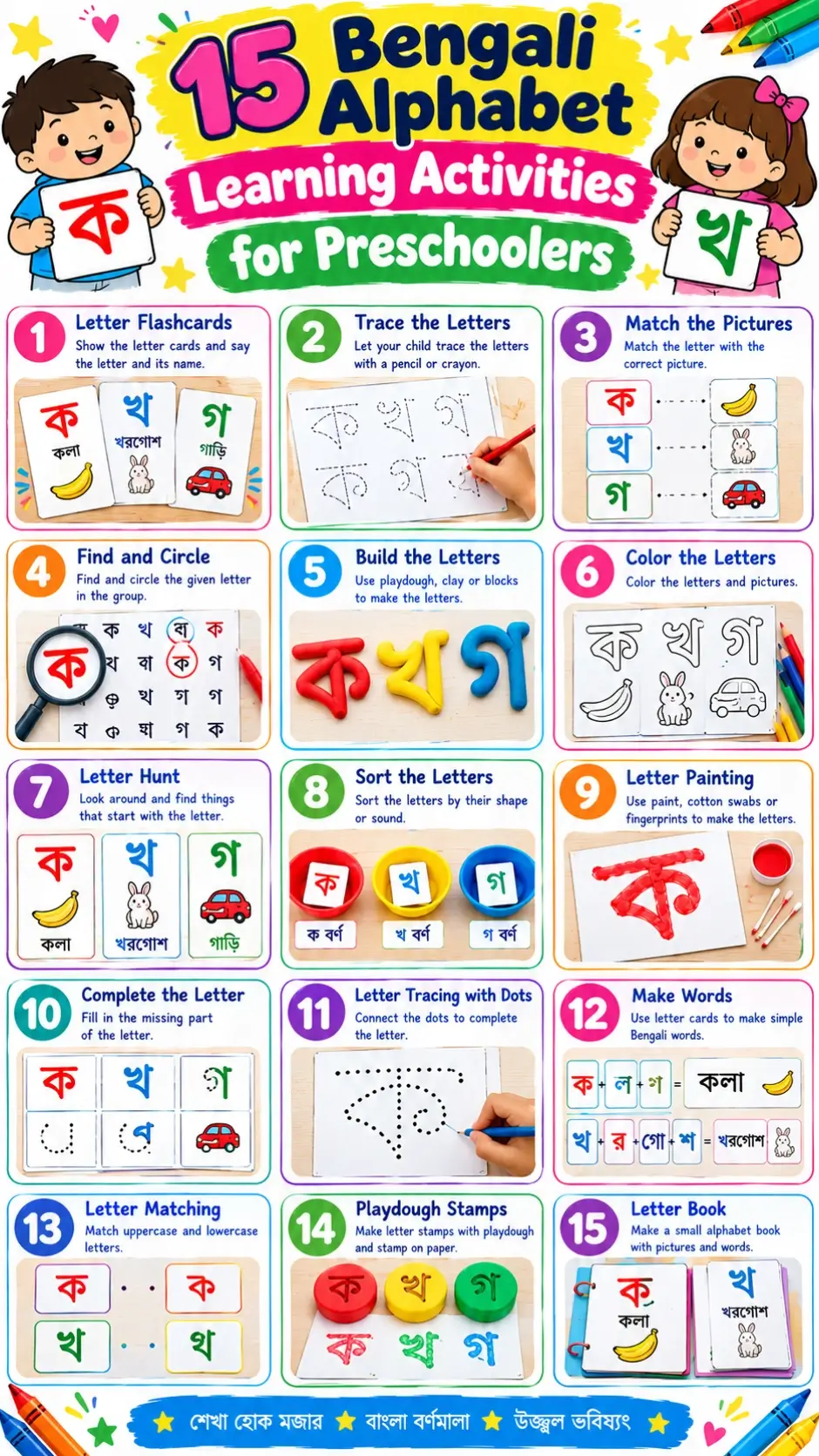
Teaching Bengali letters to a preschooler can be surprisingly fun when you bring the letters into play.
A child can hunt for অ, build ক with sticks, match ম with a mango picture, or search through a bowl of letter cards. These little activities give Bengali letters a place in the child’s everyday world.
I like keeping these sessions short. Around 5–15 minutes is plenty for a young child, especially when you’re doing several small activities throughout the week.
This guide shares practical Bengali alphabet learning activities for preschoolers, including Bangla bornomala games, tracing practice, matching activities, coloring, flashcards, and simple ways to teach Bangla at home.
Why should preschoolers learn the Bengali alphabet?
Learning Bengali letters gives children an early connection with the language they hear at home.
For preschoolers, the first goal is usually letter familiarity. A child gradually learns that অ is a particular letter, recognizes it when it appears in a book, and later connects it with words such as অজগর or অমল.
The same process happens with স্বরবর্ণ and ব্যঞ্জনবর্ণ. Children can first recognize the shapes and names of letters before you expect them to write them correctly.
Play has a natural place here. BRAC’s pre-primary curriculum specifically describes play as part of learning Bengali alphabet reading and writing, along with games, rhymes, books, and hands-on materials.
If you’re building a broader preschool routine, you can also see these Best educational activities for preschoolers for ideas that mix language, math, movement, and early learning.
15 Bengali alphabet learning activities for preschoolers
Here are 15 activities you can use with children from about 3–5 years old. They focus on recognition, sounds, letter shapes, matching, early writing, and simple word connections.
1. Bengali letter treasure hunt
Write 5–8 Bengali letters on separate pieces of paper.
Hide them around one room. Give your child one target letter, such as ক, and ask them to find every ক they can see.
Once they find one, have them say the letter aloud.
For a younger child, use only 3 different letters. Older preschoolers can search for 5–6.
2. Build a letter with sticks
Give your child craft sticks, drinking straws, or thin strips of paper.
Choose letters with shapes that can be built with the materials you have. Ask your child to copy the large letter you made.
This is a good hands-on Bengali alphabet activity for kids because the child studies the shape while using their hands.
You can make the letter first and then let your child make their own version.
3. Match Bengali letters to pictures
Prepare picture cards showing familiar objects.
For example:
- অ → অজগর
- আ → আম
- ই → ইঁদুর
- উ → উট
- ক → কলা
- ম → মাছ
Put 3–5 letter cards on the table. Give your child one picture and ask which letter belongs with it.
These simple Bengali letter matching activities help children connect a letter with a familiar word.
4. Letter parking lot
Draw several parking spaces on paper.
Write one Bengali letter inside each space. Then make small “cars” from paper scraps or use toy cars.
Call out a letter:
“ক-এর গাড়ি কোথায় যাবে?”
Your child drives the car to the correct space.
This works especially well with children who enjoy moving objects around while they learn.
5. Make a Bengali letter with playdough
Roll playdough into thin ropes.
Write a large Bengali letter on a sheet of paper, then ask your child to place the playdough along the letter.
Start with one letter.
You can also let your child choose the letter after you’ve introduced several. Ask, “আজ কোন অ বানাবে?”
6. Bengali letter fishing game
Cut small paper circles and write one Bengali letter on each.
Attach a paper clip to each circle. Use a toy fishing rod with a magnet at the end.
Call out a letter and let your child “fish” for it.
For toddlers, use 3 letters. For older preschoolers, mix 6–8 letters and search harder.
7. Sworoborno sorting tray
Make two simple sections on a tray or sheet of paper:
স্বরবর্ণ
অন্য অক্ষর
Give your child a small collection of letter cards.
Ask them to place the target স্বরবর্ণ cards in the correct area.
For a younger child, work with only a few familiar vowels. Later, introduce more.
These can become Bangla swarabarna worksheets later when your child is ready for paper-based practice.
8. Letter and picture memory game
Make pairs of cards.
One card has a Bengali letter. The matching card has a picture connected with that letter.
Place the cards face down.
Your child turns over 2 cards at a time and tries to find a match.
Keep the first version very small, perhaps 3 pairs. Once your child understands the game, add more cards.
This is one of my favorite Bengali alphabet games for toddlers because the child has to look closely and remember where cards were placed.
9. Trace the letter in a rice tray
Pour a thin layer of uncooked rice onto a flat tray.
Write a large Bengali letter on a card and place it beside the tray.
Your child uses one finger to copy the letter in the rice.
Then smooth the rice and try again.
This gives children Bengali alphabet writing practice for kids without immediately asking them to hold a pencil perfectly.
Supervise closely and use a material that’s appropriate for your child’s age.
10. Bengali letter coloring pages
Give your child one large Bengali letter at a time.
For example, print a large ম and add pictures around it, such as a mango or fish depending on the target word.
Let your child color the letter and pictures.
These Bangla alphabet coloring pages work well as a quiet activity after a more active game.
You can also create a small Bangla bornomala worksheet PDF with one large letter, one matching picture, and a simple tracing line.
11. Find and circle the Bengali letter
Write a mixture of letters in rows.
For example:
অ আ ক অ ম আ অ
Tell your child to find every অ and circle it.
For 3-year-olds, make the letters large and use only 2–3 different letters.
For 4–5-year-olds, make the page slightly busier.
This is a simple form of Bengali alphabet recognition worksheets and works well once your child already knows a few letters.
12. Missing letter train
Draw a train with 3–5 carriages.
Write a simple sequence of Bengali letters and leave one space empty.
For example:
অ → আ → ই → ___
Ask your child which letter is missing.
You can also use familiar sequences that you’ve already practiced.
These Bangla alphabet missing letters worksheets work best after children have some basic letter recognition. They can become frustrating if the child hasn’t learned the letters yet.
13. Bengali letter stamp activity
Write 4 large Bengali letters on a sheet of paper.
Give your child a washable stamp or a homemade sponge stamp.
Call out one letter and ask your child to stamp it.
You can make the game more interesting by saying:
“ম কোথায়? ম-তে একটা stamp দাও।”
The repeated searching helps with Bengali letter identification games for kids.
14. Make a Bengali alphabet mini book
Fold a few sheets of paper and staple them safely into a small book.
Put one letter on each page.
Your child can draw or paste one picture for each letter.
For example:
আ
আম
ক
কলা
ম
মাছ
You can write the word underneath and read it together.
This activity can grow with your child. At first, you may do most of the writing. Later, your child can trace or copy selected letters.
15. Letter sound basket
Choose one Bengali letter.
Put 3–5 objects or pictures into a basket. Some should connect with the target sound or letter, while others should not.
For example, with ম, you could use pictures of মাছ, মাটি, and মোম, along with unrelated pictures.
Ask your child to find the pictures that start with the target letter.
This connects Bengali letter recognition with early sound awareness.
You can also pair it with these Beginning sound activities for preschoolers.
Bangla swarabarna and banjonborno for kids
Preschoolers don’t have to memorize every category in one sitting.
Start by helping your child recognize a small number of স্বরবর্ণ and gradually introduce ব্যঞ্জনবর্ণ.
You can make 2 small card sets and use different games with each set.
For example, one day you might play a swarabarna fishing game. Another day, you might match a few banjonborno letters with familiar pictures.
As children become comfortable, mix the cards.
You can also create Bangla banjonborno worksheets with large letters, picture clues, tracing lines, and simple identification tasks.
The point is to give the child repeated contact with the letters in different forms.
Bangla alphabet tracing worksheets for preschoolers
Tracing has a place in preschool Bengali learning, especially when your child already recognizes the letter.
Start with large letters.
Show your child where to begin and guide the direction with your finger. Then let them try.
For a 3-year-old, one or two letters may be enough for one session.
A 4- or 5-year-old may enjoy tracing several letters, especially when each page includes a picture or small challenge.
If you already use tracing as part of your preschool routine, you may also like these Number tracing activities for preschoolers. The same short-session approach works well for Bengali writing practice.
Bengali alphabet worksheets for preschoolers
Worksheets can help children practice what they’ve already seen through play.
I wouldn’t start with a full page packed with 20 or 30 letters. Give your child a clear task with enough space to work.
A useful printable worksheet collection can include:
- Large-letter tracing
- Match letters to pictures
- Color the target letter
- Find and circle a letter
- Fill in a missing letter
- Simple swarabarna practice
- Simple banjonborno practice
- Early handwriting practice
You can make a Bangla bornomala worksheet PDF for home practice and print only the pages your child is ready for.
Bengali alphabet flashcards for Preschool kids
Flashcards are useful when you keep the game quick.
Show one card.
Ask, “এই অক্ষরটা কী?”
If your child answers, put the card in a “known” pile. If they don’t remember, say the answer and bring the card back later.
You can also make Bengali alphabet flashcards for kids with a picture on the back.
For example:
ম → মাছ
The picture gives your child a clue without turning the activity into a test.
Bengali alphabet activities for 3–5 year olds
Children in this age range can be at very different stages.
For 3-year-olds
Keep activities short and physical.
Good choices include:
- Bengali letter treasure hunt
- Letter fishing
- Playdough letters
- Large letter coloring
- Picture-to-letter matching
- Simple flashcard games
Use 2–4 target letters at a time.
If you’re looking for more ideas for this age, see Preschool learning activities for 3-year-olds.
For 4-year-olds
You can add more recognition work.
Try:
- Find and circle
- Letter memory
- Sworoborno sorting
- Letter stamps
- Rice-tray tracing
- Missing-letter games
A 4-year-old may also enjoy choosing the next letter to practice.
Here are more Preschool learning activities for 4-year-olds if you’re building a wider weekly routine.
For 5-year-olds
You can gradually ask for more independent work.
Try:
- Writing familiar letters
- Missing-letter activities
- Letter-picture matching
- Mini books
- Mixed-letter recognition
- Simple sound games
- Short Bengali writing practice
You can also introduce simple words after your child has a reasonable number of familiar letters.
For more age-specific ideas, see Preschool learning activities for 5-year-olds.
Bangla bornomala activities for nursery students
Nursery children usually need plenty of repetition.
A simple routine could look like this:
Monday: Introduce 1 new letter
Tuesday: Find the letter
Wednesday: Match it with a picture
Thursday: Make it with playdough
Friday: Trace or color it
That’s enough.
You can repeat the same letter for a week before adding another. Some children will move faster, while others need more time.
And that’s fine. The goal is familiarity, not racing through the entire bornomala.
If you want to mix language learning with other areas, you can also use your Alphabet activities for preschoolers, Fun rhyming activities for preschoolers, and Who Am I preschool activities as separate language activities.
Keep Bengali alphabet practice short
A preschool child doesn’t need long study sessions for letter practice.
Try 5–10 minutes of focused Bengali alphabet play, then move on to another activity.
Your weekly routine can include Bengali, English, numbers, drawing, movement, stories, and free play.
If you’re trying to plan the whole day, this guide on How many hours should a preschooler study? can help you keep structured learning realistic.
A simple Bengali alphabet learning routine
Here’s a routine you can repeat:
Day 1: Introduce 1–2 letters with picture cards.
Day 2: Find those letters around the room.
Day 3: Play a matching or fishing game.
Day 4: Build the letters with playdough.
Day 5: Trace, color, or complete a simple worksheet.
Then repeat with the next small group.
You can also add a Bengali story or rhyme before the activity. Children get more chances to hear the language when letters, words, songs, and stories are part of the same routine.
If your child enjoys hands-on activities that prepare the fingers for writing, you can also see these Fine motor activities for preschoolers and Cutting activities for preschoolers.
Connect Bengali letters with everyday learning
Bengali alphabet practice can sit naturally beside your other preschool activities.
When you’re cooking, you can talk about a food word that begins with a familiar letter. When you’re reading a story, ask your child to find one letter on the page.
You can also combine language with your existing Preschool cooking activities.
A story about animals can lead to letter-picture matching. A nature walk can turn into a search for familiar printed letters when you return home.
You already have plenty of opportunities around you.
For example, after an animal activity such as Where do animals live preschool activities, you could choose one animal name and look at its first Bengali letter.
The same idea works with food, stories, and other topics:
- Where does food grow preschool activities
- Where the Wild Things Are preschool activities
- Arctic animals activities for preschoolers
These connections give children more reasons to use words and letters.
A few more preschool learning ideas
Bengali alphabet learning is one part of a preschool routine.
You can also rotate in number recognition, counting, shapes, patterns, and early math without making every day feel like a worksheet day.
For example:
- Number recognition activities for preschoolers
- Counting activities for preschoolers
- Math activities for preschoolers
- Simple addition activities for preschoolers
- Subtraction activities for preschoolers
- Shape recognition activities for preschoolers
- Pattern activities for preschoolers
You don’t need to do all of them in one day. Pick 1 language activity, 1 number or math activity, and plenty of free play.
Frequently asked questions
What is the easiest way to teach Bengali letters to a preschooler?
Start with a few familiar letters and use them in short games. Letter hunts, picture matching, playdough building, flashcards, coloring, and simple tracing are good starting points.
Should I teach swarabarna before banjonborno?
You can start with a small set of familiar স্বরবর্ণ and gradually introduce ব্যঞ্জনবর্ণ. The exact order can depend on your child’s preschool curriculum and readiness.
How many Bengali letters should a 3-year-old learn?
There’s no need to set one fixed number for every 3-year-old. Some children will recognize several letters, while others will still be getting comfortable with a few.
Focus on recognition and enjoyment first.
Are Bengali alphabet worksheets useful for preschoolers?
Yes, when they’re used at the right stage. Large tracing pages, letter matching, coloring, and circle-the-letter activities can give children extra practice after they’ve met the letters through play.
How can I teach Bangla bornomala at home?
Use everyday words, picture cards, letter games, storybooks, songs, tracing, and short worksheet sessions. Keep the practice regular and brief.
What are good Bengali alphabet games for toddlers?
Try letter fishing, a simple treasure hunt, matching a letter to a picture, finding a target letter, and building letters with playdough.
When should my child start Bengali alphabet writing practice?
You can introduce large, playful letter tracing before formal handwriting. Finger tracing, rice-tray writing, playdough letters, and large crayons can come first.
Final thoughts
Bengali alphabet learning can become part of ordinary family life.
Let your child find অ in a book, build ক with playdough, match ম with a picture, or color a big আ. Then come back to the same letters another day.
Some days you’ll get 10 focused minutes. Some days you’ll get 2 minutes and a child who suddenly wants to run around the room.
That’s preschool.
Keep the letters familiar, keep the activities varied, and give your child plenty of chances to hear, see, touch, say, and eventually write Bengali letters.